
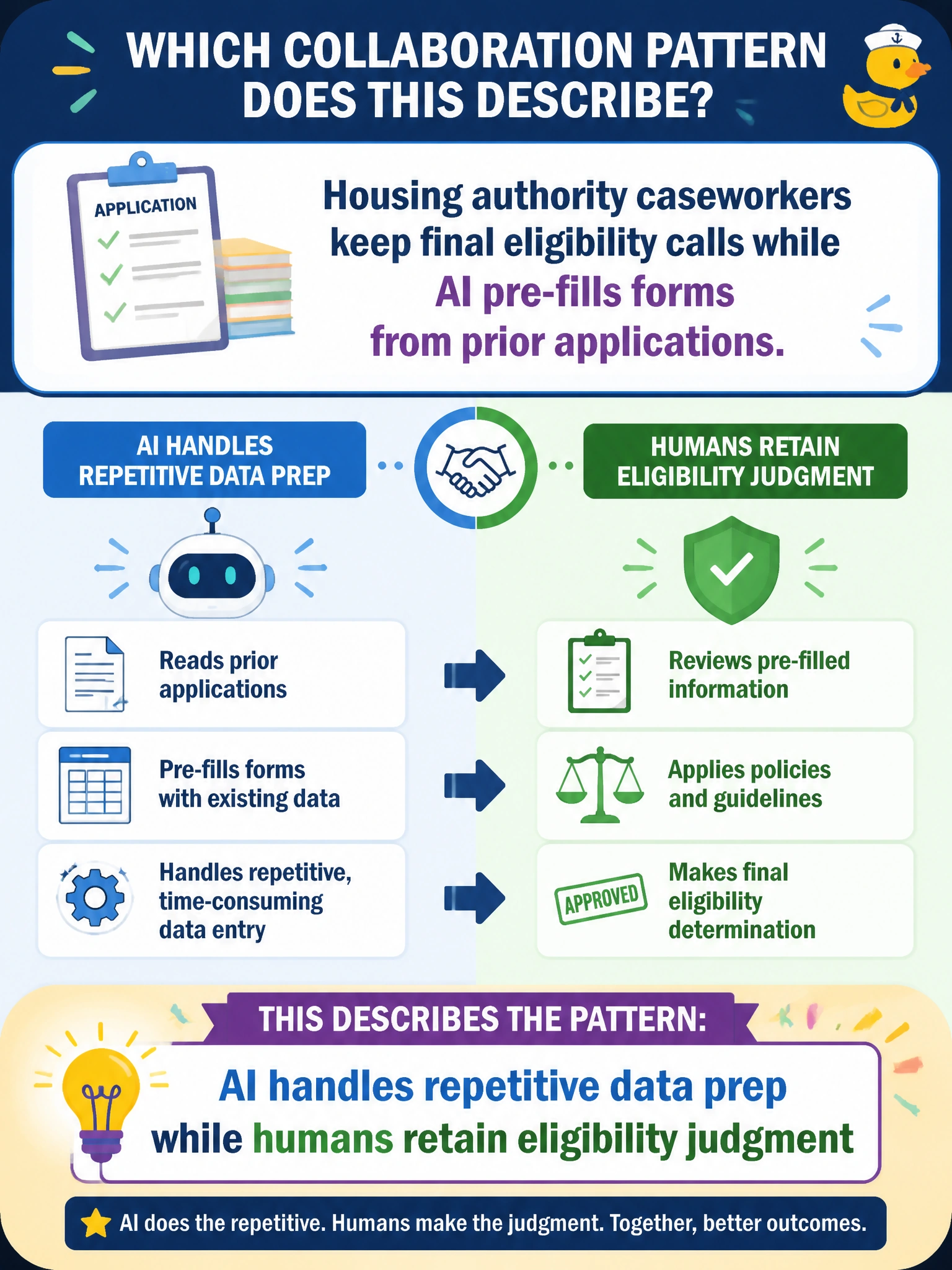
Housing authority caseworkers keep final eligibility calls while AI pre-fills forms from prior applications. Which collaboration pattern does this describe?
Select an answer to reveal the explanation.
Short Explanation
Let the AI copy last year’s address into the blanks—that is grunt work. Who qualifies still sits with the caseworker and the rulebook. Prep versus judgment is the whole collaboration pattern.
Full Explanation
Housing authority practice that keeps final eligibility calls with caseworkers while AI pre-fills forms from prior applications illustrates AI handling repetitive data prep while humans retain eligibility judgment. Pre-fill reduces re-keying of addresses, household members, and prior program participation—high-volume clerical work where models or extraction tools can help. Eligibility determination, however, involves interpreting documentation, applying board-approved rules to edge cases, detecting fraud or hardship nuance, and bearing accountability for benefits decisions that affect housing stability. Separating prep from judgment is the collaboration pattern civic AI governance prefers for consequential determinations.
AI retains eligibility judgment while humans handle repetitive data prep fails because it reverses the assignment, giving final eligibility calls to the model and clerical work to caseworkers, rather than operational casework where AI only pre-fills forms and caseworkers keep final eligibility calls. AI handles repetitive data prep while humans monitor system performance misstates the human role because caseworkers retain final eligibility judgment on each application, not just general monitoring of system performance without making the determination. AI handles repetitive data prep while humans retain threshold calibration narrows the human role to calibrating thresholds, rather than retaining full eligibility judgment with substantive review of documentation, edge cases, and accountability for each household.
Exam caveat: ‘AI pre-fills / humans decide’ is not the same as ‘AI recommends approval scores that staff rubber-stamp.’ Final judgment means substantive review, especially on denials and complex households.
Operational check: limit AI to draft field population with visible source citations, require caseworker attestation before submission, prohibit the model from altering rule tables, audit pre-fill error rates on protected characteristics and language-access cases, and ensure applicants can correct AI-populated data before eligibility is decided.
Prefer to study offline? Printable PDF study book + test engine ($7.50, unofficial). These questions stay free here.