
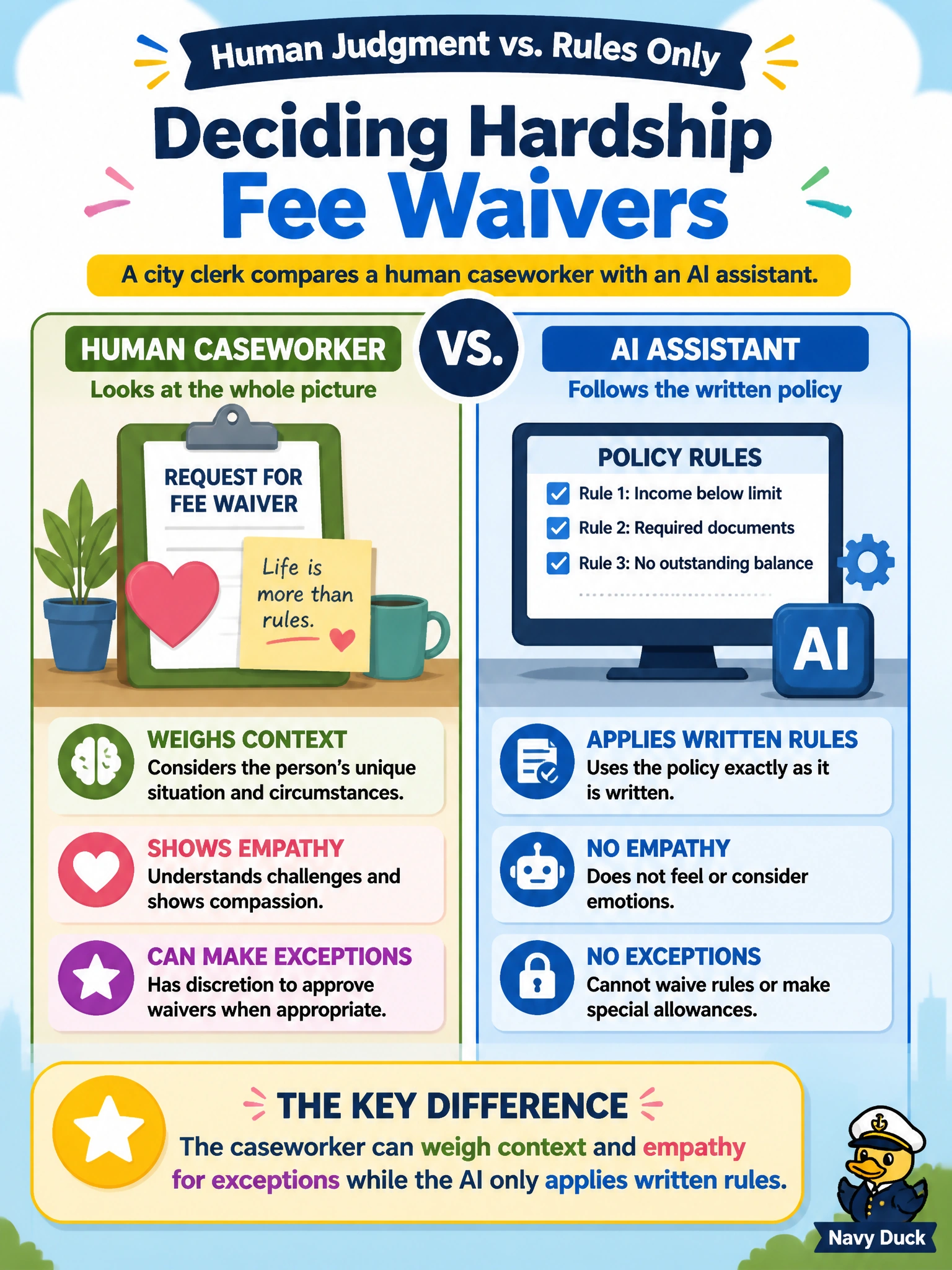
A city clerk compares a human caseworker deciding hardship fee waivers with an AI assistant that only applies written policy rules. What difference should the clerk highlight?
Select an answer to reveal the explanation.
Short Explanation
Picture a fee-waiver desk like a referee with a rulebook and a heart. The AI sticks to the printed rules; the caseworker can still see a family’s messy real life and apply judgment the book never spelled out. That empathy-and-context gap is the big human-versus-AI difference.
Full Explanation
In municipal hardship fee-waiver work, the decisive difference between a human caseworker and a policy-bound AI assistant is situational judgment. The correct answer is that the caseworker can weigh context and empathy for exceptions while the AI only applies written rules. Written ordinances and fee schedules define eligibility bands, documentation, and appeal paths; an AI assistant can reliably check whether submitted fields match those rules and flag missing paperwork. What it cannot do well is interpret edge cases that ordinances leave to discretion—sudden medical debt, domestic violence shelter stays, or temporary homelessness that do not map cleanly onto a checkbox. Experienced clerks synthesize incomplete narratives, community knowledge, and proportional fairness before recommending a waiver. That human capacity is precisely why cities keep humans in the loop on hardship determinations rather than treating rule engines as final adjudicators.
The claim that the caseworker can establish verifiable audit pathways for exceptions while the AI only applies written rules misattributes auditability; a policy-bound AI can reliably log which ordinance section and fields it checked to create a verifiable pathway, while the caseworker's distinctive contribution is weighing context and empathy — audit pathways support review but do not capture that discretionary judgment. Saying the caseworker can evaluate unstructured text documents for exceptions while the AI only applies written rules misstates the capability gap; modern AI assistants can parse unstructured letters, medical notes, and shelter statements for relevant facts, while the caseworker's distinctive work is weighing that context with empathy for a proportional exception — reading documents alone does not equal discretionary judgment. Claiming the caseworker can maintain strict decision consistency for exceptions while the AI only applies written rules reverses the comparison; the rule-bound AI is the consistent applier across cases, while the caseworker weighs context and empathy case by case with transparent, reviewable discretion — human exceptions introduce principled variation, not strict uniformity.
Exam caveat: do not confuse ‘AI follows written rules’ with ‘AI is always fair.’ Rules can encode bias, and humans can apply rules inconsistently; the tested concept here is comparative capability on contextual exceptions, not a blanket endorsement of either side.
Operational check: for each waiver pathway, document which fields are strictly rule-checkable versus which require human discretion, require the AI to cite the ordinance section it applied, and keep an audit trail showing a named caseworker approved any exception before fee relief posts to the ledger.
Prefer to study offline? Printable PDF study book + test engine ($7.50, unofficial). These questions stay free here.