
For a building-permit workflow, which logging strategy best records behavior without drowning operators in noise?
Select an answer to reveal the explanation.
Short Explanation
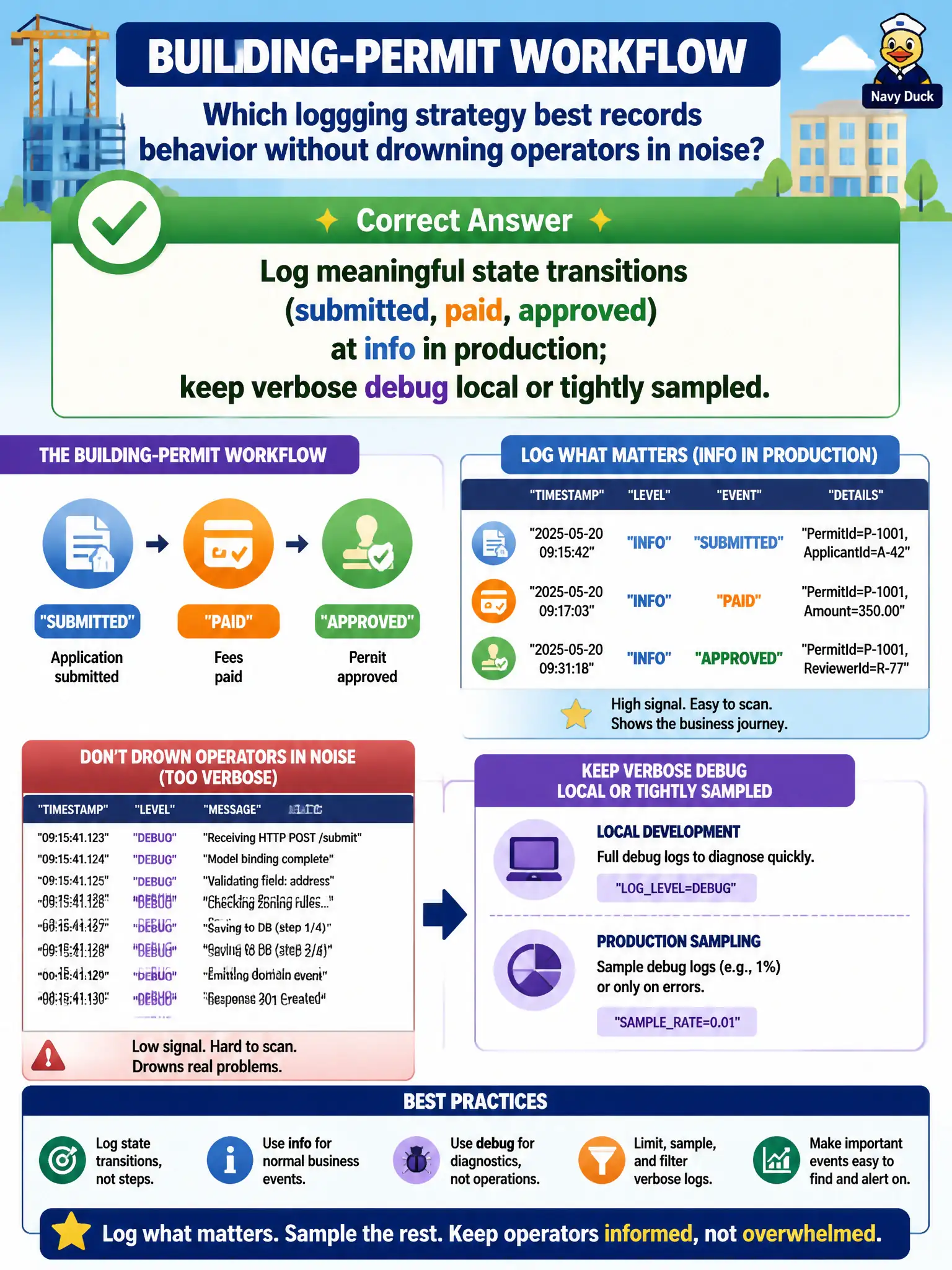
Log the plot twists—submitted, paid, approved—at info. Leave the play-by-play debug chatter for local or tight sampling so production stays readable.
Full Explanation
For a building-permit workflow, the best logging strategy records meaningful state transitions—submitted, paid, approved—at info in production while keeping verbose debug local or tightly sampled. That balance gives operators an auditable story of each permit without drowning CloudWatch in loop noise or leaking excessive detail. Production info logs should answer where a case is in the civic pipeline.
Logging every loop iteration and library trace at fatal in production always creates cost, noise, and false severity.
Disabling all application logs so CloudWatch stays empty removes essential operational evidence.
Printing full request bodies including secrets at info on cold starts exposes credentials and PII.
Exam caveat: Log levels and content discipline are part of instrumentation best practices on the exam.
Operational check: Define a small set of permit state events, log them as structured JSON at info, sample debug in non-prod, redact secrets, and verify Insights can reconstruct a sample permit's lifecycle. Keep the civic/municipal context in mind: building departments and auditors expect clear state history without secret-laden debug spam. Document the finding in the municipal incident ticket so the next on-call engineer inherits evidence rather than folklore.