
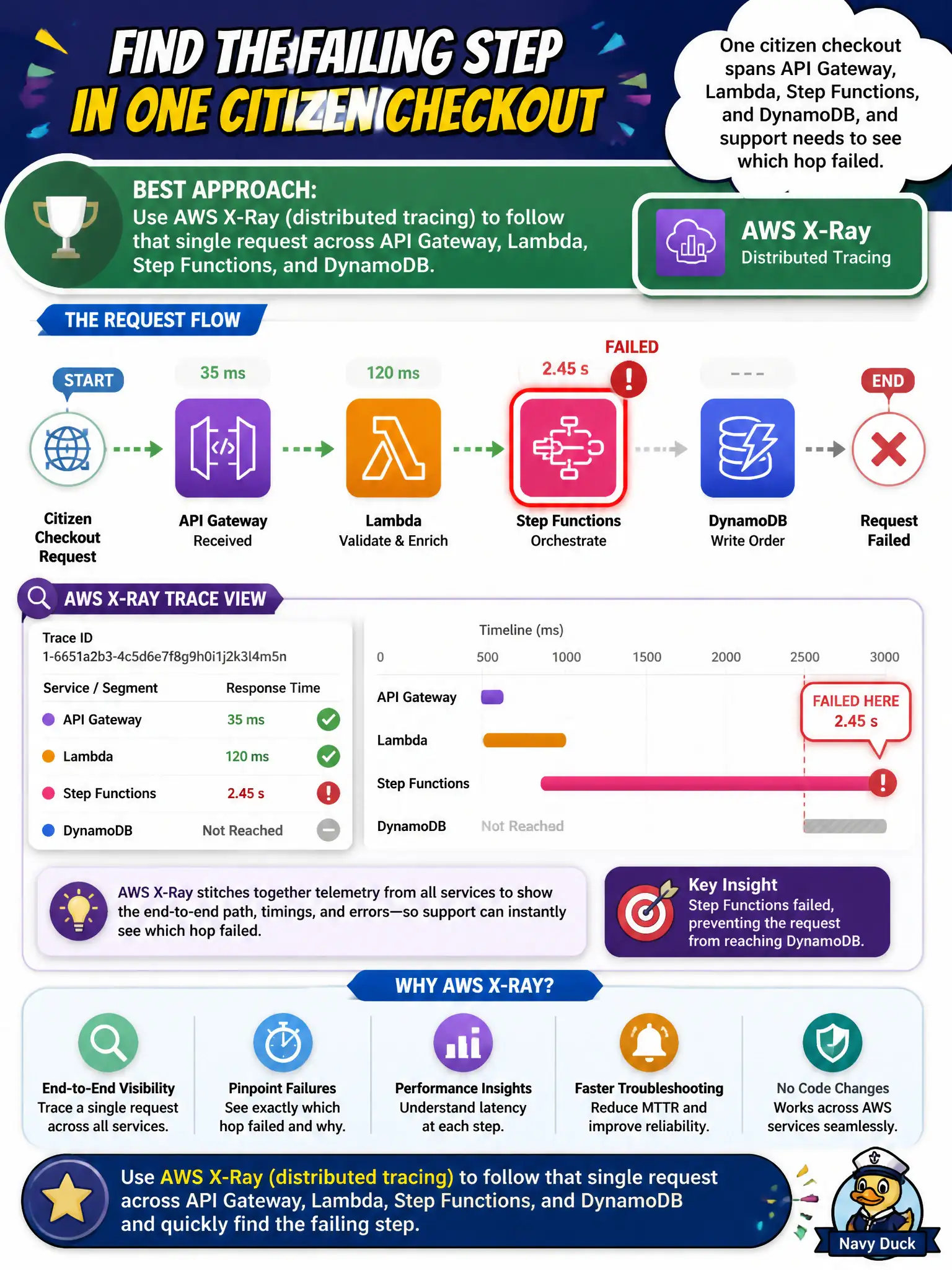
One citizen checkout spans API Gateway, Lambda, Step Functions, and DynamoDB, and support needs to see which hop failed. Which approach best finds the failing step?
Select an answer to reveal the explanation.
Short Explanation
One citizen click hops four services—following it by gut feel is a scavenger hunt. X-Ray distributed tracing stitches that path so you see which hop actually failed.
Full Explanation
When one citizen checkout spans API Gateway, Lambda, Step Functions, and DynamoDB, support needs distributed tracing to see which hop failed. AWS X-Ray follows that single request across those services on a trace and service map so on-call engineers stop guessing which layer dropped the checkout. Enabling X-Ray on the participating services and propagating trace context is the approach that finds the failing step quickly during municipal payment or checkout incidents.
Comparing only monthly Cost Explorer line items shows spend by service name, not per-request failure hops along one citizen journey. Opening each service console alphabetically is slow and uncorrelated. Relying solely on S3 server-access logs fails when the checkout path never touches S3 and therefore cannot explain Lambda or Step Functions failures.
Exam caveat: X-Ray is the Associate-level answer for cross-service request timelines; CloudWatch metrics remain useful for aggregates but do not replace a single-request distributed trace when ownership of a hop must be proven.
Operational check: enable X-Ray on API Gateway, Lambda, and Step Functions for the checkout path, reproduce a failing purchase, open the trace, identify the first error or fault subsegment, and assign the fix to the owning municipal team for that hop.