
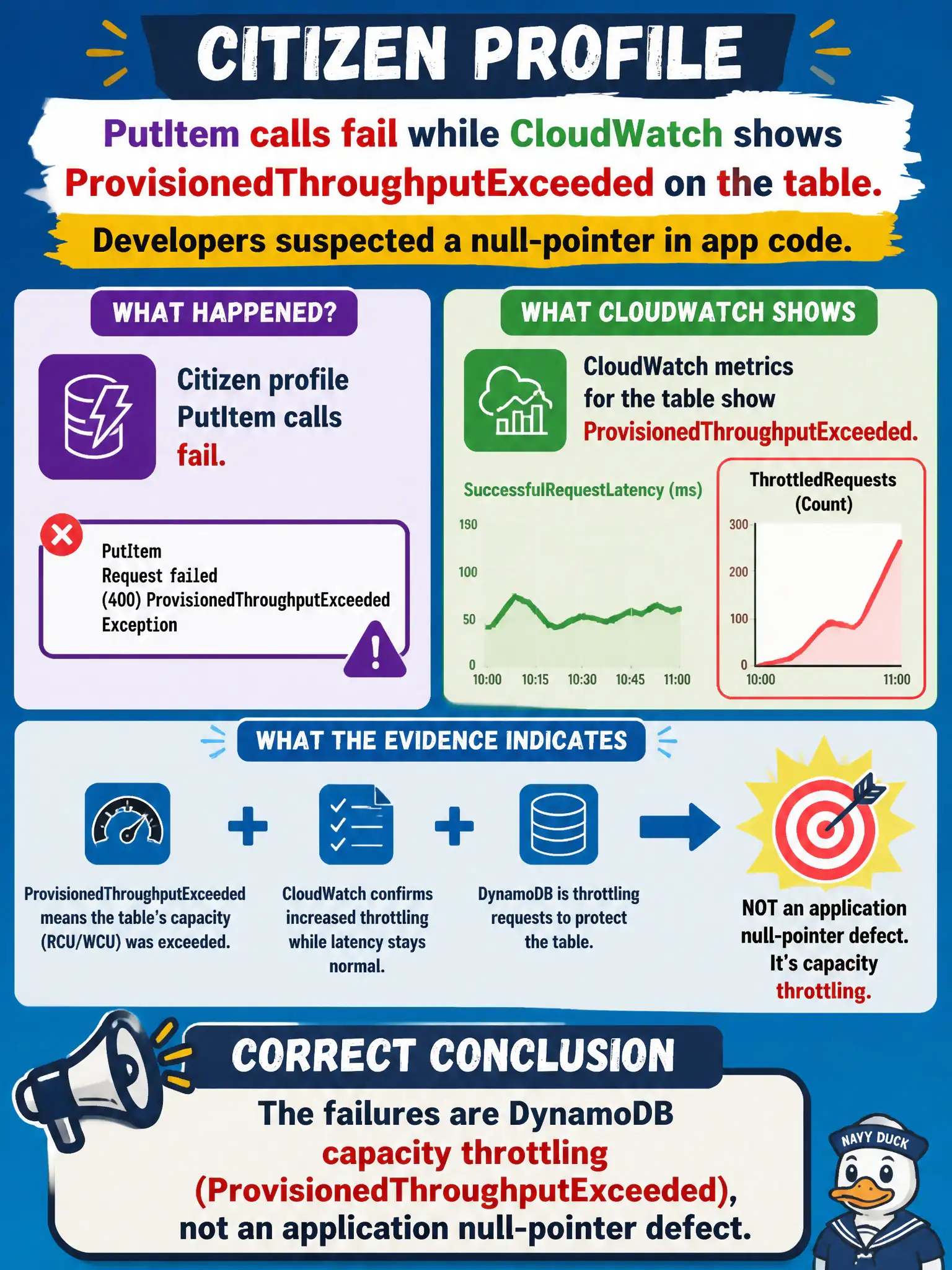
Citizen profile PutItem calls fail while CloudWatch shows ProvisionedThroughputExceeded on the table. Developers suspected a null-pointer in app code. What does the evidence indicate?
Select an answer to reveal the explanation.
Short Explanation
ProvisionedThroughputExceeded is DynamoDB waving a capacity flag, not your app tripping over a null. Separate throttle error codes and metrics from code bugs before you rewrite the handler.
Full Explanation
When citizen profile PutItem calls fail and CloudWatch shows ProvisionedThroughputExceeded on the table while developers suspected a null-pointer, the evidence indicates DynamoDB capacity throttling—not an application null-pointer defect. Trust the named exception and table metrics: civic profile writes are being rejected because consumed capacity exceeded provisioned limits (or related capacity constraints), which requires capacity tuning, key design fixes, or backoff—not a scavenger hunt for unrelated NPEs.
The SDK does not invent ProvisionedThroughputExceeded merely because a JSON field is null; null handling would surface different application errors. API Gateway stage variables do not rename DynamoDB errors into compile failures. S3 Transfer Acceleration is unrelated and is not the service that emits ProvisionedThroughputExceeded for DynamoDB PutItem.
Exam caveat: map CloudWatch DynamoDB throttle metrics and exception names to capacity or hot-key issues before rewriting unrelated application null checks.
Operational check: inspect ConsumedWriteCapacityUnits versus provisioned limits, identify hot partition keys in profile writes, implement exponential backoff with jitter, consider on-demand mode or partition redesign, and retest PutItem success rates for citizen profile updates.