
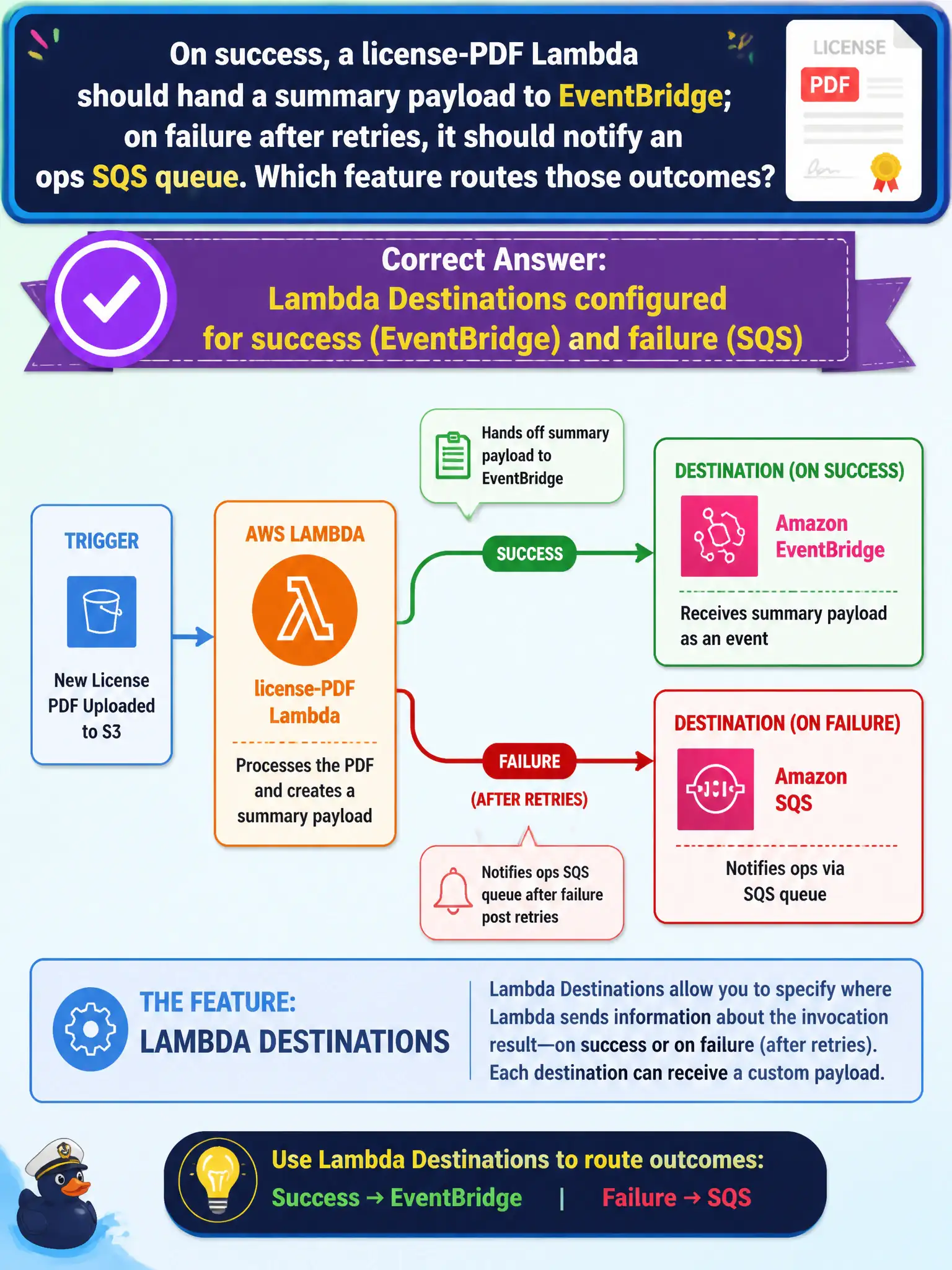
On success, a license-PDF Lambda should hand a summary payload to EventBridge; on failure after retries, it should notify an ops SQS queue. Which feature routes those outcomes?
Select an answer to reveal the explanation.
Short Explanation
Success goes to the town herald (EventBridge); failures after retries go to the ops mailbox (SQS). Lambda Destinations are that labeled outbox. Duration alarms alone, API Gateway sync responses, and weekly S3 inventory mail don't give async success/failure routing.
Full Explanation
On success, a license-PDF Lambda should hand a summary payload to EventBridge; on failure after retries, it should notify an ops SQS queue—Lambda Destinations route those outcomes. Destinations attach success and failure targets for asynchronous invocations, carrying payloads without bolting custom “final notify” code onto every exit path. Ops gets failure messages on SQS for replay; downstream automation reacts to success events on EventBridge for records indexing or citizen notifications.
CloudWatch Alarms on duration alone do not route success payloads to EventBridge. Synchronous API Gateway integration responses are the wrong channel for async failure routing after internal retries. S3 inventory reports emailed weekly cannot stand in for real-time success/failure routing of individual license generations.
Exam caveat: Destinations apply to asynchronous invokes (with nuances for certain event sources)—know your invoke mode. DLQs and failure destinations can overlap; design so operators do not double-process. Success destinations should carry summaries, not necessarily entire PDF bytes, when PII minimization matters.
Operational check: configure OnSuccess→EventBridge and OnFailure→SQS; async-invoke with forced success and failure tests; verify payloads and IAM; alarm on failure-queue depth; and document which teams own each target.