
A county GIS portal team wants merges to main to start automated tests, deploy to an Elastic Beanstalk test environment, then wait for a human gate before production. Which approach implements that commit-triggered path?
Select an answer to reveal the explanation.
Short Explanation
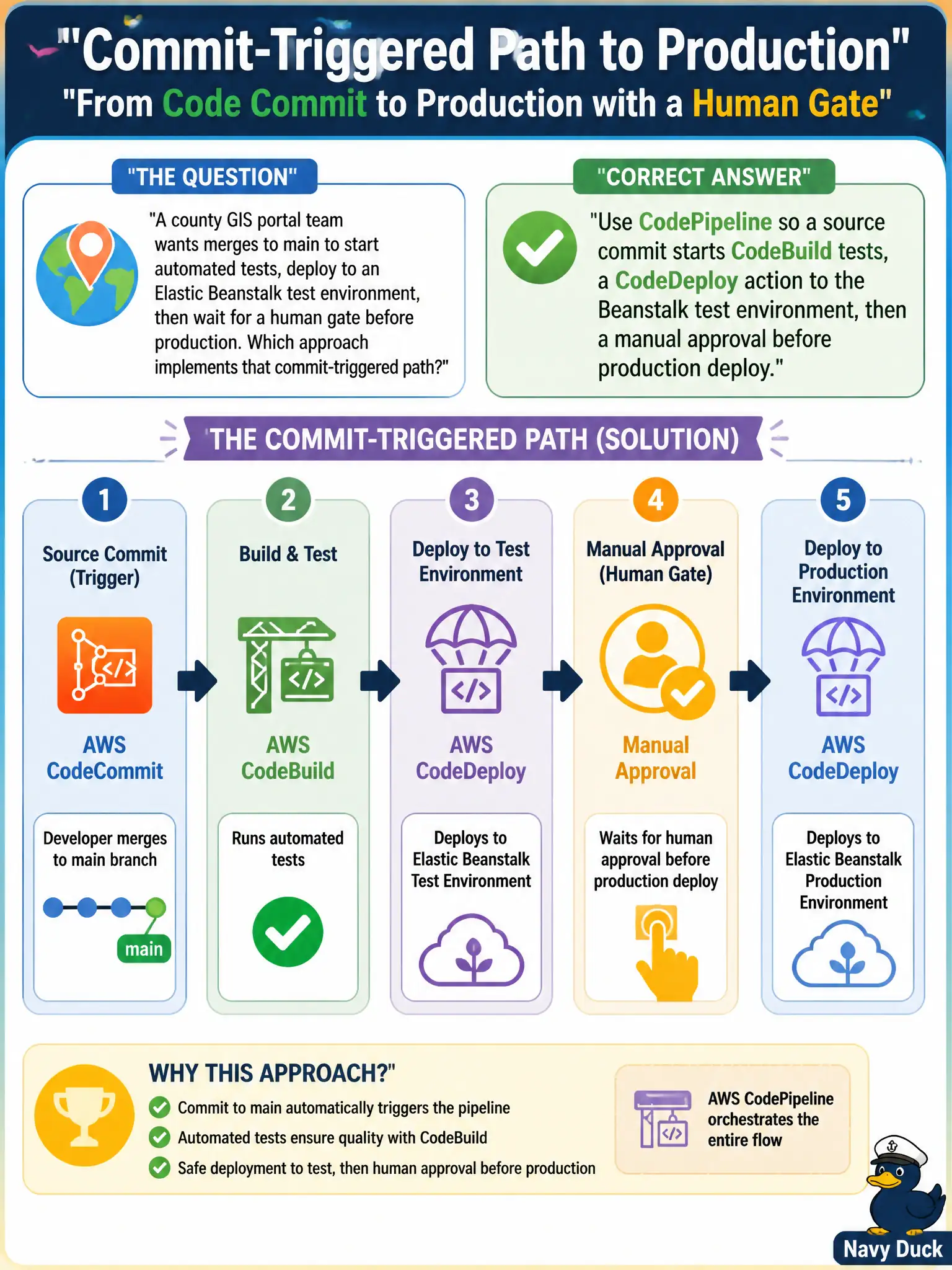
Picture a conveyor: merge drops the box on the belt, CodeBuild shakes it, CodeDeploy parks it in test Beanstalk, and a human stamps "go" before prod. That is CodePipeline doing the orchestration—not weekend SSH theater.
Full Explanation
County GIS portals need a commit-triggered path: merge to main starts automated tests, a non-production Elastic Beanstalk deploy receives the build, and a human gate stands between that success and production. AWS CodePipeline is the orchestrator designed for that sequence. A source stage watches the repository; a CodeBuild action runs unit and integration tests; a deploy action (CodeDeploy or Beanstalk) targets the test environment; a manual approval action pauses promotion; only then does a production deploy stage run. That wiring ties every citizen-visible GIS release to an auditable merge event rather than tribal knowledge.
SSH into each Beanstalk instance after every merge to run unit tests by hand fails because it is not commit-triggered automation, does not scale, and bypasses consistent test environments. A weekly Lambda that rebuilds from a random branch fails because it is schedule-driven and branch-nondeterministic, not merge-driven. Publishing directly from a developer workstation to production Beanstalk skips the test environment and the human gate the county required.
Exam caveat: CodePipeline coordinates stages; CodeBuild provides build/test compute; CodeDeploy (or Beanstalk deployment actions) delivers revisions. Candidates should not collapse those roles or invent SSH-based CI.
Operational check: merge a trivial change to main, watch the pipeline start without manual kickoff, confirm CodeBuild green, confirm the test Beanstalk environment updated, confirm the approval action blocks production until an authorized reviewer acts, and only then allow the GIS production stage to proceed.