
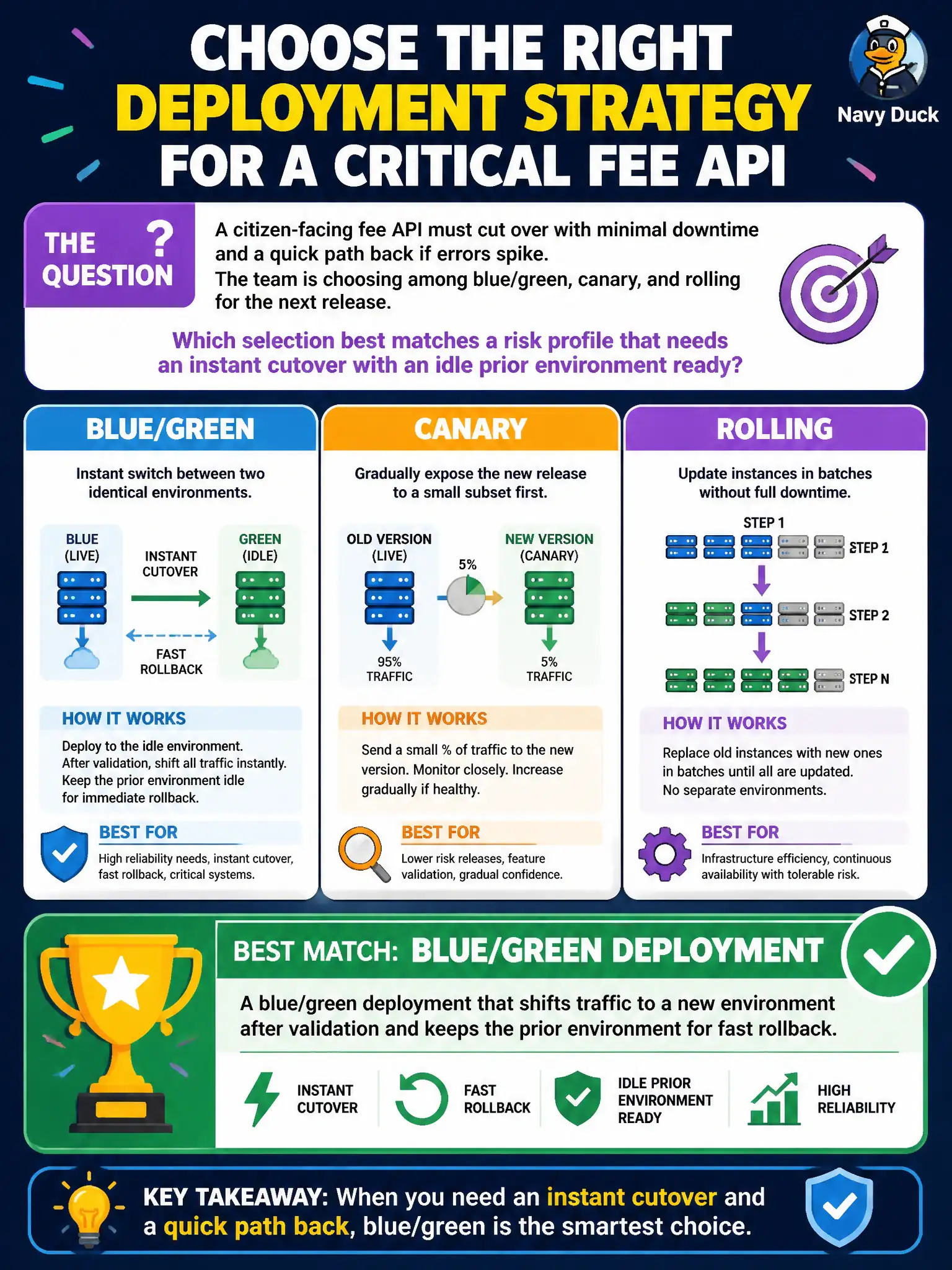
A citizen-facing fee API must cut over with minimal downtime and a quick path back if errors spike. The team is choosing among blue/green, canary, and rolling for the next release. Which selection best matches a risk profile that needs an instant cutover with an idle prior environment ready?
Select an answer to reveal the explanation.
Short Explanation
Blue/green gives you a spare runway: stand up the new strip, land traffic there, and keep the old strip warm if you need to bounce back. Rolling chews through instances in place; canary sips traffic first. For "flip hard, undo fast," blue/green is the civic API's friend.
Full Explanation
Citizen-facing fee APIs often need a cutover that is both fast and reversible: validate a fully provisioned new environment, shift traffic, and keep the prior environment warm if error rates spike after the flip. Blue/green deployment matches that risk profile. Green is built and health-checked independently; traffic moves from blue to green after validation; blue remains available as an idle prior environment for an environment-level rollback without rebuilding capacity under incident pressure. For a municipal fee surface where downtime and double-charge risk are politically costly, that spare-runway pattern is the deliberate choice.
The gradual instance replacement that moves traffic incrementally and rebuilds the prior fleet only after errors spike fails the stated requirement because it doesn't keep a full prior environment idle and ready for an instant flip back. The rolling update that replaces instances in place also fails because there is no second full environment to flip back to; rollback means redeploying or reversing batches on the same fleet. The canary that permanently leaves half of traffic on the old version with no full cutover plan confuses gradual exposure with the "instant cutover plus idle prior environment" profile; canary is valuable for blast-radius control, but it is not the same as blue/green's environment-level switch. The rolling Beanstalk batch update that deletes the previous version as each batch starts actively removes the prior revision you would need for a fast environment flip.
Exam caveat: blue/green, canary, and rolling are all valid strategies; the exam tests matching strategy to risk and rollback needs, not declaring one strategy universally best.
Operational check: after promoting green for the fee API, verify health checks and synthetic transactions, confirm traffic shifted cleanly (alias, listener, or environment URL swap), and prove that reverting to blue is a single traffic action with blue still healthy—before declaring the civic cutover complete.