
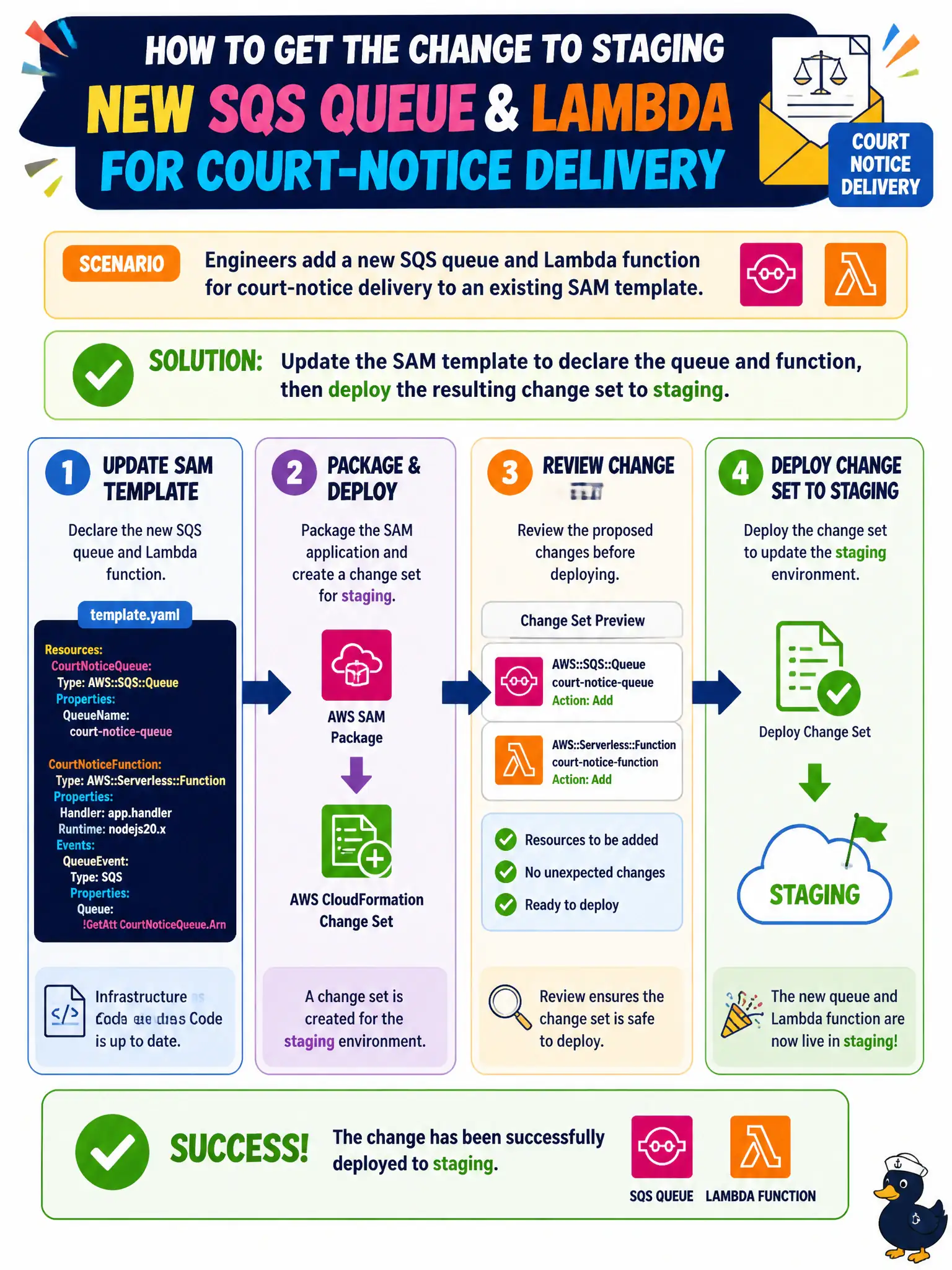
Engineers add a new SQS queue and Lambda function for court-notice delivery to an existing SAM template. How should the change reach staging?
Select an answer to reveal the explanation.
Short Explanation
Write the new room on the blueprint, then build from the blueprint—do not nail lumber by memory. Update SAM, deploy the change set to staging. Console-only creates drift the map from the building.
Full Explanation
Engineers adding a new SQS queue and Lambda function for court-notice delivery should update the existing SAM template to declare those resources, then deploy the resulting change set to staging. Infrastructure-as-code keeps municipal notice delivery resources reviewable, repeatable, and aligned with the application release unit. Console-only creates leave the template lying about what staging actually runs and break future stack updates.
Creating the queue and function only in the AWS console in staging so the template stays unchanged fails because the next template deploy can drift or delete unmanaged resources unexpectedly. Adding the resources in production first and reverse-engineering a template later fails conceptually by using production as a scratchpad. Keeping the template as documentation only and using ad-hoc AWS CLI creates in every environment fails as unaudited snowflake provisioning.
Exam caveat: new queue and function resources need IAM permissions, event source mappings, and encryption settings declared in the same change—not bolted on silently after. Operational check: run a change set against staging, review added resources in the set, execute the deploy, and confirm the template in Git matches the live stack resources for court-notice delivery.