
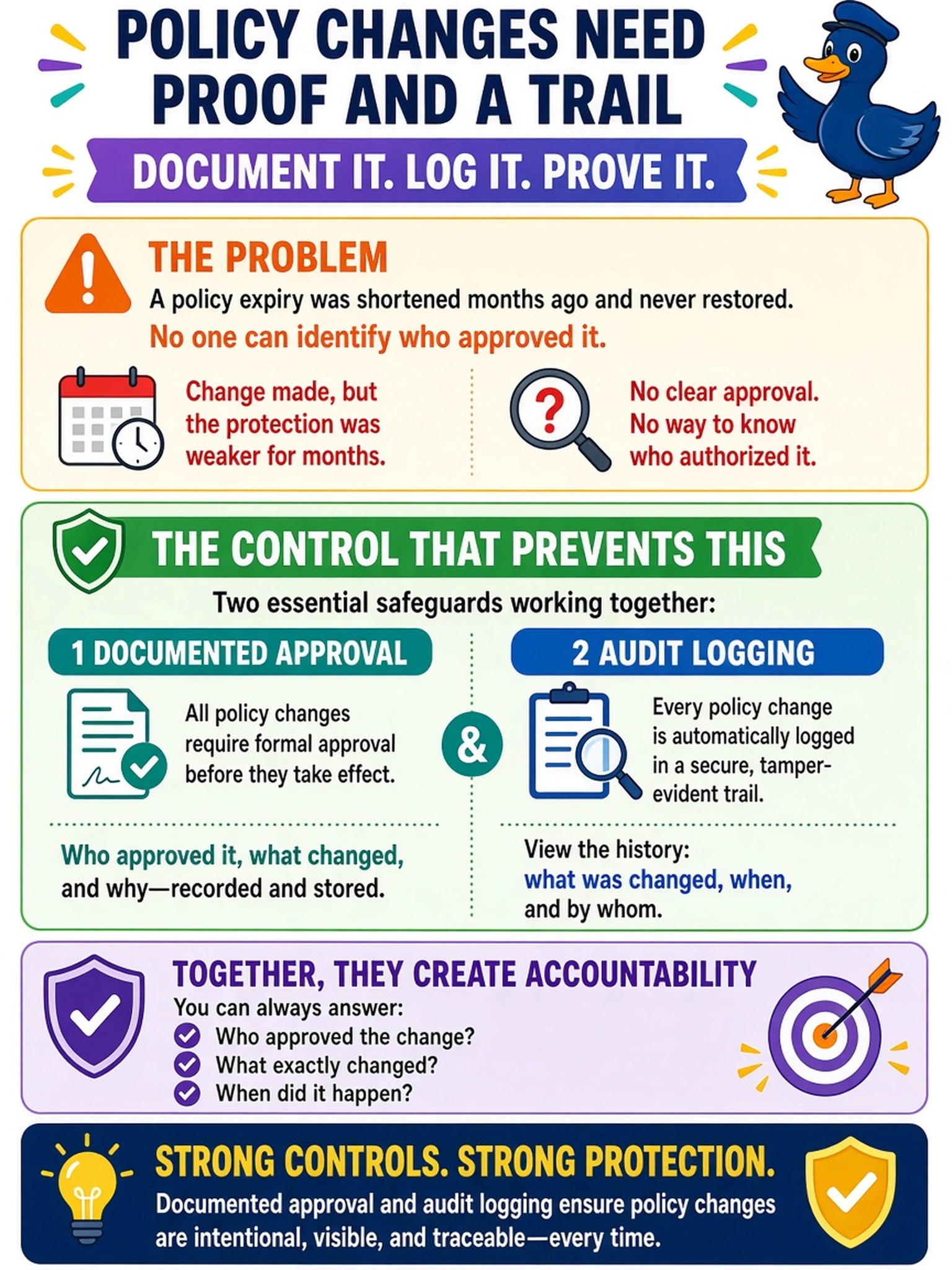
During a post-deployment review of a Data Domain system, you find that a policy expiry was shortened months ago and never restored. No one can identify who approved it. Which control should have prevented this?
Select an answer to reveal the explanation.
Short Explanation
Think of policy edits like unlocking a door: you want a signed work order and a log, not a hallway rumor. If someone can shorten an expiry without approval, the audit trail is just decoration. You enforce approval and logging so every change has an owner and a paper trail.
Full Explanation
Policy changes on a Data Domain deployment should be governed as security-relevant configuration changes because they can weaken data protection controls. The correct control is a documented approval plus an audit trail: the request is authorized before implementation, and the resulting change is attributable to an accountable person or process. This matches the rigor expected for security settings, where unapproved edits to authentication, access, retention, or encryption-related policy can create silent compliance and recovery gaps. Automatic reversion is a useful operational hygiene measure, but it does not prevent an unauthorized change from occurring or provide evidence of who made it. Approval limited to changes that shorten retention beyond a fixed threshold creates a blind spot for smaller or temporary adjustments that still violate governance. Email notification after the fact informs stakeholders, but it is not authorization and does not create a reliable, queryable record of approval. Exam caveat: focus on change control principles for configuration policy rather than memorizing a specific menu path or CLI command. Operational check: before handover, review the change record for each policy setting and confirm that the approval ticket, approver, implementation timestamp, and rollback plan are retained in the audit archive.