
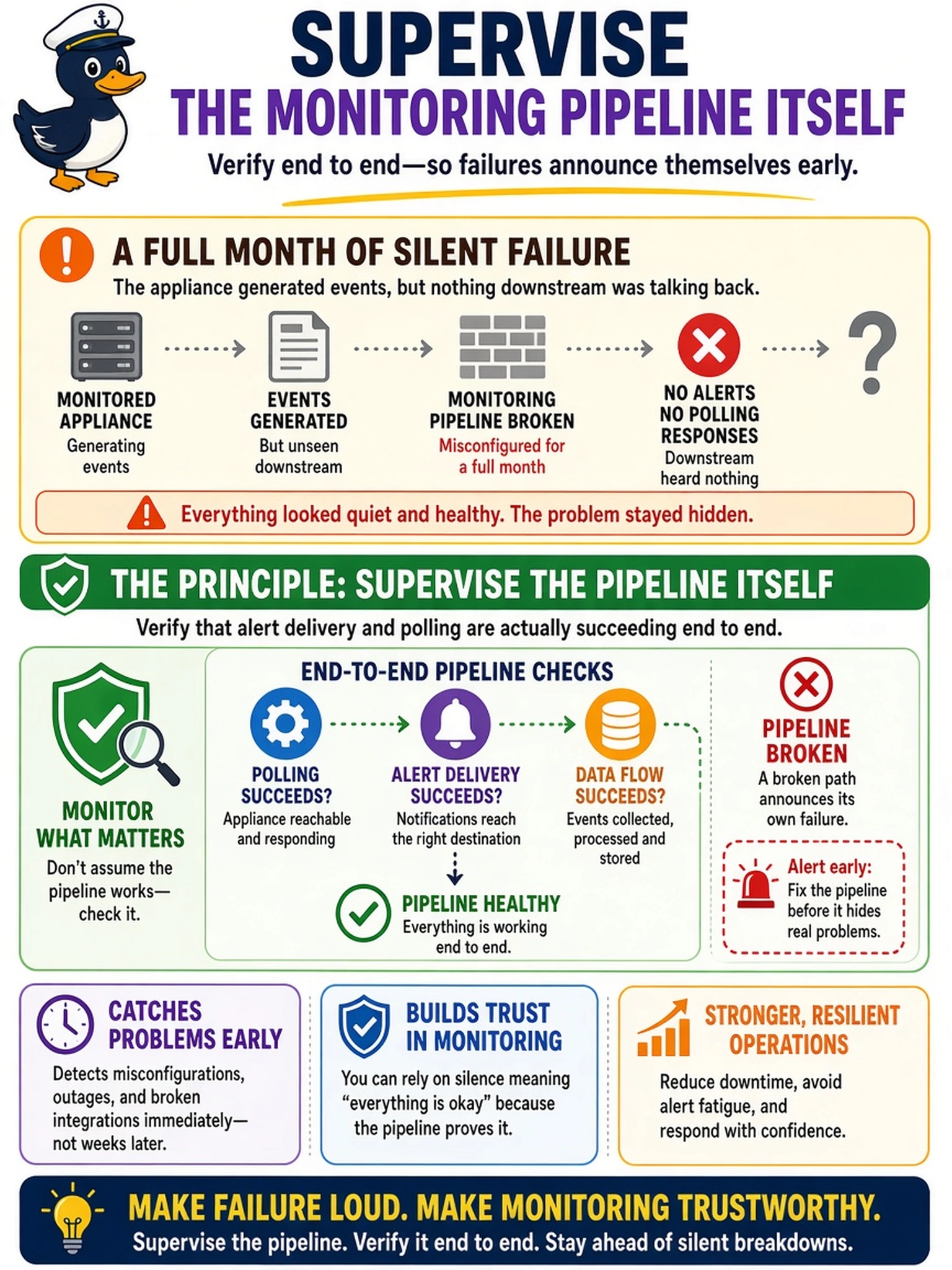
The network management station was misconfigured for a full month and nobody noticed - the appliance kept generating events, but nothing downstream was talking back. What principle of monitoring configuration would have surfaced this problem early?
Select an answer to reveal the explanation.
Short Explanation
Silence looks exactly like an all-clear, and that's the danger. Monitoring needs a watchdog of its own - a heartbeat proving the pipe is delivering, not just that the appliance is quiet. If your alerting can fail for thirty days unnoticed, you weren't being monitored at all.
Full Explanation
Event producers are blind to delivery: SNMP and email-style transports are fire-and-forget, so a misconfigured receiver looks identical to a healthy system from the appliance's side. The countermeasure is deliberate loop-closing - periodic synthetic events that must arrive at the final inbox, poll-success monitoring on the NMS side, or a heartbeat to a second observer - converting absence of traffic into a defined alarm condition. Verbosity increases add volume to a path nobody has confirmed; a fatter stream into a dead hole is still silence at the human end, which is the very failure being diagnosed. Retention on the broken receiver preserves nothing that never arrived - a month of missed events is not queued upstream waiting to be reconstructed - and retention addresses forensics, not delivery assurance. N-way duplicated channels without verification simply parallelize the same silent-failure mode: every one of five destinations can be broken quietly, and redundancy without validation buys confidence nobody has earned. Exam caveat: the verification must traverse the whole chain including the human notification step - delivery to the collector is not delivery to the on-call phone. Operational check: emit one scheduled synthetic test event daily and alert on its absence from the final destination rather than waiting for a real failure to test the path for you.