
Day one after handover: the backup operations team wants a login of its own so it can check filesystem usage, replication status and daily health output without being able to reconfigure anything. The built-in roles each give either too much or too little for that job description. How should the engineer provide the access?
Select an answer to reveal the explanation.
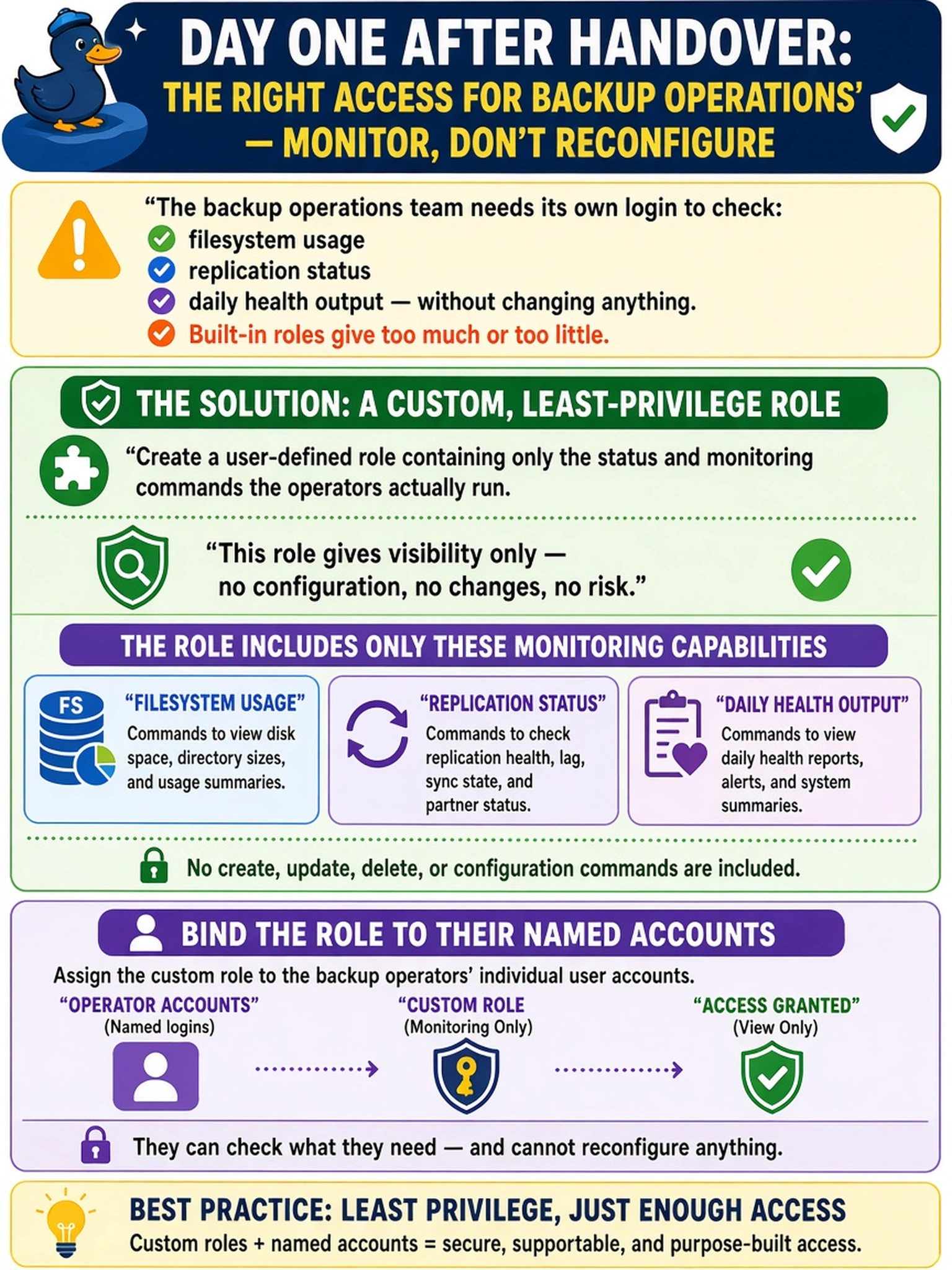
Short Explanation
Roles are like uniforms - when nothing off the rack fits the job, you tailor one. A user-defined role holding exactly the status commands the operators run gives them their access with no change authority attached. Don't hand out the administrator badge 'just for now'; you'll never get it back.
Full Explanation
DD OS role-based access control is designed so the job description drives the role: when none of the built-in roles - full administration, security, audit-style visibility - matches what a team should be able to do, a user-defined role carrying exactly the permitted command set is the sanctioned answer, bound to named accounts so the work stays attributable. Granting the administrator role and hoping a written list of forbidden commands holds fails by concept: a control that depends on restraint is not a control, and one mistyped command under full rights is exactly the accident least privilege exists to make impossible. Sharing the built-in administrative login, on a rotation or otherwise, destroys attribution - every command lands in a shared trail that no longer names a person, which is the same defect the environment is being cleaned of. Assigning the security-focused role confuses subject matter: that role owns authentication and security settings, not observation of replication or capacity, so it neither carries the needed status commands nor excludes the security ones. Exam caveat: always check the built-in set before authoring anything custom - user-defined roles are for the residue the built-ins do not cover, not a first resort. Operational check: an operator logs in, runs the required status output successfully, and one configuration command is refused and logged.