
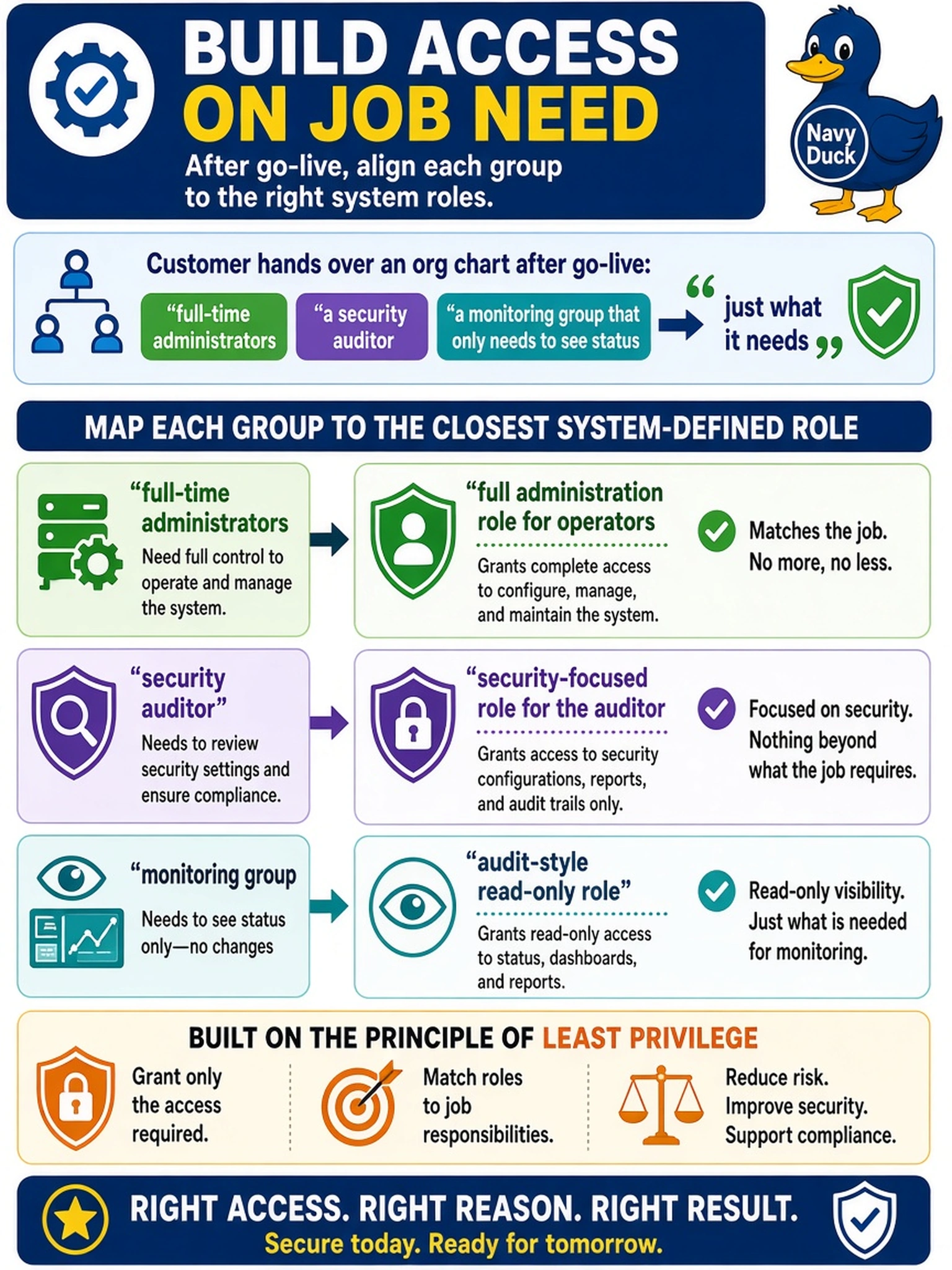
After go-live, the customer hands over an org chart - full-time administrators, a security auditor, and a monitoring group that only needs to see status - and asks that each group receive "just what it needs". How should system access be built?
Select an answer to reveal the explanation.
Short Explanation
'Just what it needs' is the definition of least privilege, and this platform already ships roles shaped like the org chart - full admin, security, and an audit-style read-only view. Map the people onto the roles instead of inventing permissions from scratch. You'll sleep far better when the monitoring desk literally cannot delete a filesystem.
Full Explanation
DDOS ships system-defined roles that group commands into coherent job shapes: full administration for day-to-day operators, a security-focused role for authentication and security settings, and restricted read-only or audit-style roles for observation. Least privilege is therefore a mapping exercise - each org-chart function matched to the closest built-in role, bound to named accounts - not a permission-authoring exercise. The ask itself rules out universal administration: training is not a control boundary, and an operator's mistyped command under a monitoring badge is exactly the accident least privilege exists to make impossible. A single custom middle-ground role collapses three different needs into one shape: auditors do not need operator command authority, operators do not need to administer security policy, and one blended grant over-privileges everyone in it. The 'auditors need admin to see consequences' argument confuses observation with mutation - review requires visibility of state and logs, which read-only roles provide, and adding change authority to an auditor destroys the independence that makes the audit meaningful. Exam caveat: check each job's commands against the available role definitions before authoring a custom role; the built-in set usually covers the org chart. Operational check: every named user carries a role matching their function, and one representative per group attempts one permitted and one forbidden action, with both results recorded.