
Before handover of a new Data Domain stack, the team debates whether to run the platform's built-in health and diagnostic battery on it. What best justifies running it at bring-up?
Select an answer to reveal the explanation.
Short Explanation
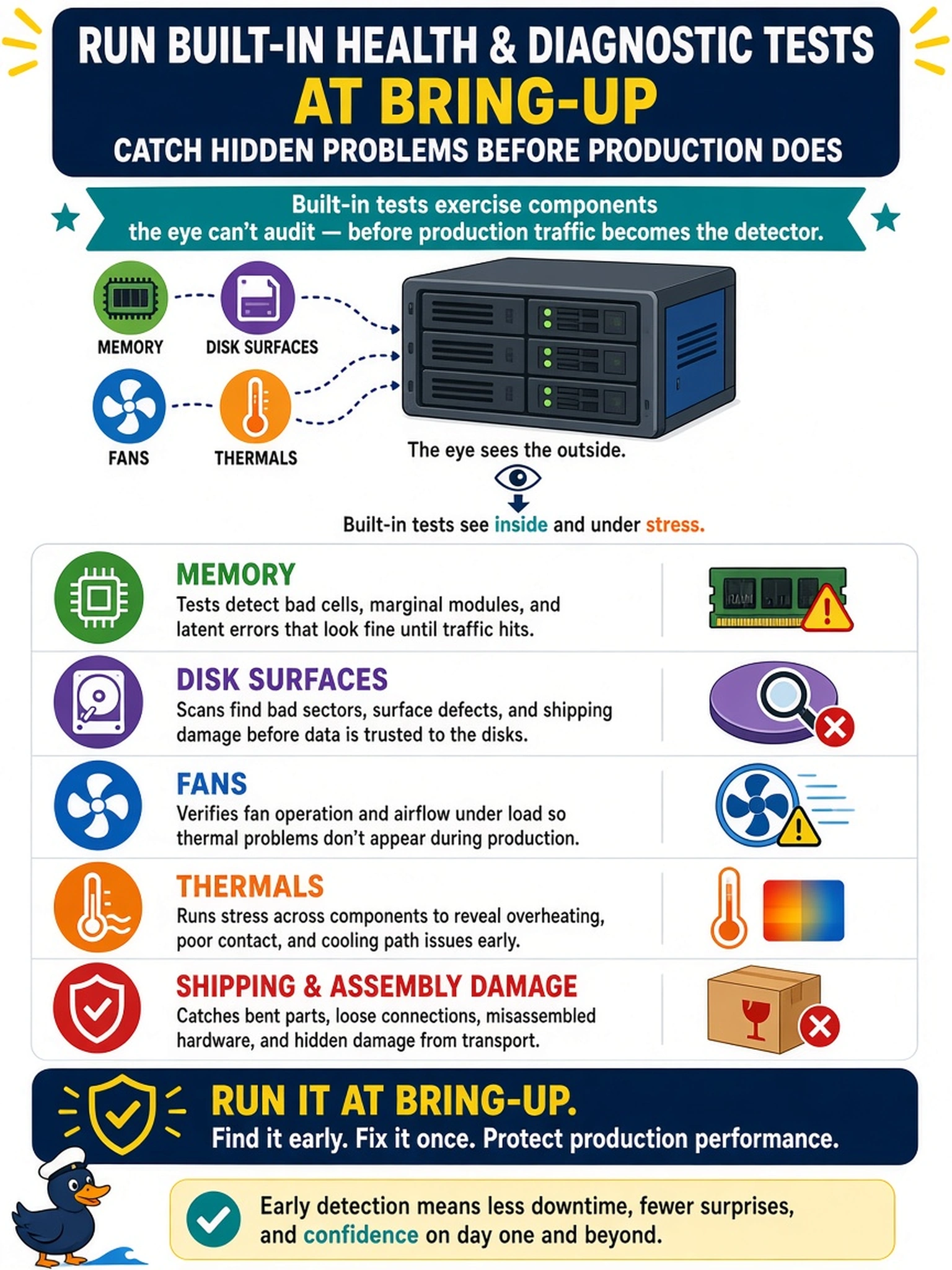
A box can look perfect in the rack and still be hiding a bad memory module or a disk surface that won't hold your data. The built-in diagnostics exist to shake those faults out while one is still a build defect instead of a production outage. Run the battery before handover, not after - you want the surprise on the bench, not in week three.
Full Explanation
Faults introduced in transit and racking - a memory module unseated by vibration, a drive tray latched only on its outer edges, a fan bearing bruised, a sensor connector half-on - tend to stay intermittent until real load or real heat finds them. The appliance's built-in health and diagnostic battery drives those components deliberately, outside the production path, so a marginal part fails during bring-up when it is still a warranty event and a build fix rather than an outage three weeks after go-live. Diagnostics measure; they do not silently rewrite firmware - version selection is a deliberate step against the compatibility guide, and a test suite that quietly changed code levels would be introducing risk, which is precisely backwards. Nor does a passing battery replace remaining validation steps or vendor processes: it is evidence inside the process, not a waiver of the process, and acceptance still walks its own checklist. The idea that a test suite repairs failing disk defects misreads both engineering and warranty practice - a failing drive is removed and replaced under support; a suite that concealed defects to spare the claim rate would corrupt the very data support relies on. Exam caveat: run the battery before the first production data lands so results describe the build, not live workload interference. Operational check: full battery passes, results dated and stored with the deployment record, any failed component replaced and retested.