
While an electrician tests circuits, one PDU feeding a Data Domain's redundant power supplies goes dark and the appliance keeps running. From a deployment standpoint, what does the team still owe this test?
Select an answer to reveal the explanation.
Short Explanation
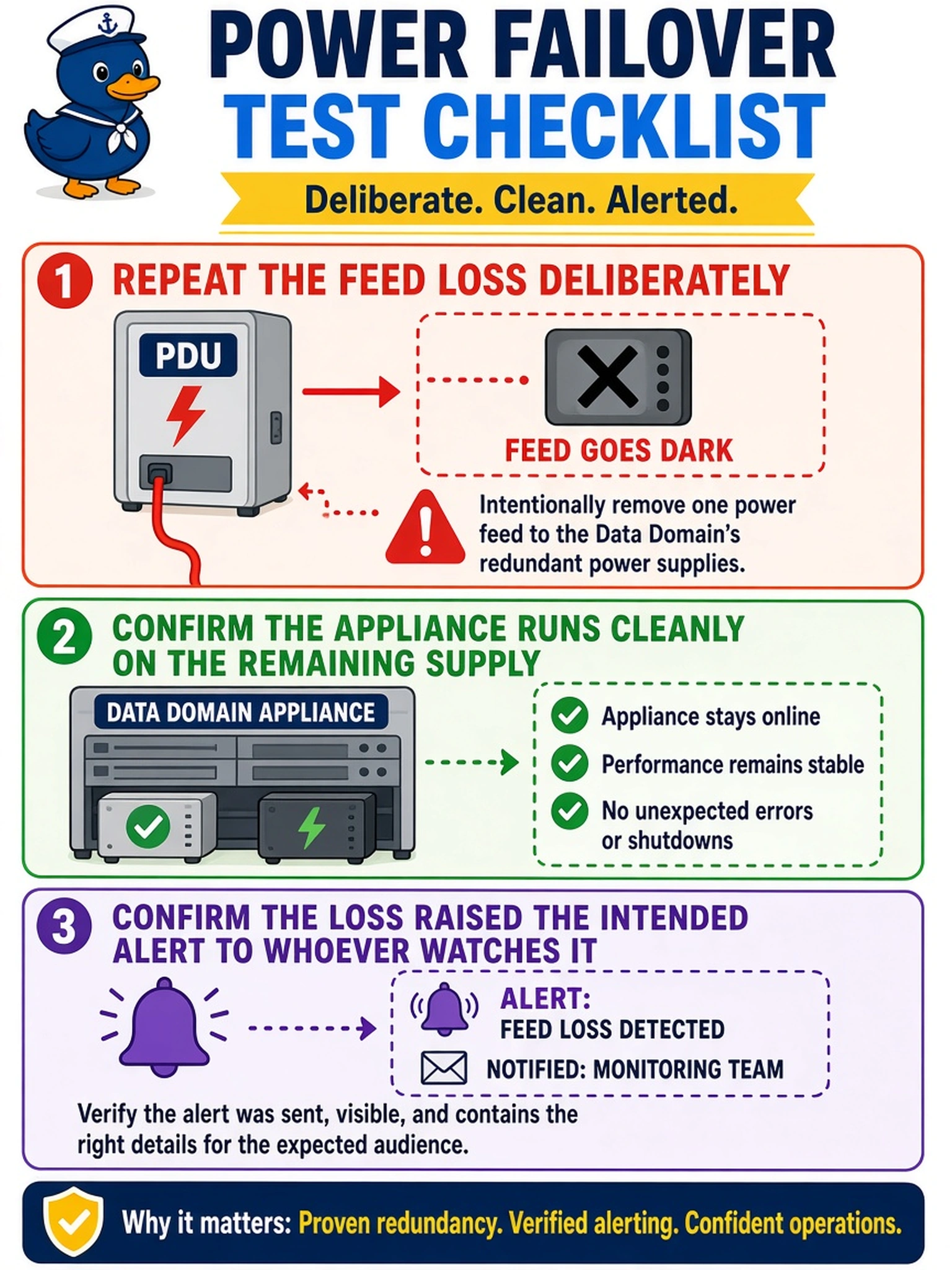
Lucky isn't the same as verified. The box surviving an accident proves the hardware works; you still owe the planned version - pull one feed on purpose, watch it run, and see the alert land where your team will actually notice. Redundancy plus silence is a gap, not a pass.
Full Explanation
Redundant-power acceptance has two halves: continuous operation on a single feed, and operational visibility of the degraded state. The accidental dark PDU demonstrated the first by accident; the team owes a deliberate repeat, performed under control, confirming the system runs cleanly on the surviving supply while the environment alert fires with the right content and reaches the monitoring path that will page someone at 2 a.m. Turning an incident into a controlled test is standard bring-up practice. Dismissing the accidental event is the opposite of free value: the planned rerun costs minutes and produces the evidence the acceptance sheet actually requires. Buying additional PDU hardware responds to the wrong observation - supplies survived on one feed, which is the redundancy working, not failing, so more gear fixes nothing. Restoring the feed and closing the line records only half the outcome; an appliance that degrades silently still surprises you, just later, and the alert half is what the customer is paying for. Exam caveat: confirm the surviving feed's circuit rating can carry the system's full draw before promising single-feed runtime in a real outage. Operational check: the planned single-feed run logged, the alert timestamped and received by the monitoring destination, and both supplies back to healthy state afterward.