
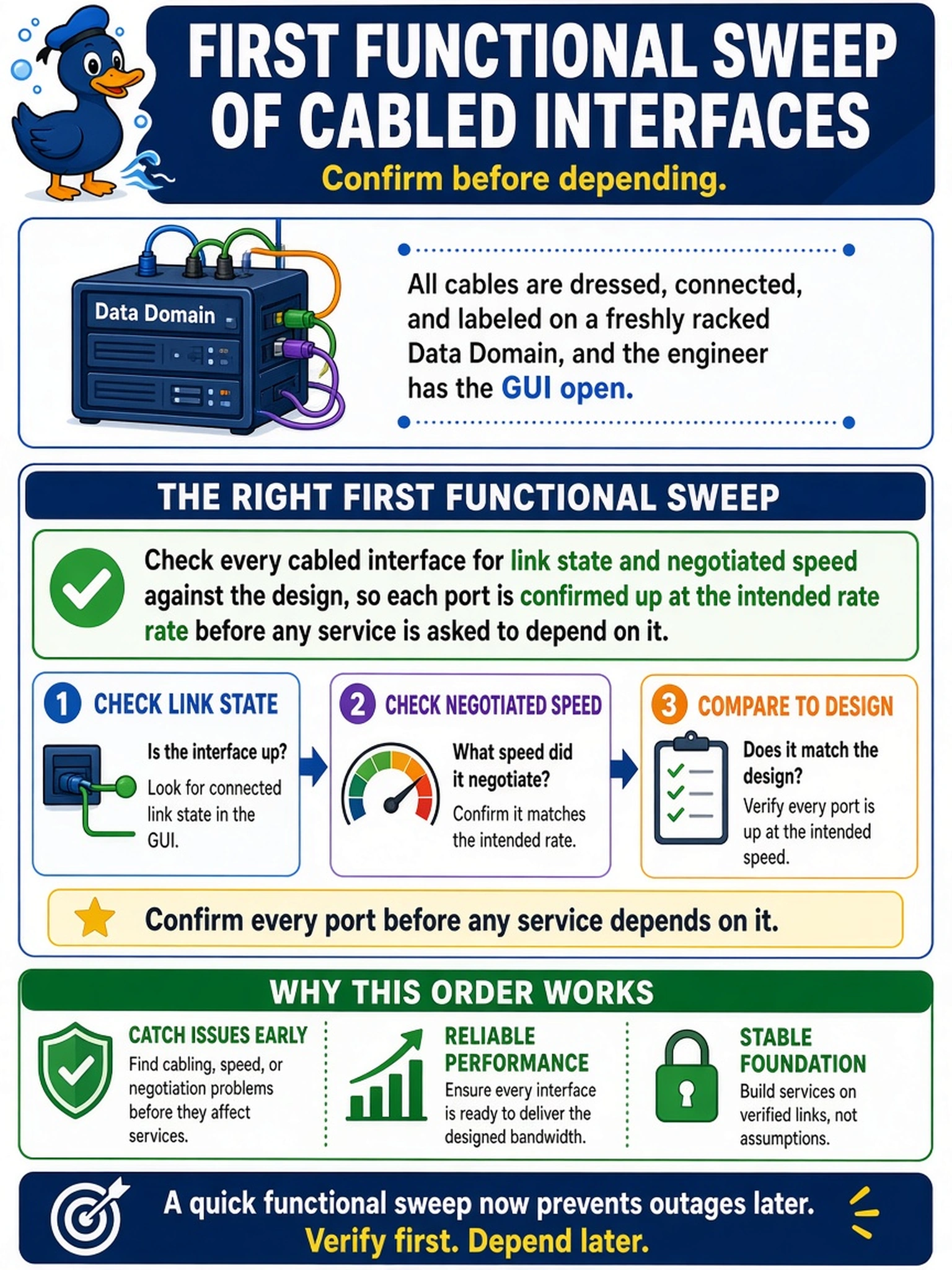
All cables are dressed, connected, and labeled on a freshly racked Data Domain, and the engineer has the GUI open. What is the right first functional sweep of the cabled interfaces?
Select an answer to reveal the explanation.
Short Explanation
Before you put real traffic on new cables, ask each port how its negotiation went. Link state and negotiated speed are the receipt for your cabling work - a port that's up at the wrong speed is a defect wearing a costume. Everything downstream rides on that receipt.
Full Explanation
Auto-negotiation is a free audit of the physical layer: a link that comes up at one gigabit where ten was designed, or a marginal transceiver that flaps, announces itself in the interface state and speed the appliance reports. Sweeping every cabled port against the design sheet catches those faults in minutes, while the fix is still just a cable, a transceiver, or a switch port setting, before any service depends on the path. Throughput testing belongs in acceptance too, but not first: a small job can complete happily over a port that negotiated one-tenth of its designed speed and only collapse under production load, so the big test both hides the fault and costs more to attribute. A day of idle error counters is schedule waste - a dead or miswired link fails link state at once, and faults that only appear under load are exactly what a designed load test should find, not a passive wait. GUI reachability is a single-path observation: management traffic can ride one good port while a second, wrongly negotiated uplink sits unused and unnoticed. Exam caveat: speed and link state do not prove forwarding policy - VLAN membership and allowed trunks still need their own reachability test. Operational check: every port in the design appears up at its designed speed in the interface view, and the comparison is recorded on the acceptance sheet.