
A VTL deployment reaches a decision point: the media server has two spare fibre-channel HBA ports on the existing SAN, but that SAN is documented for decommission next year, and the same server also has spare 10-gigabit Ethernet ports. The administrator asks which transport the virtual tape should be presented over. What is the correct reasoning?
Select an answer to reveal the explanation.
Short Explanation
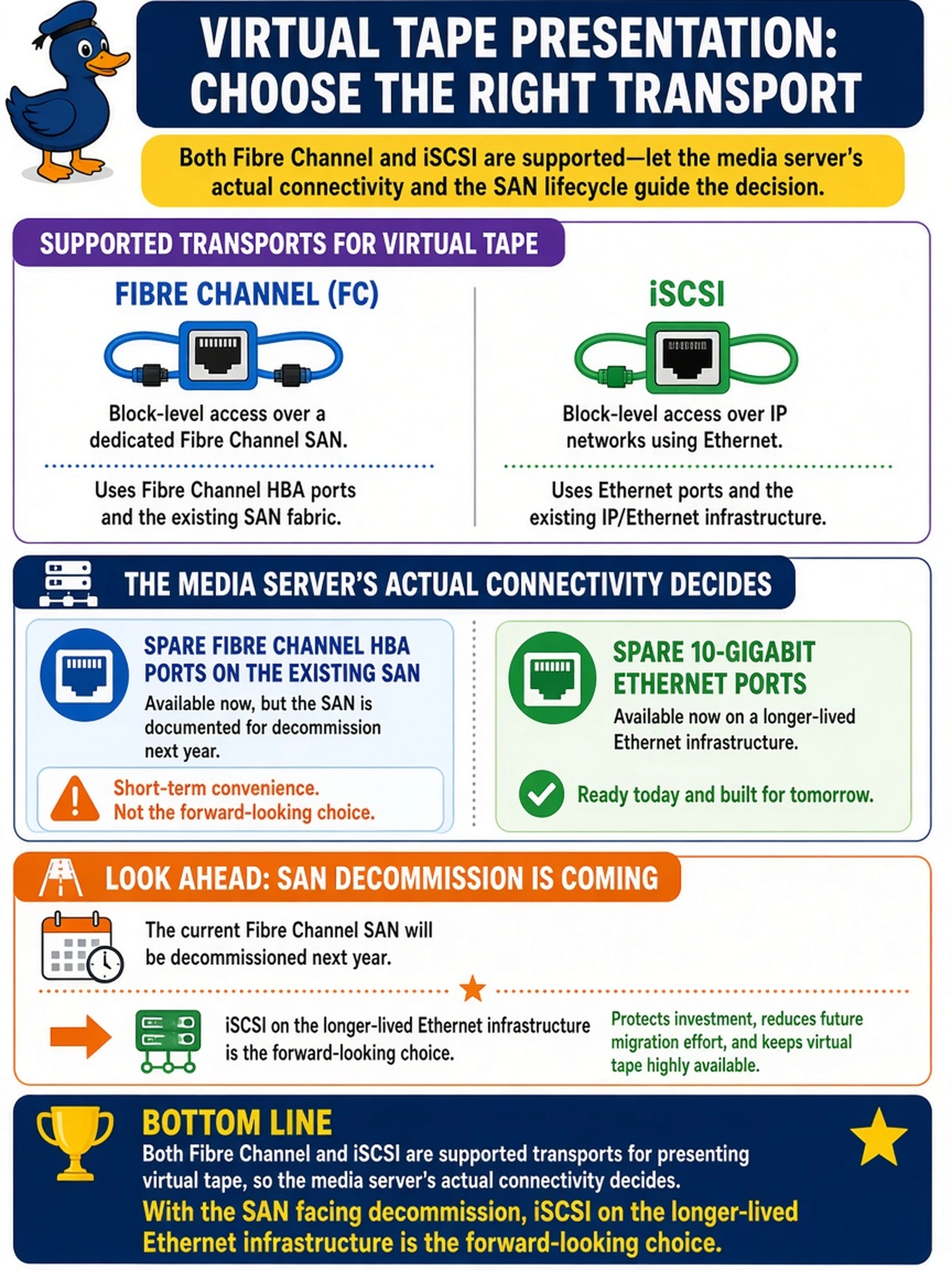
Virtual tape doesn't care whether you lie to your media server over fibre channel or iSCSI; both are real, supported transports. The reasoning the exam wants is lifecycle reasoning: choose from the media server's connectivity and how long that plumbing survives, and a SAN with a retirement date is the wrong foundation. "Both, why not" feels free but buys you a multipath design nobody asked for.
Full Explanation
DDOS virtual tape can be surfaced to media servers over fibre-channel fabrics or over iSCSI, and the device emulation the application sees is identical on either transport, so the decision is infrastructure engineering: which interfaces the media server actually has, how long that infrastructure survives, and how the traffic will be segmented and engineered. Here the SAN's scheduled decommission is the deciding fact, since building the tape path onto hardware that disappears next year guarantees a second migration, while the 10 GbE ports can carry iSCSI on a dedicated storage VLAN with bandwidth to spare. The fibre-only-for-enterprise claim is false as a rule; iSCSI VTL presentations are ordinary production deployments when the network is properly sized. Multipathing the same emulated drives across two transports misapplies block-storage habits, since tape devices are single-path sequential streams and dual presentation invites device confusion rather than resilience. Calling the choice cosmetic ignores exactly the lifecycle and traffic-engineering consequences that make the question worth asking in the first place. Exam caveat: on the iSCSI path, dedicate the VLAN and verify jumbo-frame or QoS support end to end where used. Operational check: after the rescan, confirm drives and library appear over the chosen transport and run read-write tests per drive set.