
Two backup applications and a departmental archive will write to the same new Data Domain. An administrator proposes that everyone just shares one big folder for simplicity, with different sub-folders per application. What is the correct storage-path design on the appliance?
Select an answer to reveal the explanation.
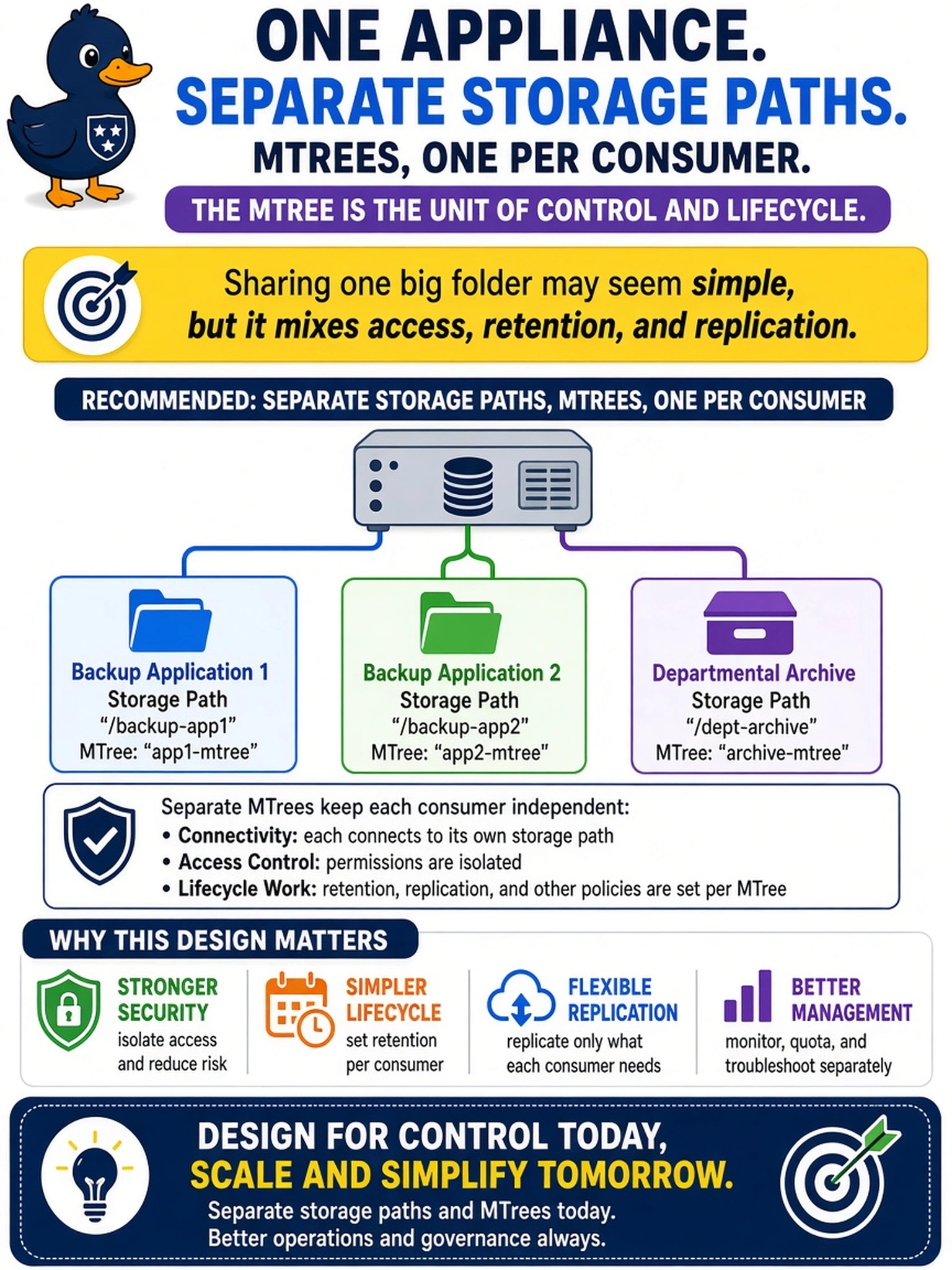
Short Explanation
One shared folder feels simple until application A's retention policy beheads application B's restore point. On the appliance, the unit of sanity is the MTree: one path per consumer, its own permissions, its own retention and replication story later. And your dedupe savings don't leak across paths, because the appliance dedupes across the whole filesystem anyway.
Full Explanation
Giving each consumer its own MTree aligns the layout with how the appliance is operated: permissions bind to paths, retention lock and policy settings are applied against storage paths, replication is configured per MTree, and reporting or capacity accounting can be read out per consumer. Cross-consumer deduplication does not require sharing a folder, because the variable-length deduplication engine works across the filesystem, so separate paths lose nothing while gaining independent control. The sub-folders-under-one-MTree proposal fails because a single MTree is one managed unit: its protocol mount, permissions, retention, and replication all apply wholesale, so per-application lifecycle separation evaporates exactly when someone needs it. The isolated-pools premise misdescribes the architecture outright, since duplicate data is tracked globally rather than per path. The one-application-per-appliance stance mistakes the actual hazard: the corruption risk lives in serving one path through two file protocols simultaneously, not in multiple consumers living on one system in their own paths. Exam caveat: name MTrees to match consumers and replication topology, since renaming later is painful. Operational check: confirm each application's configured write path resolves to its own MTree with access restricted to its own identity.