
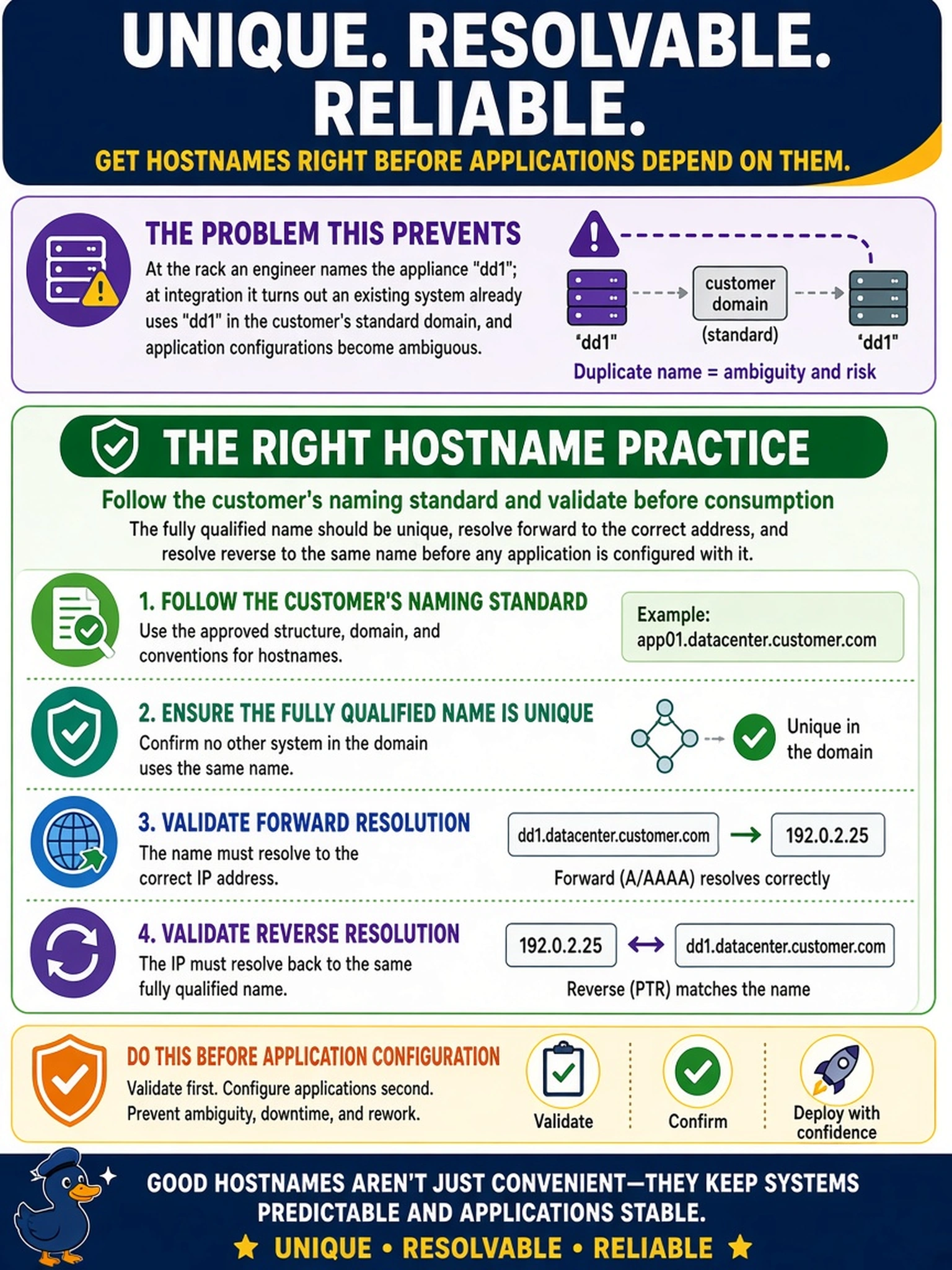
At the rack an engineer names the appliance 'dd1'; at integration it turns out an existing system already uses 'dd1' in the customer's standard domain, and application configurations become ambiguous. Which hostname practice would have prevented this?
Select an answer to reveal the explanation.
Short Explanation
Naming a box at the rack without checking the registry is like naming a star that's already on the chart — 'dd1' was taken, and now two systems answer to the same call. The naming standard exists to prevent exactly the middle-of-the-night version of this story. Pick the compliant, unique name, resolve it both directions, and only then let your applications build on top of it.
Full Explanation
A hostname is a contract with every consumer of the system: application configurations store it, certificates bind to it, logs and alerts are keyed by it, and the naming authority exists to keep it unique within the estate. Following the customer's standard and validating before consumption prevents this failure class — select the compliant unique name, create and confirm the DNS records, verify forward and reverse resolution agree, and only then release the name into application configuration. The short-names-avoid-parsers claim is an invented constraint: applications are routinely configured with fully qualified names, and it is ambiguous short names that create collisions and misrouted support. Using the IP address as the hostname confuses an address with an identity — the address plan is governed separately, certificates and logs still want a meaningful name, and an address-derived hostname adds no uniqueness guarantee the zone did not already provide while destroying readability. Declaring the hostname cosmetic fails on the dependency list: certificates bind names, monitoring keys on them, and a name-less estate discovers during its first incident that nobody can say which system a log line came from. Exam caveat: DNS and the naming record must be settled before a certificate request is generated, because the certificate must carry the standard name. Operational check: resolve the full qualified name forward and reverse from an application host, confirm uniqueness against the naming authority, and document the validated name in the deployment record.