
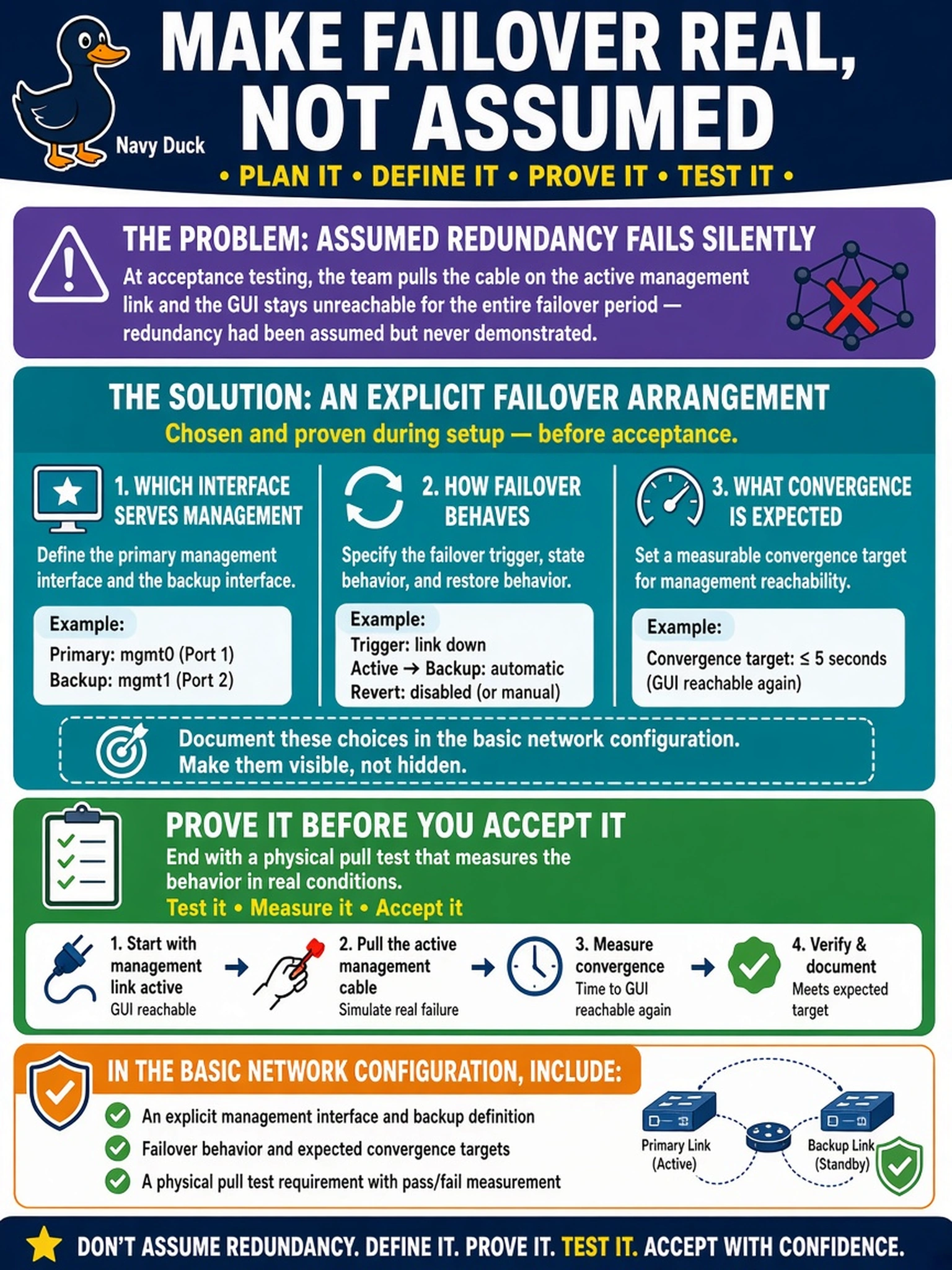
At acceptance testing, the team pulls the cable on the active management link and the GUI stays unreachable for the entire failover period — redundancy had been assumed but never demonstrated. What belongs in the basic network configuration to prevent this outcome?
Select an answer to reveal the explanation.
Short Explanation
The cable-pull test is the moment 'we think it's redundant' meets reality — pull it yourself, during setup, while it's your schedule and your reputation. If failover was never configured and measured, what you own is two cables, not redundancy. Configure the arrangement, prove it with a pull, and write down the seconds it cost you.
Full Explanation
Redundancy is a configuration plus an observed behavior, never an intention. The management path should reach acceptance with an explicit arrangement selected — which interface is active, what standby exists, what the failover behavior and expected convergence time are — and the setup should end with a physical pull test that measures that behavior while the deployer still controls the window. Silence for the entire failover period in this story is the test telling the truth: without configured failover, a failed link simply removes the path, and the recovery people expected was never built. Replication-layer guarantees fail by scope — data replication protects data placement across systems and does nothing to move a management address from a dead interface to a live one. Switch-side spanning-tree priorities fail by mechanism: STP prevents and repairs loops within a switching topology; it cannot relocate an interface's IP identity to another appliance port that was never configured to hold it. Postponing the proof to a later team fails the definition of done — the pull test is the configuration task's verification step, and deferring it converts a measurable design attribute into a surprise reserved for the first real failure. Exam caveat: record the measured interruption in seconds, not just a pass-or-fail tick, so future changes have a baseline. Operational check: pull the active management link, watch reachability drop and return, confirm the standby interface answers with the management address, and file the measured failover time in the acceptance record.