
Cabling left three data interfaces linked with working switches, although the design uses only two. During configuration the engineer administratively disables the unused ones. What is the strongest reason for that action?
Select an answer to reveal the explanation.
Short Explanation
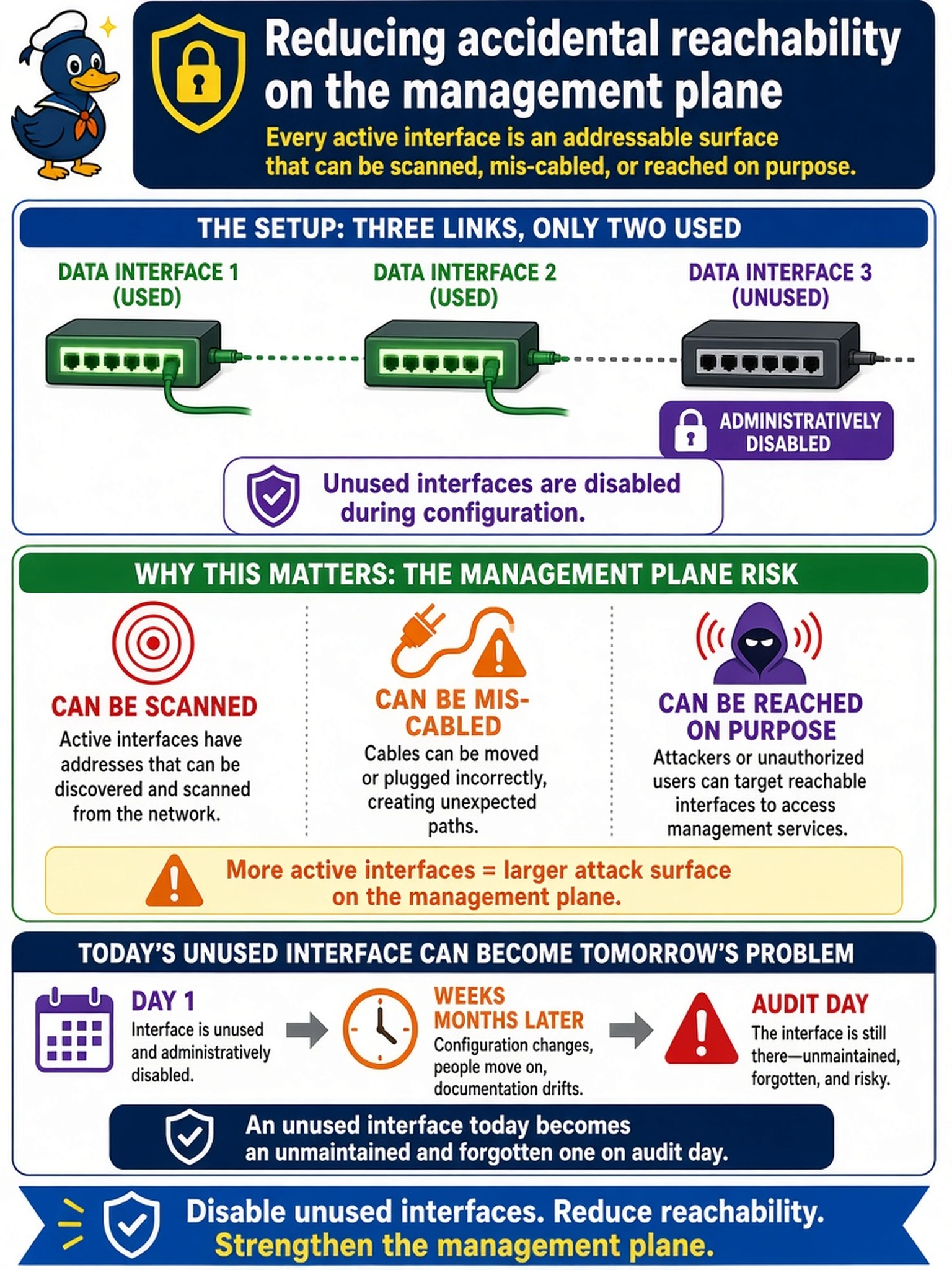
Every live interface is a door, a window, or at least a number someone can find on a scan of your network. Leaving three extra links up 'because the cabling crew did it' isn't capability, it's debt with an Ethernet jack on it. Disable what your design doesn't use — unused today means forgotten by the audit.
Full Explanation
Every active interface is an address, an ARP responder, and a potential avenue for access whether or not anyone planned to use it — management-adjacent services can answer wherever an interface is active. Administratively disabling the surplus links during the configuration phase is deliberate reduction of the management-plane attack surface: it converts 'we are not using those' from an assumption living in someone's head into enforced machine state that survives staff turnover and cable moves. The alert-noise justification invents behavior — linked but unused interfaces do not inherently flood capacity or health alerting, and silencing noise was never the reason for the hygiene. Releasing PCIe bandwidth fails by hardware concept: a port's administrative state is a switch on its transceiver and logic, not a reallocation of bus resources to sibling ports, and throughput on active interfaces is unchanged. A two-interface routing limit simply does not exist on these platforms, which are built to carry several active network roles at once. The durable value is subtraction of surprises: a forgotten active port can be reconnected to a hostile network during any maintenance night and instantly become a real attack path. Exam caveat: administratively disable rather than physically unplug, and document the disabled set with its reason. Operational check: list interface state after the change and confirm exactly the designed interfaces are active, with the remainder shown administratively down in the deployment record.