
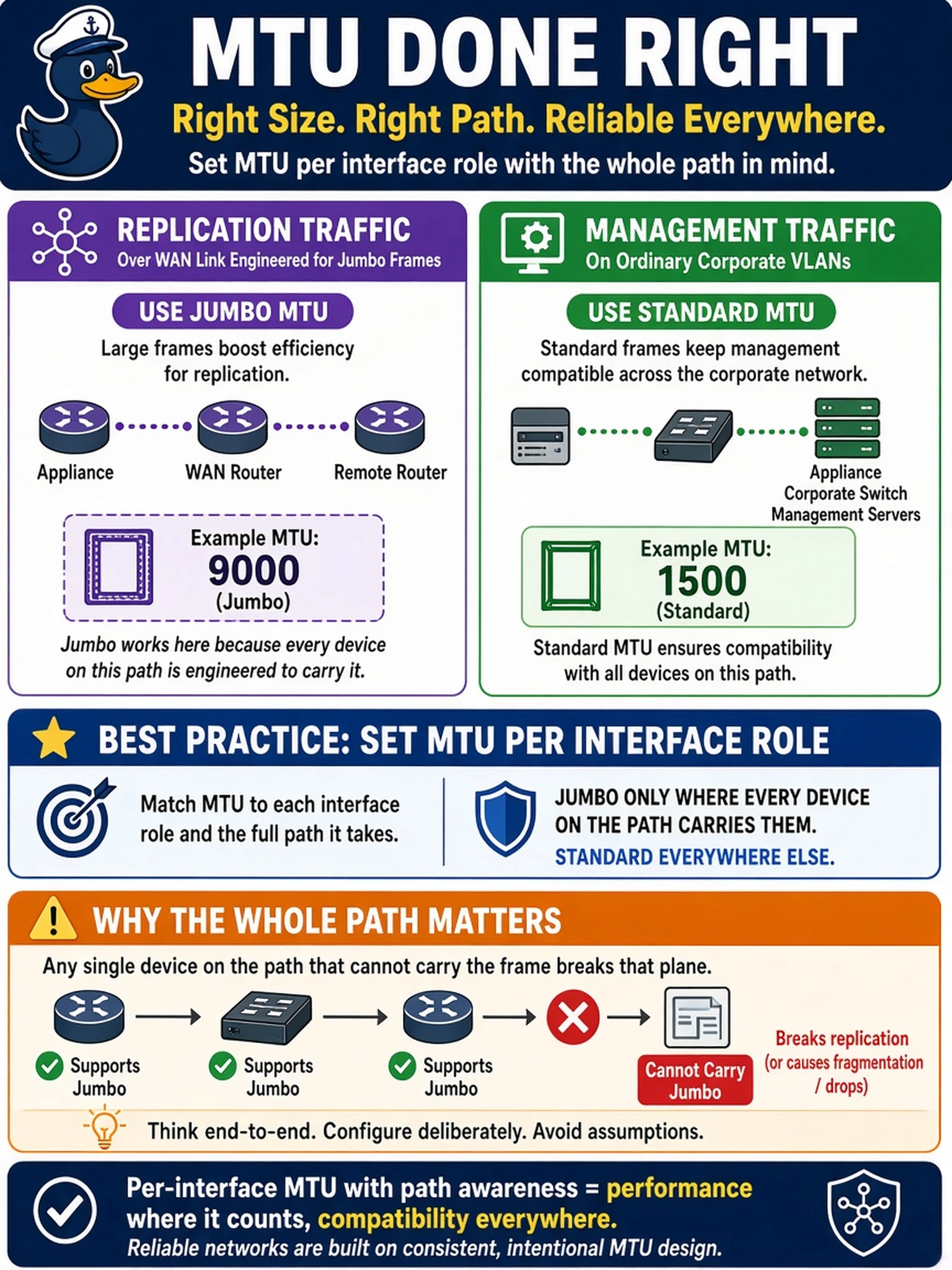
The network team is standardizing interface MTU on the new appliance. Replication runs over a WAN link engineered for jumbo frames, while management sits on ordinary corporate VLANs. What is the correct approach to MTU here?
Select an answer to reveal the explanation.
Short Explanation
MTU is a property of the road, not the car. Replication gets jumbo frames only when every switch and router in between is built for them; management keeps the standard size because the corporate network has no interest in hauling anything oversized. Uniform values break one plane or the other — size to the path, then test before you celebrate.
Full Explanation
MTU is a path property, not a device preference: a frame of a given size survives only if every switch, router, and tunnel between endpoints is configured to carry it. Sizing per interface role therefore means jumbo frames on replication interfaces where the whole WAN path supports them — gaining reduced per-packet overhead on the highest-volume flows — while management keeps the standard value the corporate access layer actually forwards. Uniform jumbo fails by coverage: oversized management frames meet access devices that drop rather than reliably reassemble, producing intermittent, hard-to-find management-plane failures. The 'compression makes MTU irrelevant' claim fails by mechanism — frame size governs per-packet overhead and sustained throughput on clean paths, a separate lever from compression that the scenario states is already tuned for jumbo, making the uniform default a missed tuning opportunity rather than a neutral choice. Auto-negotiation propagating MTU is fiction: link negotiation does not extend a frame-size agreement across intermediate hops, each of which must be configured independently. Exam caveat: verify jumbo support with a large test frame bearing the don't-fragment setting before trusting any paper claim. Operational check: confirm the MTU on each replication interface and the adjacent switch ports, send one oversized do-not-fragment test frame to the peer, and document the per-role values.