
At handover the customer asks for the as-built port map, and the team realizes nobody recorded which head port lands on which switch port while the cables were going in. What practice does this failure point to?
Select an answer to reveal the explanation.
Short Explanation
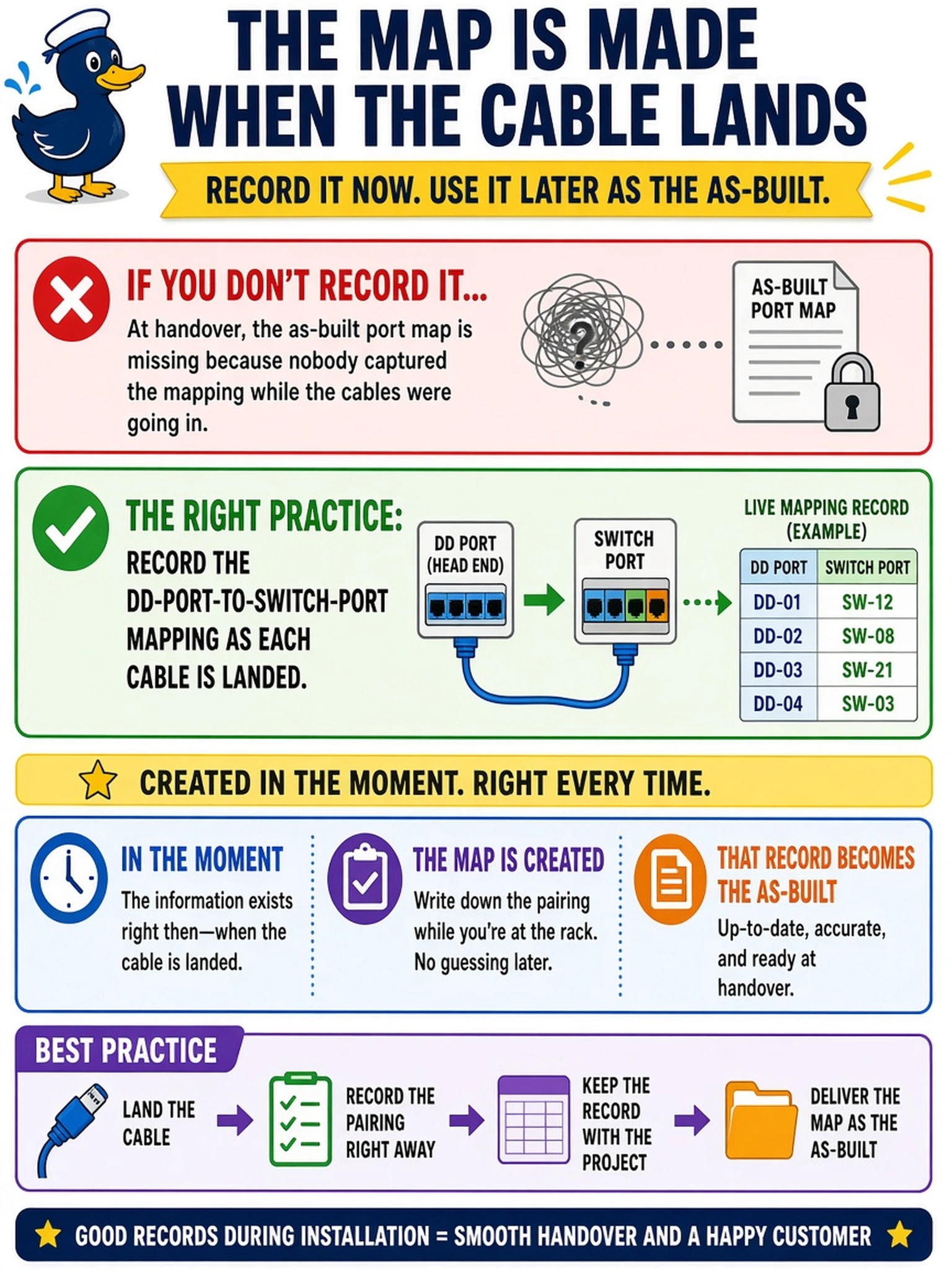
Here's the thing: port maps don't exist after the fact — they only exist while you're cabling. Six identical cables all lit up look exactly the same once they're dressed in, and rebuilding the map later costs you link flaps scheduled at the worst possible time. Write each row down as each cable lands; your future self will thank you at handover.
Full Explanation
A port map is information that exists physically only during cabling. At the instant each cable is landed, someone present knows which head port meets which switch port; once identical cables are dressed in and all carry traffic, that knowledge is unrecoverable by inspection, and reconstruction requires deliberately taking links down to trace them. Recording head-port-to-switch-port pairs as work proceeds costs seconds per cable and yields a handover document no later tool can rebuild without disruption. Reconstructing afterwards by toggling links fails on cost and risk: it forces an outage per traced link on a system that may already carry production traffic, to recover knowledge that was free at install time. Labels on both ends being sufficient fails because a label identifies a cable end, not a relationship — a far-end marking helps only if the pairing was noted when made, and labels applied wrongly produce a confidently wrong map. Assigning the map to the switch team by division of labor fails on information flow: whoever lands the cable sees both ends at the same moment, and a team documenting from the other side can only record assumptions. Exam caveat: an as-built without a port map is an incomplete installation at handover review. Operational check: at cabling sign-off, confirm one table row per cable with head interface, switch, and port, and spot-check three rows against the physical rack.