
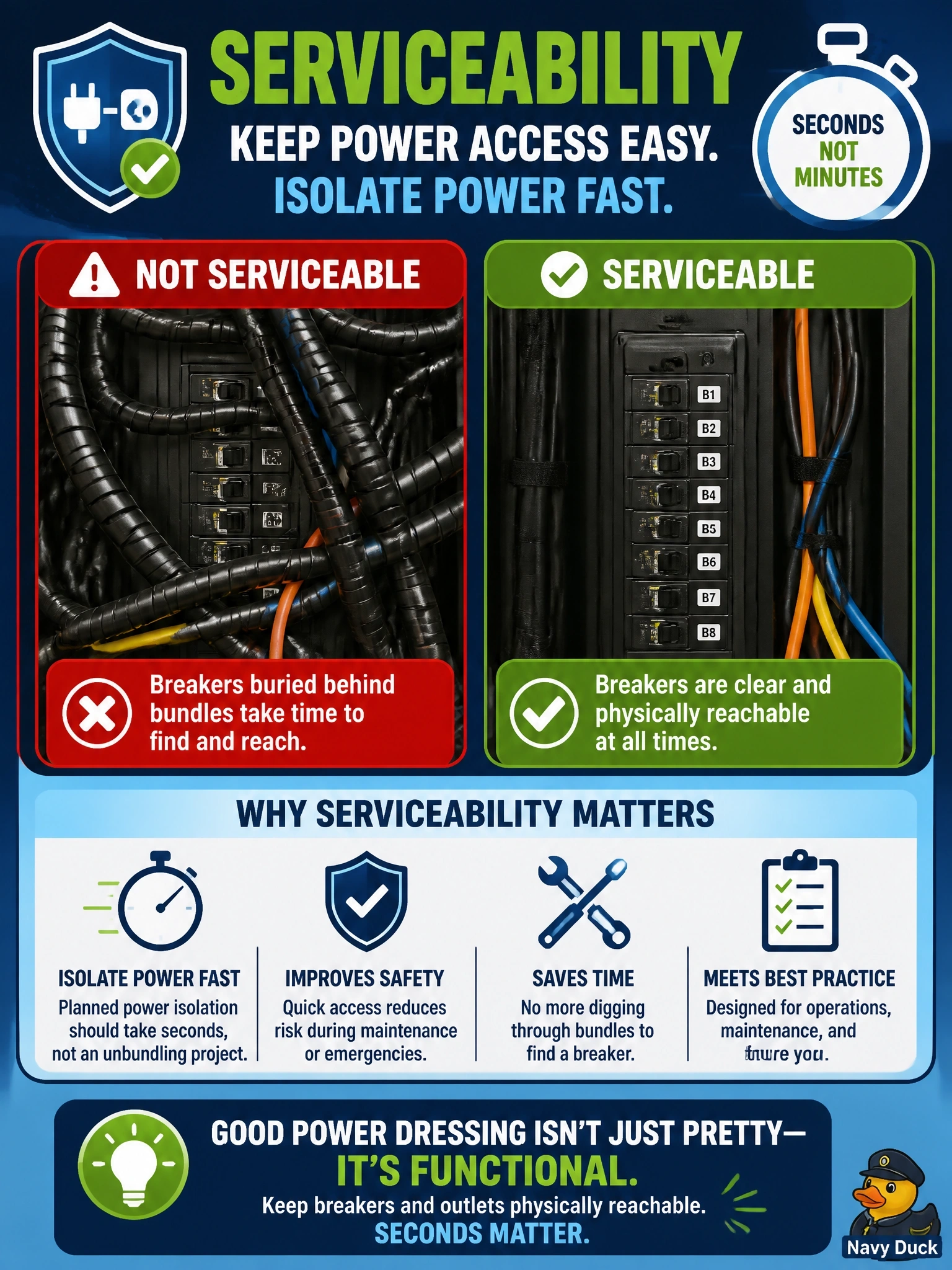
After a beautiful cable-dressing pass, the rack's branch-circuit breakers sit buried behind a bundle of spiral-wrapped power cords. What did the dressing job violate?
Select an answer to reveal the explanation.
Short Explanation
Here's the test that matters: it's 2 in the morning, there's smoke in the room, and you need to cut power to that rack in ten seconds. If the breakers hide under spiral wrap and forty velcro ties, you just wrote yourself a very bad night. Dress power so protective devices stay reachable — tidy is nice, serviceable is required.
Full Explanation
Serviceability is a functional requirement of power cabling, not an aesthetic preference. Branch-circuit breakers and PDU outlets serving an appliance are deliberate disconnect points: emergency power-down, planned isolation, and maintenance all depend on reaching them in seconds, and dressing that buries them turns a ten-second breaker operation into an unbundling project performed under stress. Correct dressing routes and secures cords while keeping inlets, outlets, and protective devices visibly and physically accessible without tools. The view that nothing was violated because dressing quality is judged solely by appearance at the handover walk-through fails by purpose — the walk-through evaluates an operable installation, and an unreachable breaker is an operability defect regardless of how neat the bundle looks. The material rule that spiral wrap is never used on power cords because wrap overheats cords carrying continuous current is an invented rule; wrap is not a thermal failure mode at these currents, and the real standard here is access, not braid type. The requirement to dress all power cords loose and unbundled so each cord can flex freely with thermal movement fails by trading one hazard for another: dangling cords snag, obscure labels, and trap heat and dust at the rear; the answer is a secure bundle that deliberately leaves the access zones open. Exam caveat: judge cable work as an operator would meet it during an outage, not as it photographs at handover. Operational check: stand at the dressed rack and confirm every breaker and inlet serving the stack can be reached and operated in seconds with the dressing in place.