
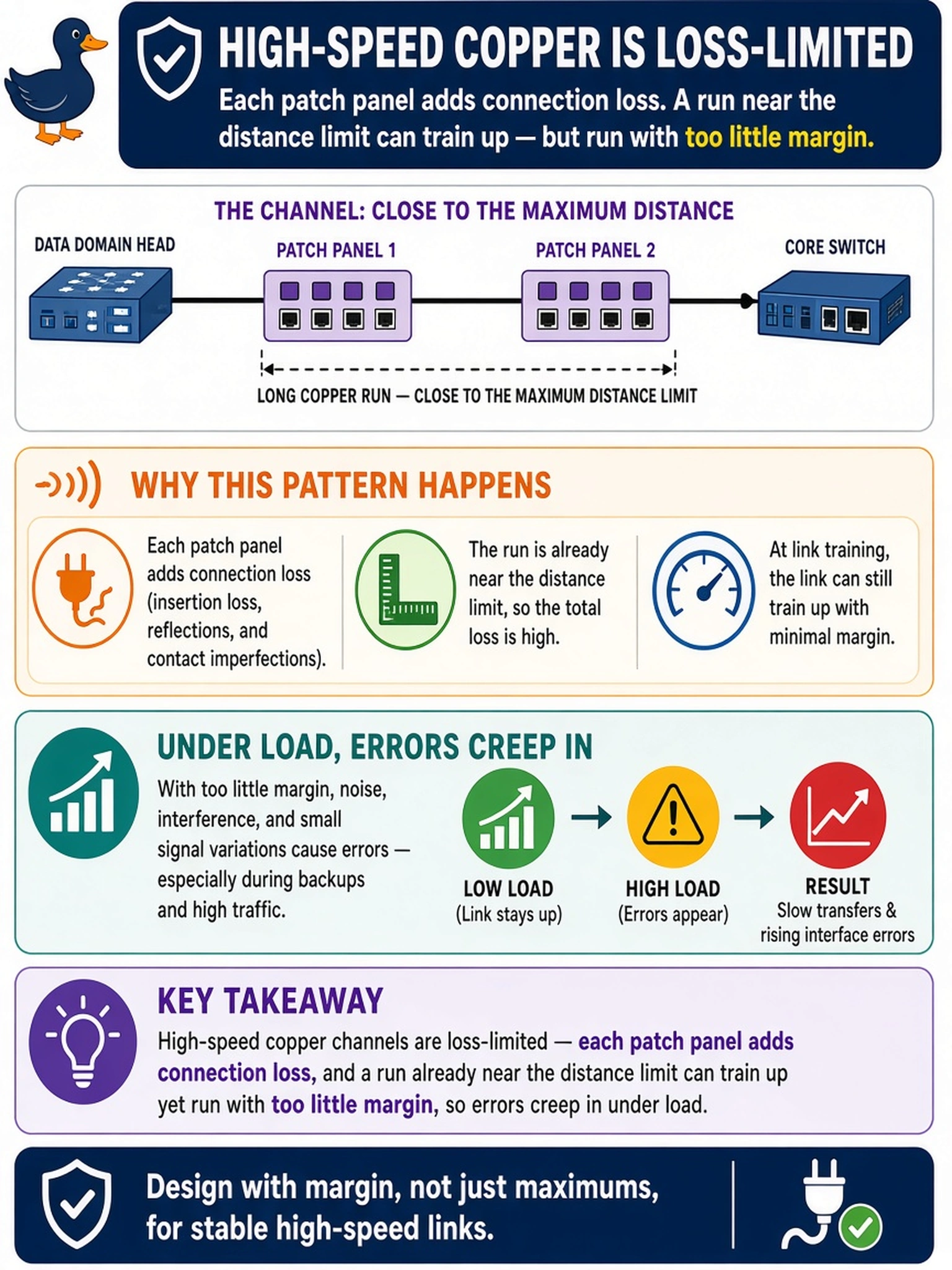
You cable a 10GBASE-T run from the Data Domain head to the core using two patch panels in the path, and the channel sits close to the maximum distance for copper. The link trains up, but weeks later the backup team reports slow transfers and rising interface errors. What best explains this pattern?
Select an answer to reveal the explanation.
Short Explanation
A link that trains up is like a whisper you can barely hear — sure, you hear it… until the room gets noisy. Every patch panel you add to a copper run eats margin, and a channel already near the distance limit has nothing left to give. Keep high-speed copper inside its distance and connection budget, and never let 'link up' sign off on a dying channel.
Full Explanation
High-speed copper channels are loss-limited: the cabling class defines a maximum insertion-loss budget, and both distance and mated connections consume it. A permanent link close to the distance limit can still train successfully, because link training needs only enough signal to agree on a speed — not enough margin to stay error-free afterward. Each patch panel adds connection loss and reflection points, and once the channel has no margin left, temperature swings and load push frames past the error threshold, so CRC counters climb while the interface status stays green. Automatic fallback to 1GbE based on panel count fails by confusing two mechanisms: negotiation decides speed from advertised capabilities, not connector count, so a green light proves nothing about channel quality. Passive meaning harmless inverts physics — every mated connection adds measurable loss and impedance discontinuity, because a passive panel cannot retime or regenerate the signal. A standards ban on patch panels in 10G channels does not exist; structured-cabling standards allow them within bounded budgets of total length and connector count, and the installation exceeded that budget. Exam caveat: the channel budget includes patch cords and every mated connection, not just the horizontal run. Operational check: audit channel length and connector count against the cabling class specification, reduce or re-terminate connections, then verify the interface error counters stay flat under sustained load.