
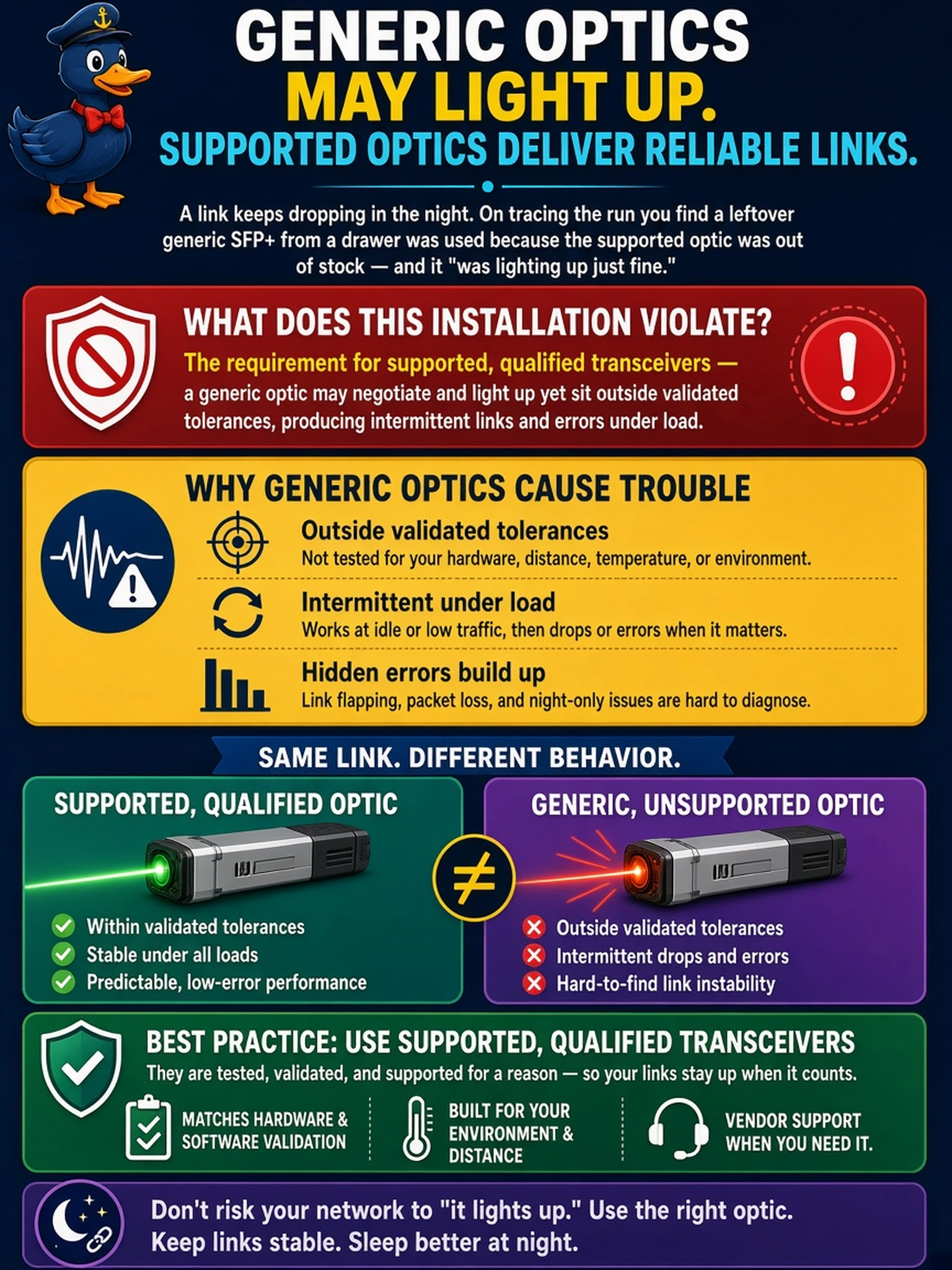
A link keeps dropping in the night. On tracing the run you find a leftover generic SFP+ from a drawer was used because the supported optic was out of stock — and it 'was lighting up just fine.' What does this installation violate?
Select an answer to reveal the explanation.
Short Explanation
'It lights up' is the most expensive sentence in deployment. A link can associate with the wrong optic and misbehave in every way that matters — flapping, CRC errors, drops under load — but only when someone's backup window depends on it. Use the supported optic — your platform's compatibility list, not the drawer down the hall, is what you plug in.
Full Explanation
Supported transceivers are the platform's qualified set: optics tested against the port's electrical, signal, and firmware behavior, holding margin under load and across temperature. A generic module may negotiate and light because basic link establishment is a low bar, while operating outside validated tolerances — the result is exactly the observed pattern: intermittent links, CRC errors, and drops that appear under load and hide when idle, and a support path that assumes qualified parts for its diagnosis. Link-up-at-speed meeting every requirement fails by inverting evidence: negotiation proves a handshake, not margin, drift, or long-term stability, so the weakest observation is being treated as the strongest proof. Compatibility lists as pure sales artifacts fails as an engineering misread: the list summarizes interoperability testing the installer did not perform, and its absence is an unvalidated risk rather than a formality. A two-year replacement rule for fiber is an invented interval that misattributes cause — the fault here is a part outside the qualification matrix, and swapping fresh generics on a schedule reproduces the same exposure. Exam caveat: optics come from the platform's supported list, documented by part number in the as-built. Operational check: install the supported optic, clear the interface error counters, and verify the link stays quiet under sustained traffic.