
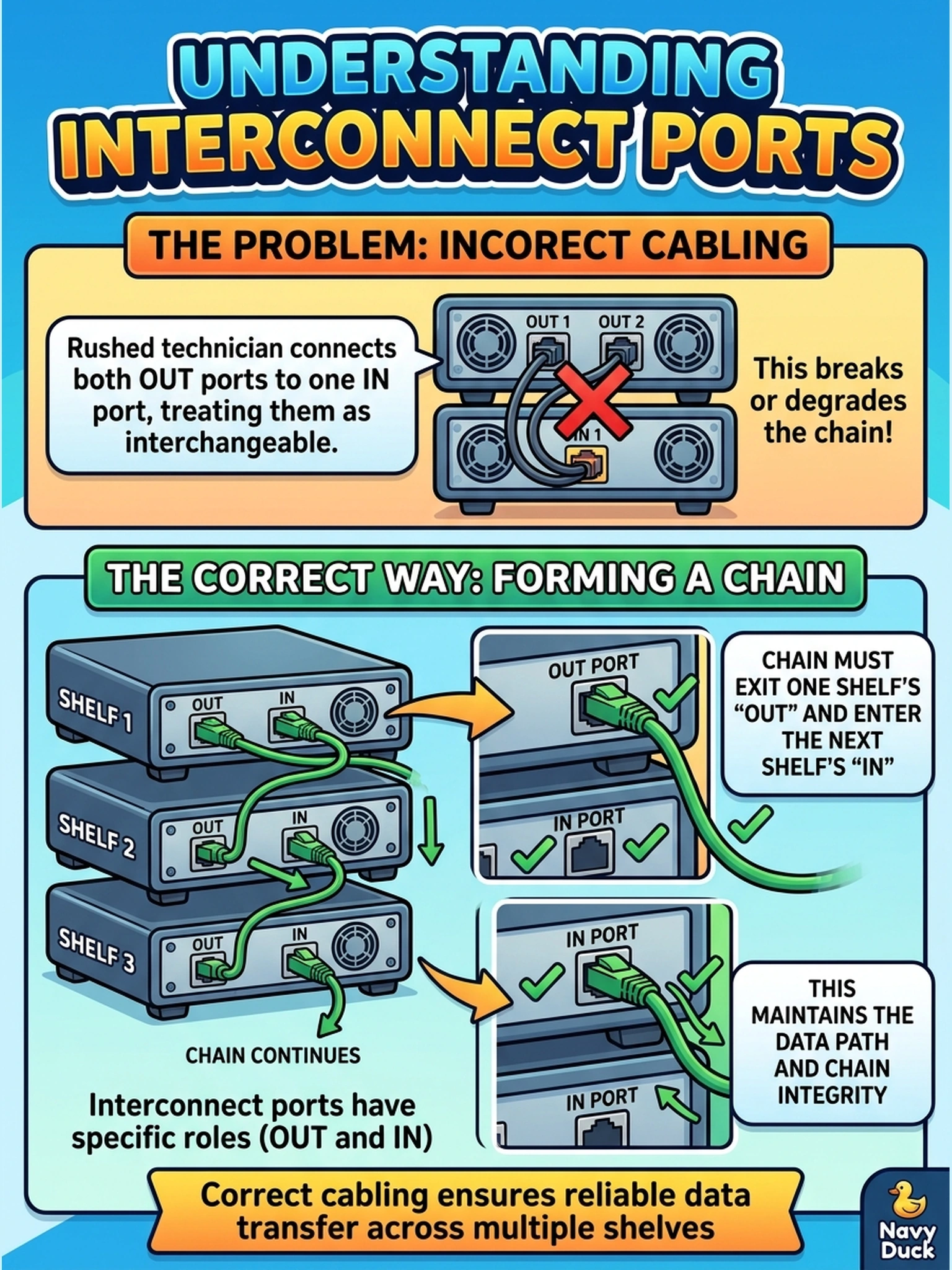
A shelf has two interconnect ports on the back, and a rushed tech jumpering to the next shelf lands both of them on the same port there, treating the pair as interchangeable. What is wrong with that cabling?
Select an answer to reveal the explanation.
Short Explanation
A daisy chain has a flow, like an assembly line — out goes to in, shelf after shelf. Those two ports on a module aren't identical sockets, and jamming both into one target ties a knot in your own link. The chain will tell you about it, usually at the worst possible time for your schedule.
Full Explanation
SAS interconnect ports carry directional roles: the link arriving from upstream lands on the in port and the link continuing downstream leaves from the out port, and the expanders inside the enclosure are wired to expect that ordered topology. Jumpering both free ports of one shelf to a single target on the next shelf violates the chain rules and creates an invalid loop, with consequences that range from failed enumeration to a degraded or flapping path. Part-number identity of the cables fails as a defense: the roles belong to the enclosure's internal wiring, not to the assembly, so identical cables are not interchangeable across directional ports. Losing only the locator LED response understates the damage by concept — topology and path health are what break, and LED behavior is a downstream detail of enclosure services. A power cycle legitimizing the cabling is invented: cycling power cannot make an invalid topology valid, and the fix is re-cabling to the map. Exam caveat: in/out labeling exists precisely because directionality is enforced by the hardware; verify both ends of every hop while dressing. Operational check: trace out-to-in through each hop against the chain map, re-enumerate, and confirm both paths on every shelf report healthy.