
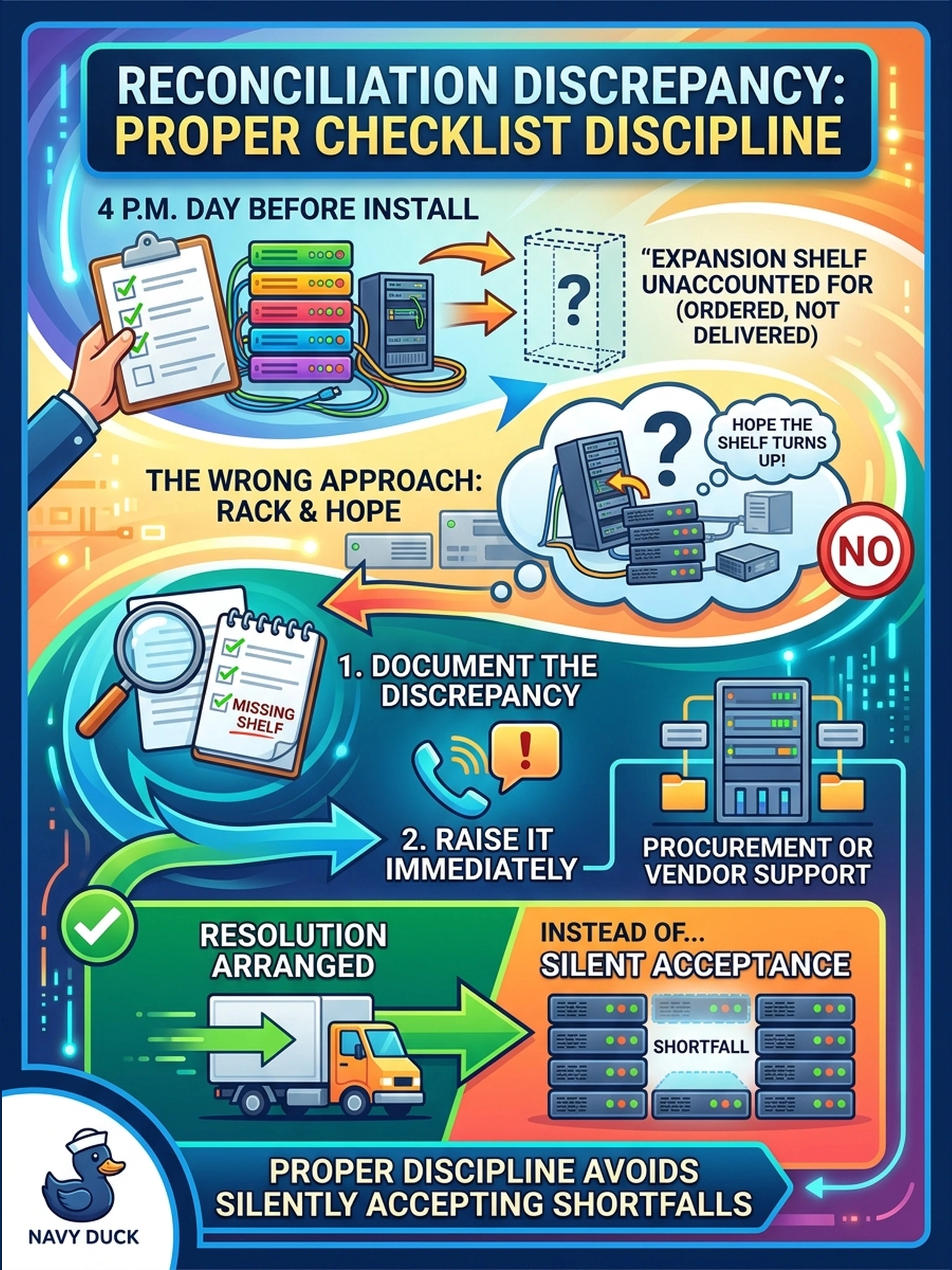
Packing-list reconciliation against the checklist at 4 p.m. the day before install finds one expansion shelf unaccounted for—ordered but on no delivery record. The team wants to rack what they have and hope the shelf turns up. What does proper checklist discipline require?
Select an answer to reveal the explanation.
Short Explanation
Here's the trap: a missing shelf found at four p.m. is a paperwork fix, but found the next afternoon it's a failed deployment. The checklist wants you to escalate the discrepancy the moment you find it—that's what the escalation path is for. Silent improvising isn't resourcefulness, it's tomorrow's incident.
Full Explanation
Reconciling packing lists against the order is the checklist's completeness check, and its companion rule is that any discrepancy—missing, damaged or substituted items—travels the documented escalation path before the installation continues. Escalating at discovery costs an evening phone call; escalating after install costs a revisit, a corrected handover and a customer who learned the news last. Waiting quietly fails by concept: escalation lead times run in days, so delaying the report makes every resolution miss its window, and a missing record breaks the audit trail. Cannibalizing another project's shelf fails twice: it borrows capability from a different customer's commitment, and an undocumented substitution severs the inventory-to-order link the reconciliation protects. Private notes instead of official escalation fails because a record that never enters the process changes nothing—support can only act on cases it receives; concealment converts a documented gap into an undocumented deviation. Exam caveat: if escalation concludes the install should proceed without the shelf, the correct form is a documented, approved reduced-scope delivery—not silence. Operational check: record the discrepancy and quantity, open the escalation case, attach the case reference to the checklist item, and obtain a recorded decision before install morning.