
Before shipping, an engineer notes the DD OS version the new platform will run and the customer's backup application and media server versions. What is the correct compatibility action, and where does the answer come from?
Select an answer to reveal the explanation.
Short Explanation
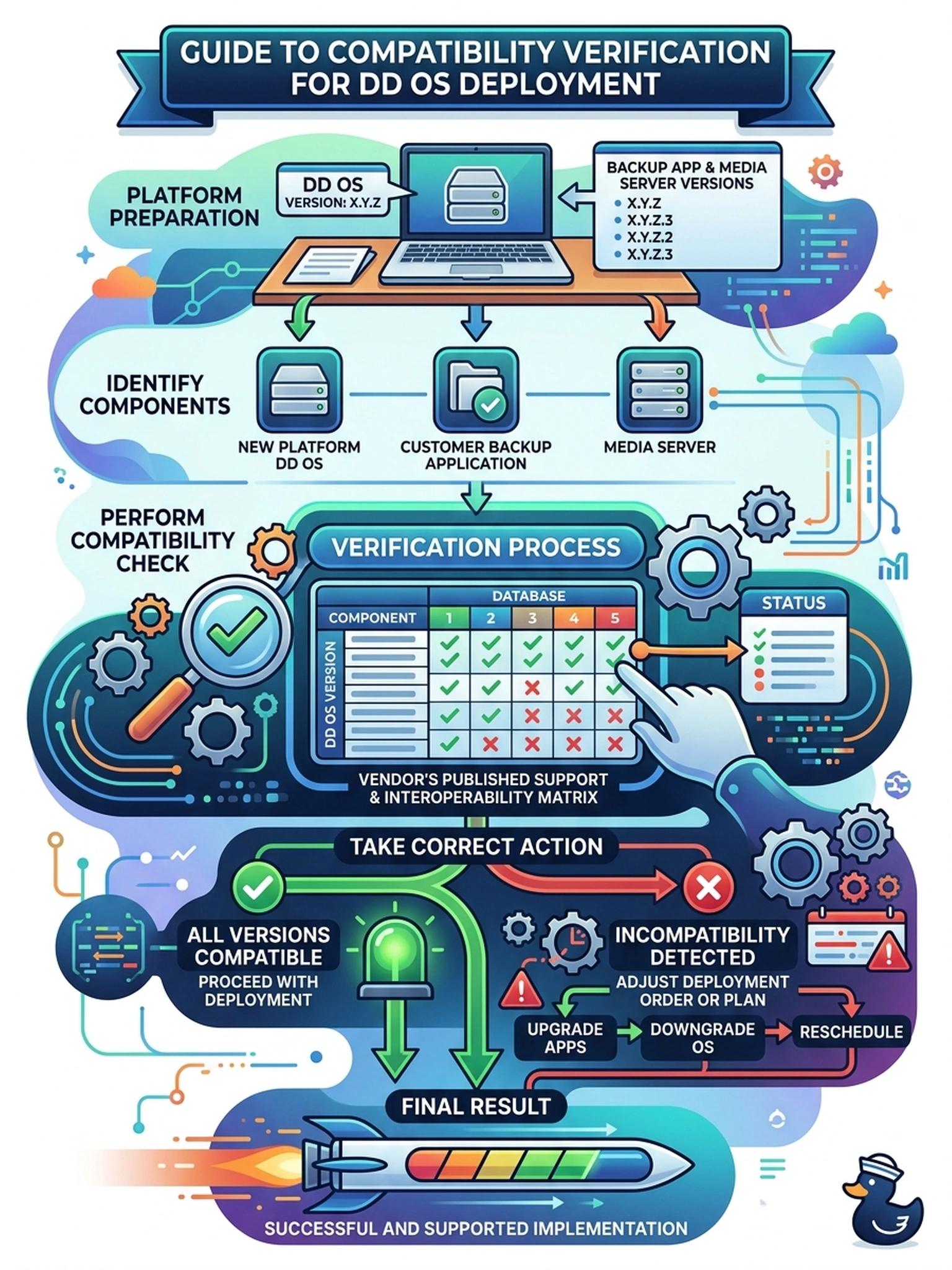
Think of the interoperability matrix like the owner's manual for a mixed-brand garage—just because two things physically bolt together doesn't mean the service desk will help you. You check the planned DD OS level against the published support matrix for every backup app in play, before you deploy, not after. Discovering a mismatch after the order lands is how deployments turn into paperwork marathons.
Full Explanation
Interoperability between DD OS and backup suites is a governed relationship: vendors publish support matrices, maintained through tools like the Enterprise Technology Labeling Vector documentation, stating which DD OS releases are supported with which backup application and media server versions. The pre-deployment task is to confirm the planned DD OS level against every component of the customer's suite—the core application, media servers, and the DD Boost or OpenStorage plug-ins—and to adjust the order, the planned DD OS, or the application level so the combination lands inside the matrix before deployment begins. Trusting a team lead's verbal assurance fails as a practice because the published matrix, not the current status quo, defines what is supported, and a running combination may itself be unsupported. Assuming indefinite backward compatibility fails because backup integrations depend on interfaces that change between releases, and older suites frequently lack the plug-ins a newer DD OS requires. Aligning major version numbers fails because no numbering relationship exists between the two product lines—the rule is invented. Exam caveat: the Boost or OpenStorage plug-in versions on media servers and proxies must be checked in the same pass as the core application. Operational check: capture the matrix rows for each component with the design documents and assign an owner to close any gap before the order ships.