In a standard GAN, what does the generator's loss typically represent during training?
Select an answer to reveal the explanation.
Short Explanation and Infographic
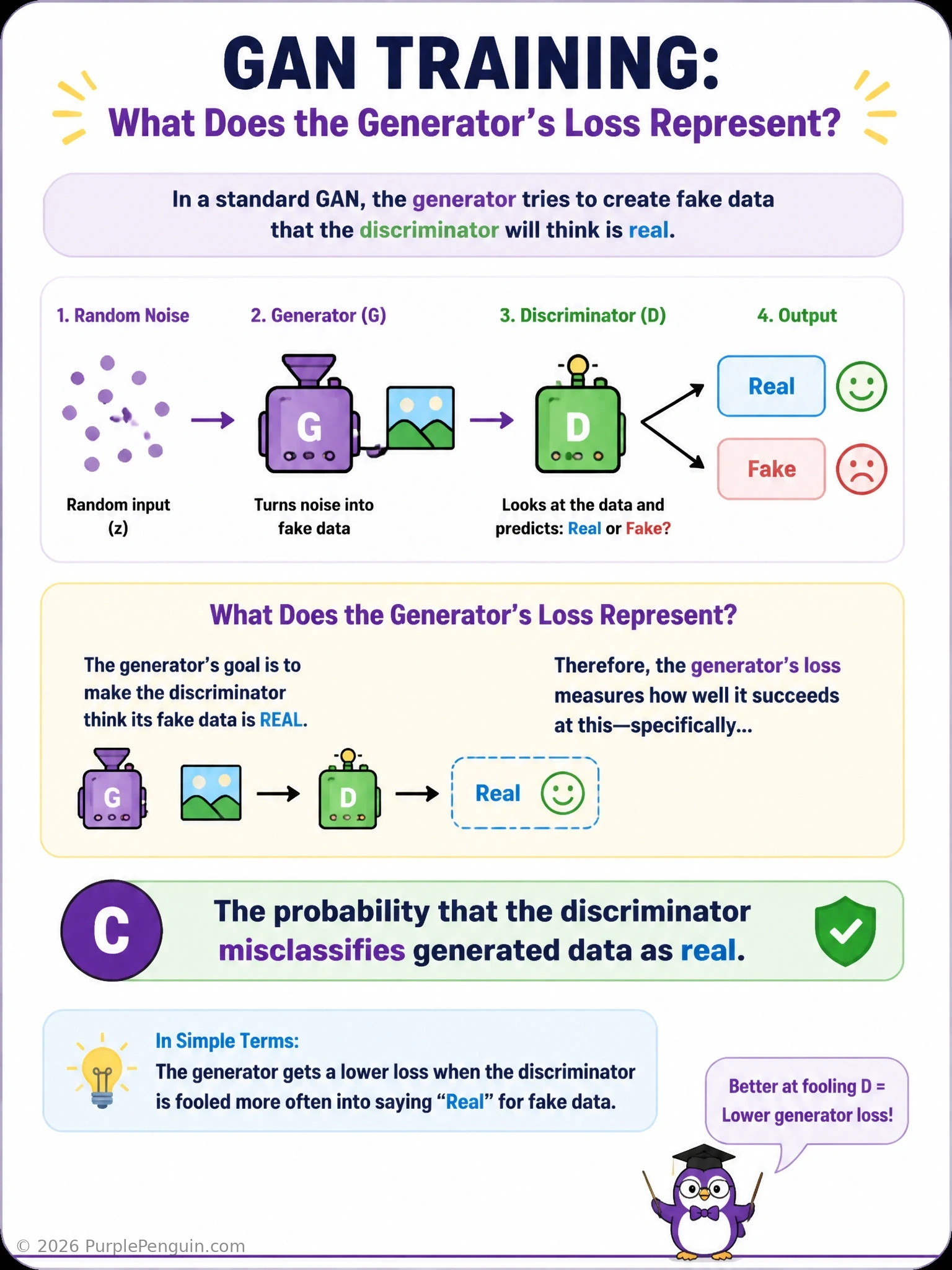
Remember, the generator never sees real data directly and isn't graded on pixel-by-pixel accuracy against some target image — it doesn't work like a regular autoencoder. Its whole job is to fool the discriminator. So its loss is built around one thing: how often the discriminator mistakes its fake output for real data. When the discriminator is easily catching the fakes, the generator's loss is high and it gets pushed to improve; when it's successfully fooling the discriminator, the loss drops. Pixel-wise reconstruction error is a supervised or autoencoder concept, not how GANs are trained — GANs don't require matching pixels to a ground truth. The epoch count is just a training-progress counter, not a loss. And the variance of the noise vector is a fixed input property you choose before training, not something the loss function measures.
Full explanation below image
Full Explanation
In the original GAN formulation (Goodfellow et al.), the generator and discriminator are trained via a minimax game defined by a value function. The discriminator is trained to maximize its ability to distinguish real samples from generator-produced (fake) samples, while the generator is trained to minimize the discriminator's ability to make that distinction — equivalently, to maximize the probability that the discriminator classifies its generated samples as real. In practice, the generator's loss is typically expressed as a function of the discriminator's output on generated samples: for example, in the non-saturating variant commonly used in practice, the generator loss is proportional to -log(D(G(z))), which decreases as D(G(z)) (the discriminator's estimated probability that a generated sample is real) increases toward 1. So the generator's loss is fundamentally tied to how successfully it is deceiving the discriminator, not to any direct comparison against real images. Pixel-wise reconstruction error describes a loss used in autoencoders, VAEs, or supervised image-to-image tasks (like L1/L2 loss against a ground-truth target), but standard GANs do not require paired real/fake image comparisons at the pixel level — indeed, part of the GAN's appeal is that it can learn to generate realistic data without needing an explicit per-pixel target to match, relying instead on the adversarial signal from the discriminator. The total number of training epochs completed is simply a training-loop counter or hyperparameter-tracking value, unrelated to any loss computation, and does not represent any function being optimized. The variance of the latent noise vector fed into the generator is typically a fixed, chosen property of the input distribution (commonly a standard normal or uniform distribution) set before training begins, not a quantity that the loss function measures or that changes as a result of generator training. Understanding that the generator loss is a function of the discriminator's classification confidence on fake samples is essential to understanding GAN training dynamics, including issues like vanishing gradients for the generator when the discriminator becomes too strong, which motivates variants like the non-saturating loss and Wasserstein GAN.