A team wants to augment their image training set by randomly flipping images horizontally during training, without writing custom flip logic from scratch. Which of these offers this built in?
Select an answer to reveal the explanation.
Short Explanation and Infographic
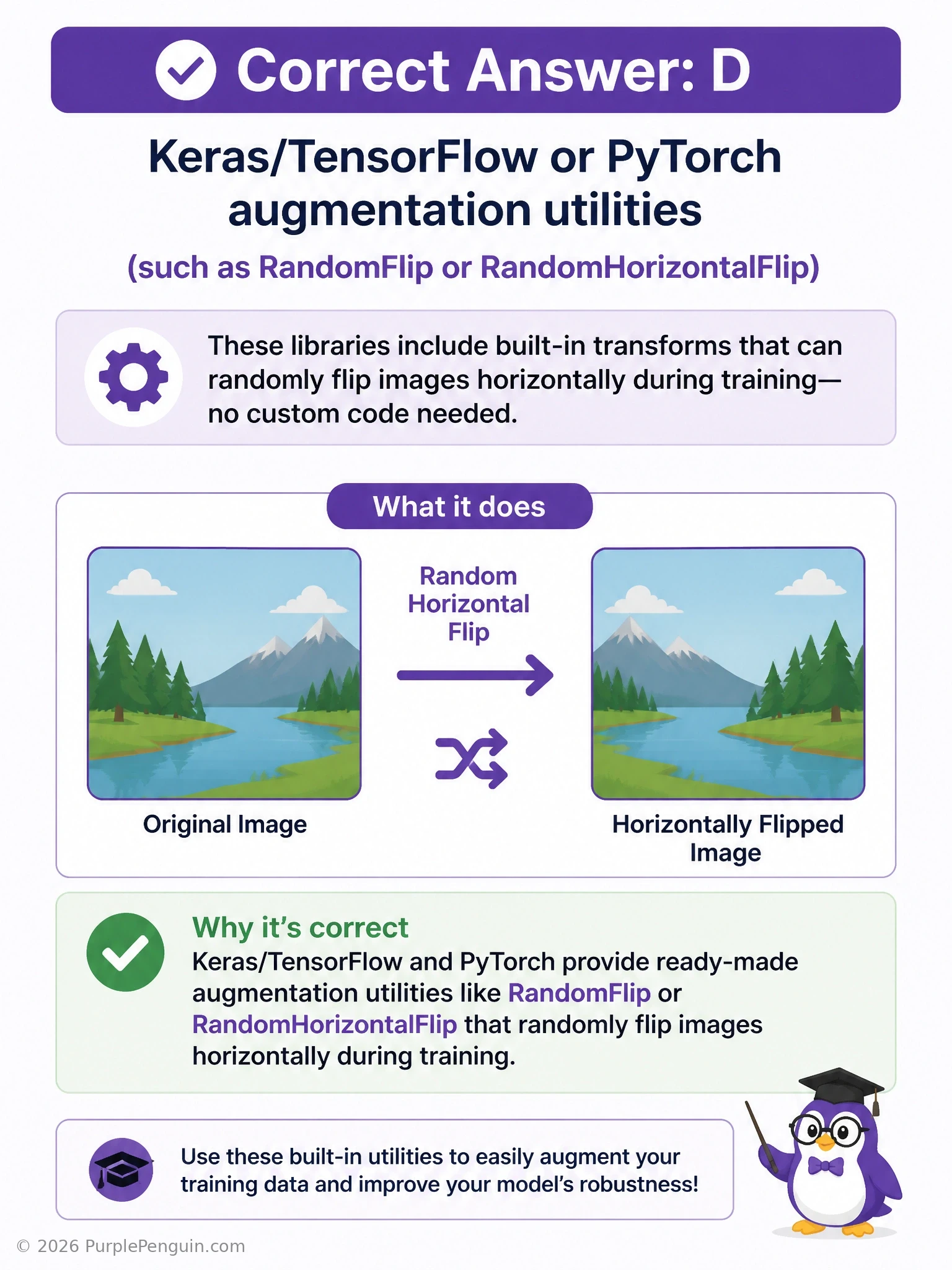
This is a solved problem — both major frameworks ship ready-made augmentation layers or transforms for exactly this. In Keras/TensorFlow you can drop a tf.keras.layers.RandomFlip('horizontal') right into your model or preprocessing pipeline. In PyTorch, torchvision.transforms.RandomHorizontalFlip() does the same thing as part of your transform pipeline. Either way, no custom flip code needed — you just plug in the built-in utility and it randomly flips images during training. So 'Keras/TensorFlow or PyTorch augmentation utilities' is correct. pickle is for saving/loading objects, nothing to do with image transforms. torch.optim contains optimizers like Adam and SGD that update weights — flipping images isn't an optimizer concern at all. And np.zeros just creates an array of zeros; it doesn't accept a 'flip flag' or do any image manipulation whatsoever.
Full explanation below image
Full Explanation
Both major deep learning frameworks provide built-in, ready-to-use utilities for common image augmentation operations, including horizontal (and vertical) flipping, without requiring developers to write custom pixel-manipulation code. In TensorFlow/Keras, this is available as a preprocessing layer, tf.keras.layers.RandomFlip('horizontal'), which can be inserted directly into a model or a separate preprocessing pipeline and will randomly flip a configurable fraction of images during training (while typically leaving evaluation/inference images unflipped, since augmentation is generally only applied during training). In PyTorch, the equivalent functionality is provided by torchvision.transforms.RandomHorizontalFlip(p=0.5), which is included as part of a transform pipeline applied to each image as it is loaded by a Dataset/DataLoader, randomly flipping images with a specified probability. Both approaches let practitioners apply flipping (and other augmentations like rotation, zoom, or color jitter) declaratively, without manually reimplementing the underlying array-reversal logic, and both integrate seamlessly into standard training pipelines. This kind of data augmentation increases the effective diversity of the training set, helping models generalize better and become more robust to variations they will encounter in real-world data (e.g., an object appearing mirrored from a different camera angle).
The pickle library is unrelated to image transformations; it exists purely to serialize (save) and deserialize (load) Python objects to and from byte streams, with no built-in capability for manipulating image pixel data such as flipping.
torch.optim is PyTorch's module containing optimization algorithms (such as SGD, Adam, and RMSprop) used to update a model's parameters based on computed gradients during training. It has no relationship whatsoever to image preprocessing or augmentation; optimizers operate on model weights, not on image data transformations.
NumPy's np.zeros function simply creates a new array filled with zeros of a specified shape; it accepts no 'flip' argument and has no built-in image manipulation capability. While one could, in principle, manually write flip logic using NumPy's array-slicing and reversal capabilities (such as array[:, ::-1] to reverse columns), np.zeros itself is unrelated to that task and does not provide any augmentation functionality out of the box.
Recognizing which library or module is responsible for which concern — data augmentation utilities for image transforms, optimizers for weight updates, pickle for generic object persistence, and NumPy for foundational array operations — is important for efficiently navigating a deep learning codebase and choosing the right built-in tool rather than reinventing functionality that already exists.