What is the main role that the NumPy library plays in a typical deep learning workflow?
Select an answer to reveal the explanation.
Short Explanation and Infographic
NumPy is the quiet foundation underneath most of the Python data science stack. Its core contribution is the ndarray — an efficient n-dimensional array — plus a huge library of vectorized numerical operations: linear algebra, statistics, random number generation, reshaping, broadcasting, all of it fast because it's implemented in optimized C under the hood rather than plain Python loops. Deep learning frameworks like PyTorch and TensorFlow even borrow heavily from NumPy's array conventions and interoperate with it directly. So 'n-dimensional array object and numerical tools' is correct. NumPy doesn't train neural networks on its own — no autograd, no built-in layers, no GPU acceleration; that's exactly what dedicated frameworks add on top. It doesn't host pretrained models either — that's the job of model hubs or the framework-specific model zoos. And it has nothing to do with installing GPU drivers or managing CUDA — that's a system-level concern, totally outside NumPy's scope.
Full explanation below image
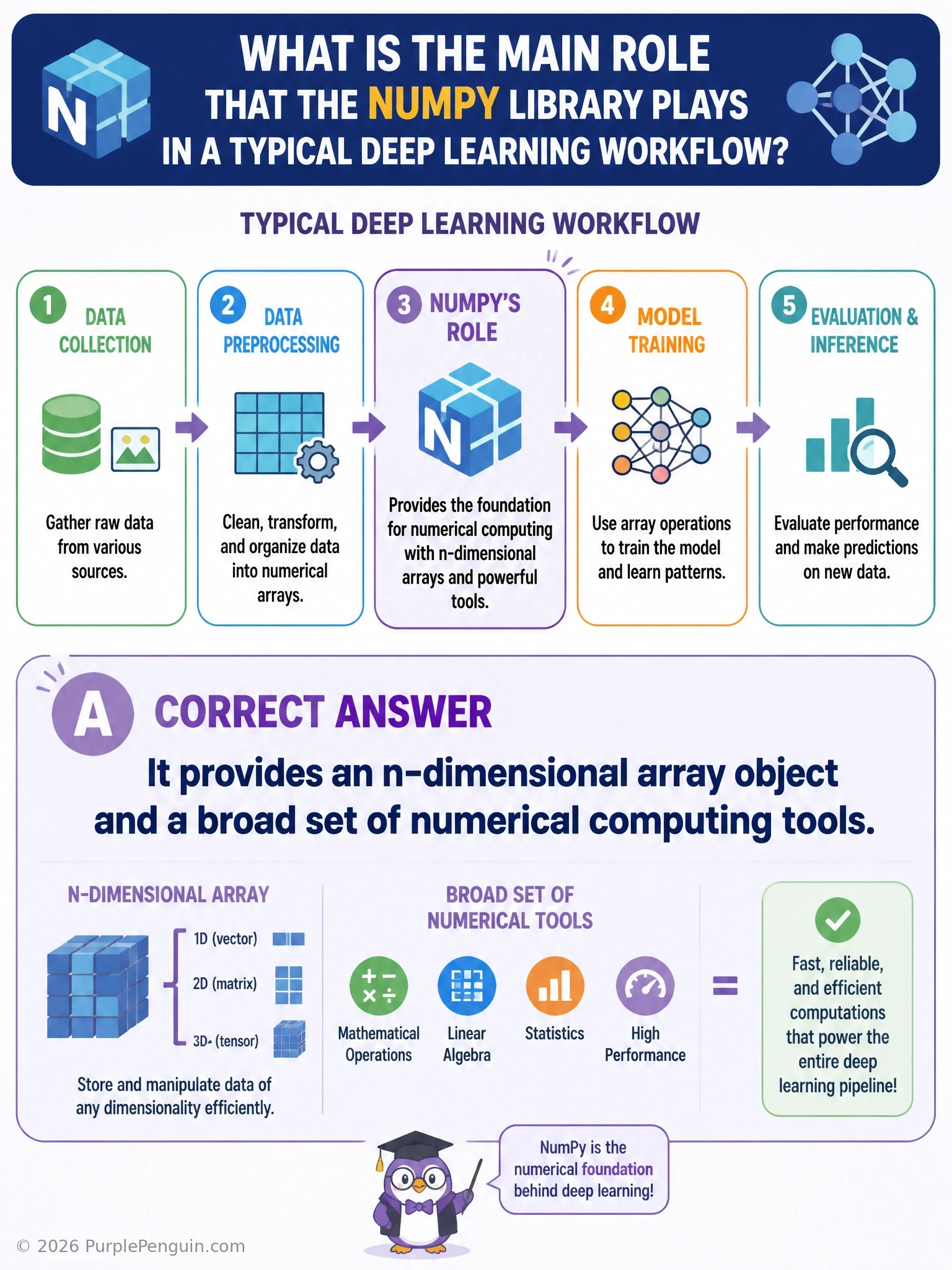
Full Explanation
NumPy (Numerical Python) is a foundational Python library whose central contribution is the ndarray, an efficient, homogeneous, n-dimensional array object, along with an extensive collection of functions for performing numerical operations on these arrays: element-wise arithmetic, linear algebra (matrix multiplication, dot products, matrix inversion), statistical functions (mean, standard deviation, sums along axes), random number generation, reshaping, slicing, and broadcasting (which allows operations between arrays of different but compatible shapes). These operations are implemented in optimized, compiled C code under the hood, making them dramatically faster than equivalent pure Python loops. In a deep learning workflow, NumPy is commonly used for tasks such as loading and preprocessing raw numeric data, performing quick exploratory computations, converting data between formats, and as a common interchange format, since many deep learning frameworks (including PyTorch's .numpy() conversion and TensorFlow's array interoperability) can convert their own tensor objects to and from NumPy arrays. NumPy's array and broadcasting conventions also directly influenced the design of tensor libraries in PyTorch and TensorFlow, making NumPy familiarity a practical prerequisite for working comfortably with either framework.
NumPy does not automatically train neural networks. It has no built-in support for defining neural network layers, no automatic differentiation (autograd) engine to compute gradients through arbitrary computational graphs, and no built-in optimizers; while it is technically possible to implement a simple neural network's math manually using NumPy arrays, this requires the developer to write the forward pass, the backward pass (gradient computations), and the optimization update all by hand — none of which NumPy provides automatically. This is precisely the gap that frameworks like PyTorch and TensorFlow fill.
NumPy does not host pretrained models. Repositories of pretrained models are provided by services and libraries such as Hugging Face Hub, TensorFlow Hub, or torchvision's model zoo, which are entirely separate ecosystems from NumPy.
NumPy also has no role in managing GPU drivers or CUDA installation; NumPy arrays live in CPU memory and NumPy's operations run on the CPU (with some interoperability via other libraries), whereas CUDA driver and toolkit management is a system-level, hardware-driver concern handled by NVIDIA's own installers and is unrelated to NumPy's scope as a numerical computing library.