Training crashes partway through with a CUDA out-of-memory warning. The team wants to resolve it quickly without redesigning the model architecture. What is the simplest effective fix?
Select an answer to reveal the explanation.
Short Explanation and Infographic
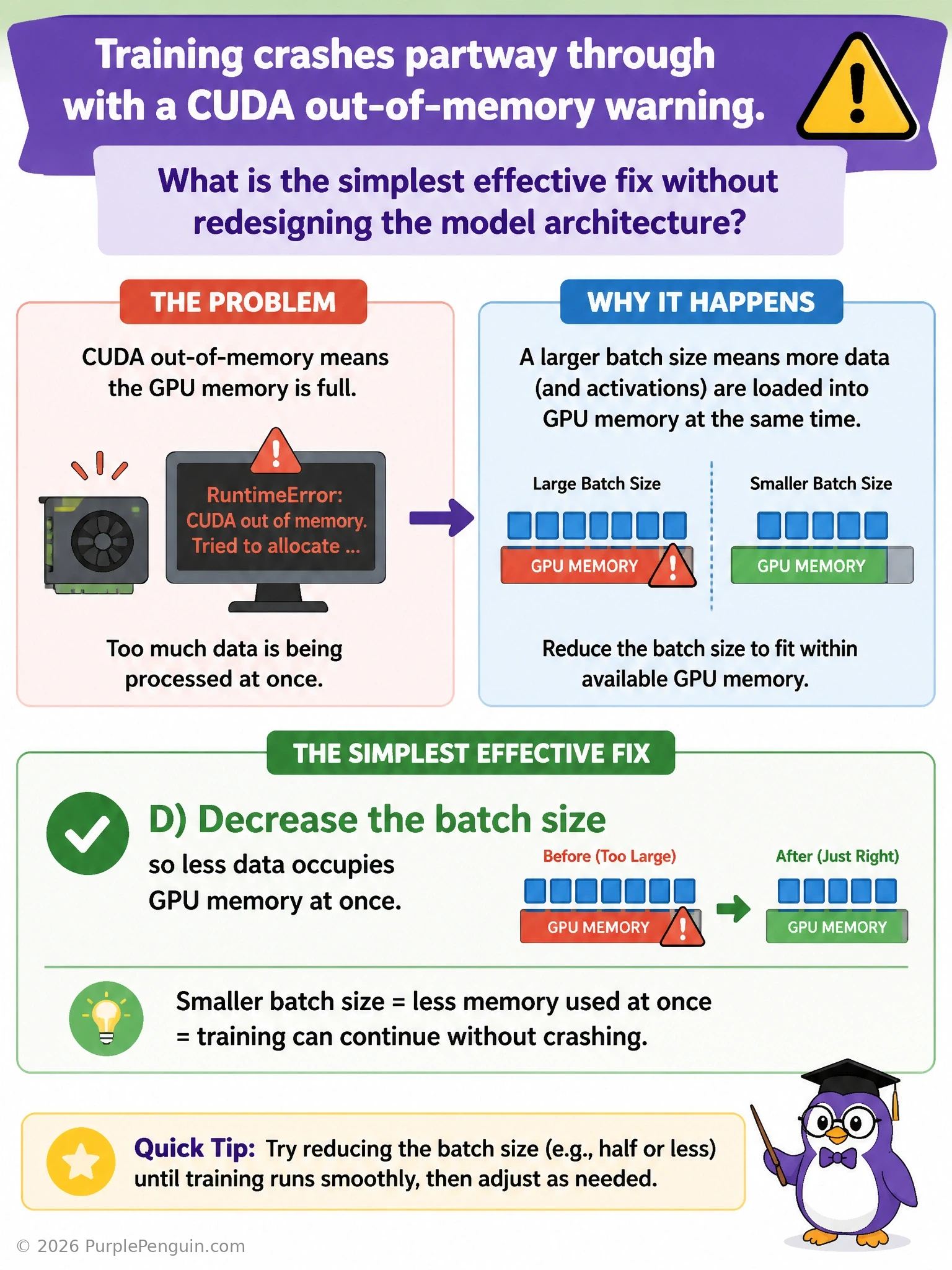
Out-of-memory errors on the GPU almost always trace back to one thing: you're trying to hold too much data and too many intermediate activations in memory at the same time, and batch size is the single biggest lever controlling that. Cut the batch size — say from 128 down to 32 — and you're loading and processing fewer samples per step, which directly shrinks the memory footprint of activations, gradients, and the batch data itself. That's why 'decrease the batch size' is the quick, no-architecture-change fix here. Increasing the batch size does the exact opposite — it needs more memory, not less, and would make the crash worse. Swapping loss functions barely touches memory usage; loss functions themselves are cheap regardless of which one you pick. And adding more layers is architectural surgery that would likely need MORE memory for extra activations, plus it directly violates the 'without redesigning the architecture' constraint.
Full explanation below image
Full Explanation
A CUDA out-of-memory (OOM) error indicates the GPU has run out of available memory to hold everything required for the current computation — the model's parameters, the input batch, the intermediate activations produced during the forward pass, and the gradients computed during the backward pass. Among the levers available to a practitioner without altering the architecture itself, batch size has the most direct and predictable impact on memory usage, because memory consumption for activations and gradients scales roughly linearly with the number of samples processed simultaneously. Reducing the batch size (for example, from 128 to 32, or using gradient accumulation to simulate a larger effective batch size across several smaller ones) directly reduces the amount of data and corresponding activations held in GPU memory at any one time, which is precisely the standard, fastest fix engineers reach for when an OOM error appears and architectural changes are undesirable or impractical in the short term.
Increasing the batch size would increase memory demand rather than reduce it, since more samples, more activations, and more gradient tensors would need to be held simultaneously, making an existing OOM situation worse, not better. This directly contradicts the goal of resolving the crash.
Switching to a different loss function has negligible effect on GPU memory usage in most cases. Loss functions typically operate on already-computed model outputs and labels, producing a small scalar or per-sample loss tensor; the computational and memory cost of nearly any standard loss function (MSE, cross-entropy, etc.) is tiny compared to the memory consumed by the model's activations and the batch's forward/backward computation graph, so this would not meaningfully address an OOM error.
Adding more convolutional layers, even ones intended to compress the input earlier, still requires storing the activations produced by each additional layer for use during backpropagation, which increases rather than decreases memory usage. This option also explicitly conflicts with the stated constraint of not redesigning the architecture, making it doubly unsuitable here.
Other valid but more involved fixes to OOM errors — such as using mixed-precision training, applying gradient checkpointing, or reducing image resolution — exist, but reducing batch size remains the fastest, simplest, most universally applicable first response, and is typically the first thing practitioners try before reaching for more complex solutions.