Which specific technique transforms a numeric feature so that it ends up with a mean of 0 and a standard deviation of 1?
Select an answer to reveal the explanation.
Short Explanation and Infographic
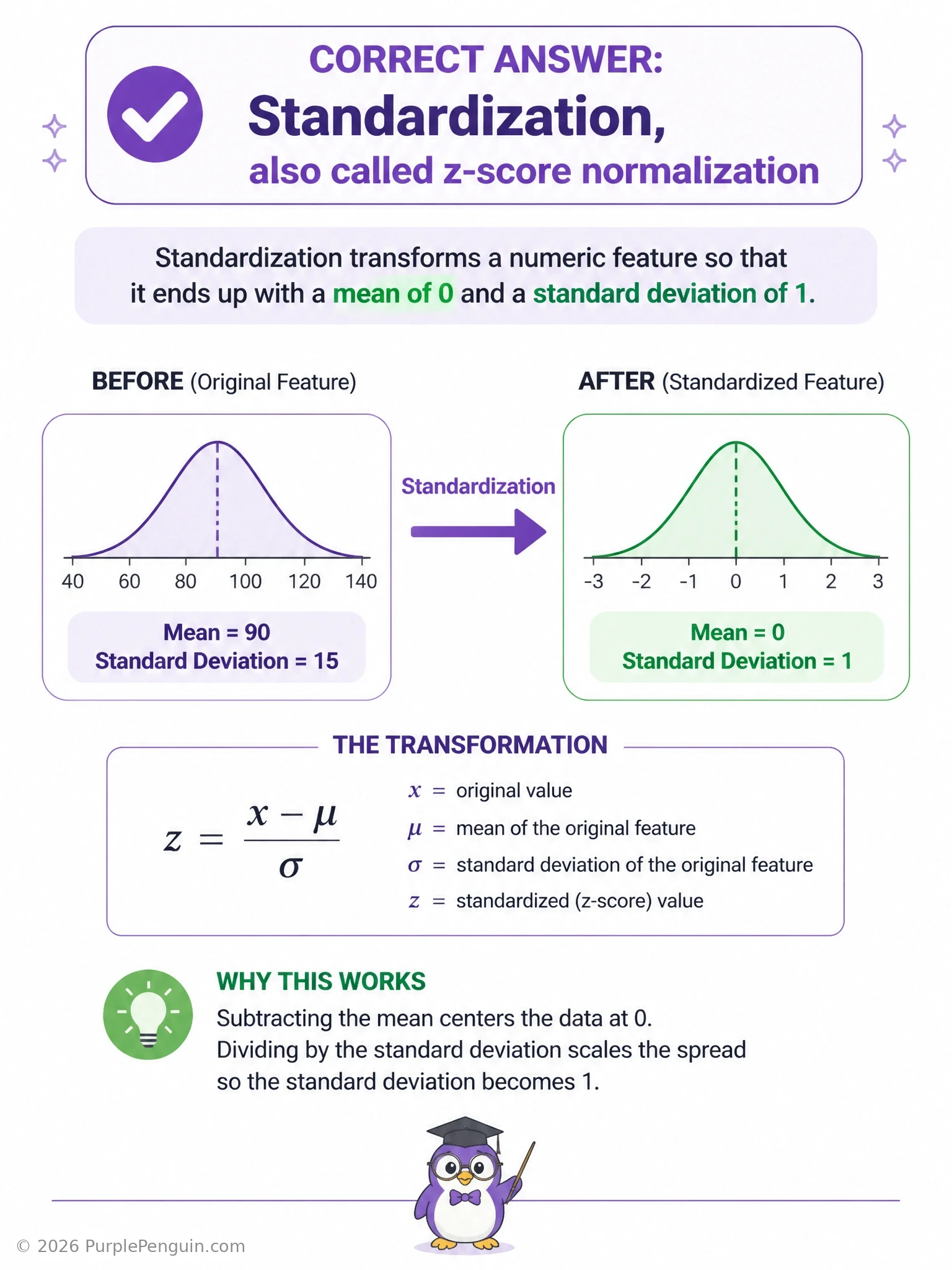
This is the z-score move: standardization. You subtract the mean of the feature from every value, then divide by the standard deviation, and what pops out the other end is a feature centered at 0 with a spread of exactly 1 standard deviation. That formula is specifically built to hit those two properties — mean 0, standard deviation 1 — so standardization (z-score normalization) is the right answer. Min-max normalization instead squeezes values into a fixed range like [0,1], with no guaranteed mean or standard deviation — different formula, different target. Label encoding assigns integers to categories and has nothing to do with numeric scaling at all. And data augmentation is about creating more, varied training examples through transformations like flips or rotations — a completely different problem from feature scaling.
Full explanation below image
Full Explanation
Standardization, also known as z-score normalization, is the technique that transforms a numeric feature so that its resulting values have a mean of 0 and a standard deviation of 1. It is computed using the formula z = (x - mu) / sigma, where mu is the mean and sigma is the standard deviation of the feature (typically computed from the training set and then applied consistently to validation and test data). This transformation centers the data around zero and scales it according to its own natural variability, which is particularly useful for algorithms sensitive to feature scale, including neural networks trained via gradient descent, since it helps produce a better-conditioned loss surface and can speed up and stabilize convergence.
Min-max normalization is a different scaling technique that rescales a feature into a fixed, bounded range, most commonly [0, 1], using the formula (x - min) / (max - min). While it also addresses scale, it does not guarantee any particular mean or standard deviation for the resulting distribution, and it is sensitive to outliers, since a single extreme value can compress the rest of the data into a narrow sub-range.
Label encoding is a categorical encoding technique that assigns each distinct category an integer value. It is unrelated to numeric feature scaling and is typically reserved for categorical variables, ideally ones with a meaningful order, since it can otherwise introduce a false sense of numeric relationship between categories.
Data augmentation refers to techniques that create additional, modified copies of training examples (such as flipping, rotating, or cropping images, or adding noise) to increase the size and diversity of a training dataset. This addresses data quantity and diversity, not feature scale, and operates on entire samples (often images or sequences) rather than transforming the numeric distribution of a single feature.
Memory aid: standardization targets mean 0 and standard deviation 1 (the 'z-score' shape), while normalization (min-max) targets a fixed bounded range like [0, 1]. Reaching for the wrong one is a very common mix-up, so tying each technique to its target property — mean/std versus min/max range — is a reliable way to keep them straight.