In PyTorch, what is the primary role of the torch.optim module?
Select an answer to reveal the explanation.
Short Explanation and Infographic
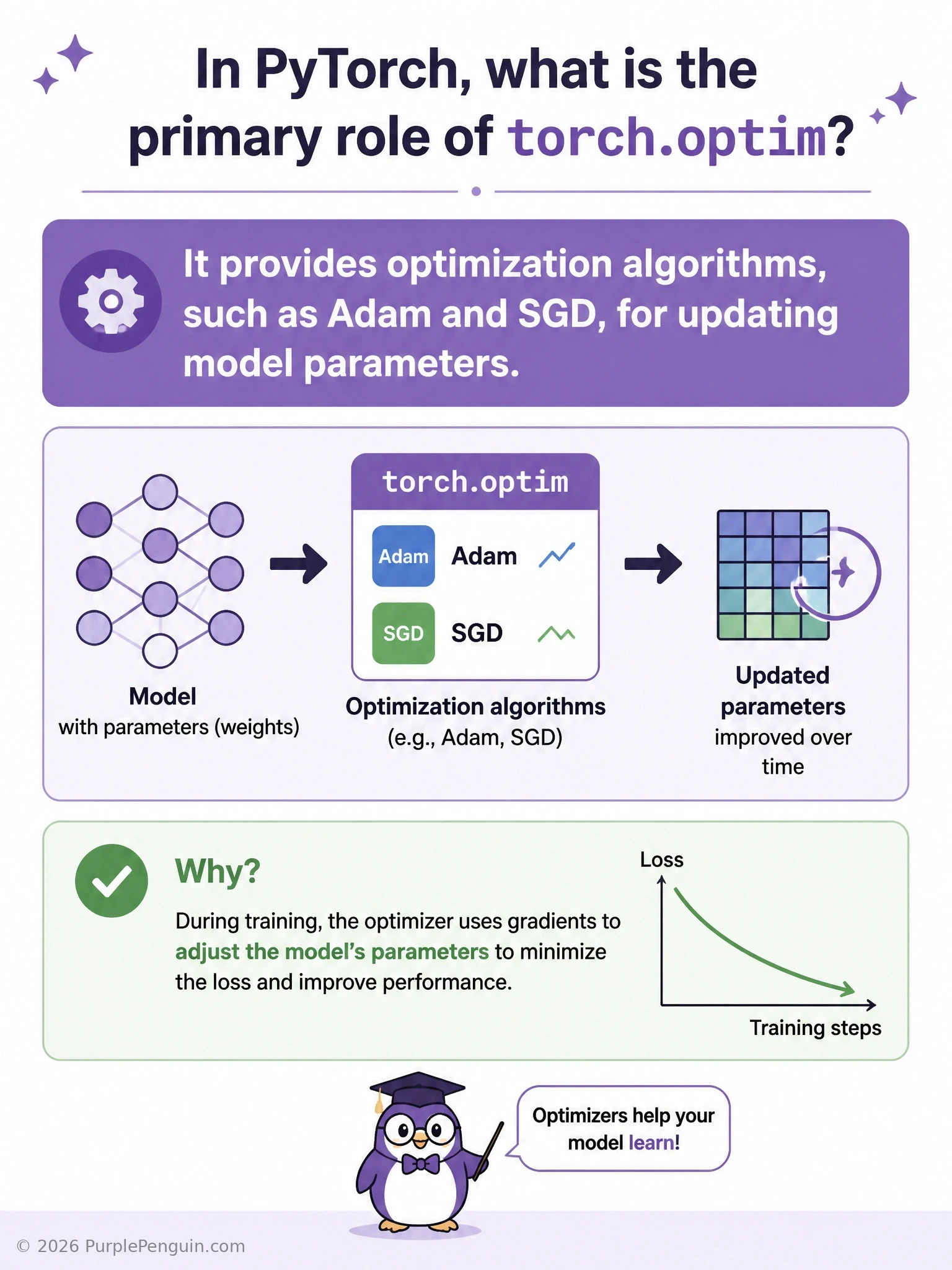
Here's the deal: torch.optim is PyTorch's toolbox of optimization algorithms — Adam, SGD, RMSprop, and friends. You hand it your model's parameters and a learning rate, and it handles the actual math of updating weights based on the gradients that backward() computed. So the right answer is that it provides those optimization algorithms. It's not defining layers — that's torch.nn. It's not loading data — that's torch.utils.data and DataLoader. And it's not computing loss — that's your loss function, like nn.CrossEntropyLoss, living in torch.nn too. Keep these three straight in your head: nn builds the network, autograd computes gradients, and optim uses those gradients to actually move the weights. Mix them up on the exam and you'll second-guess yourself on easy questions.
Full explanation below image
Full Explanation
The torch.optim module in PyTorch implements optimization algorithms used to update a model's learnable parameters based on gradients computed during backpropagation. Classes such as torch.optim.SGD, torch.optim.Adam, and torch.optim.RMSprop each implement a specific update rule; you instantiate one by passing it the model's parameters (via model.parameters()) and hyperparameters like the learning rate. During training, calling optimizer.step() applies the parameter update using gradients stored in each parameter's .grad attribute, and optimizer.zero_grad() clears those gradients before the next backward pass. This makes torch.optim correct.
The first distractor confuses optimization with model definition. Layer classes such as nn.Linear, nn.Conv2d, and nn.LSTM live in torch.nn, which defines the architecture and its trainable parameters — but torch.nn does not decide how those parameters get updated; it only exposes them for optimization.
The second distractor describes data handling, which is the job of torch.utils.data, particularly the Dataset and DataLoader classes. These wrap raw data and yield mini-batches for training, but they have no role in adjusting weights.
The third distractor describes loss computation, which is handled by loss functions such as nn.CrossEntropyLoss or nn.MSELoss (also under torch.nn, or torch.nn.functional). The loss quantifies how wrong the model's predictions are and is the starting point for backpropagation via loss.backward(), but it is a measurement, not an optimization step.
Understanding this separation of concerns — nn for architecture, autograd/loss for measuring error and computing gradients, and optim for applying updates — is core to reading and debugging any PyTorch training loop, and it's a common early exam distinction between framework components.