A team wants a regression metric that punishes large prediction errors much more severely than small ones. Which metric fits that requirement?
Select an answer to reveal the explanation.
Short Explanation and Infographic
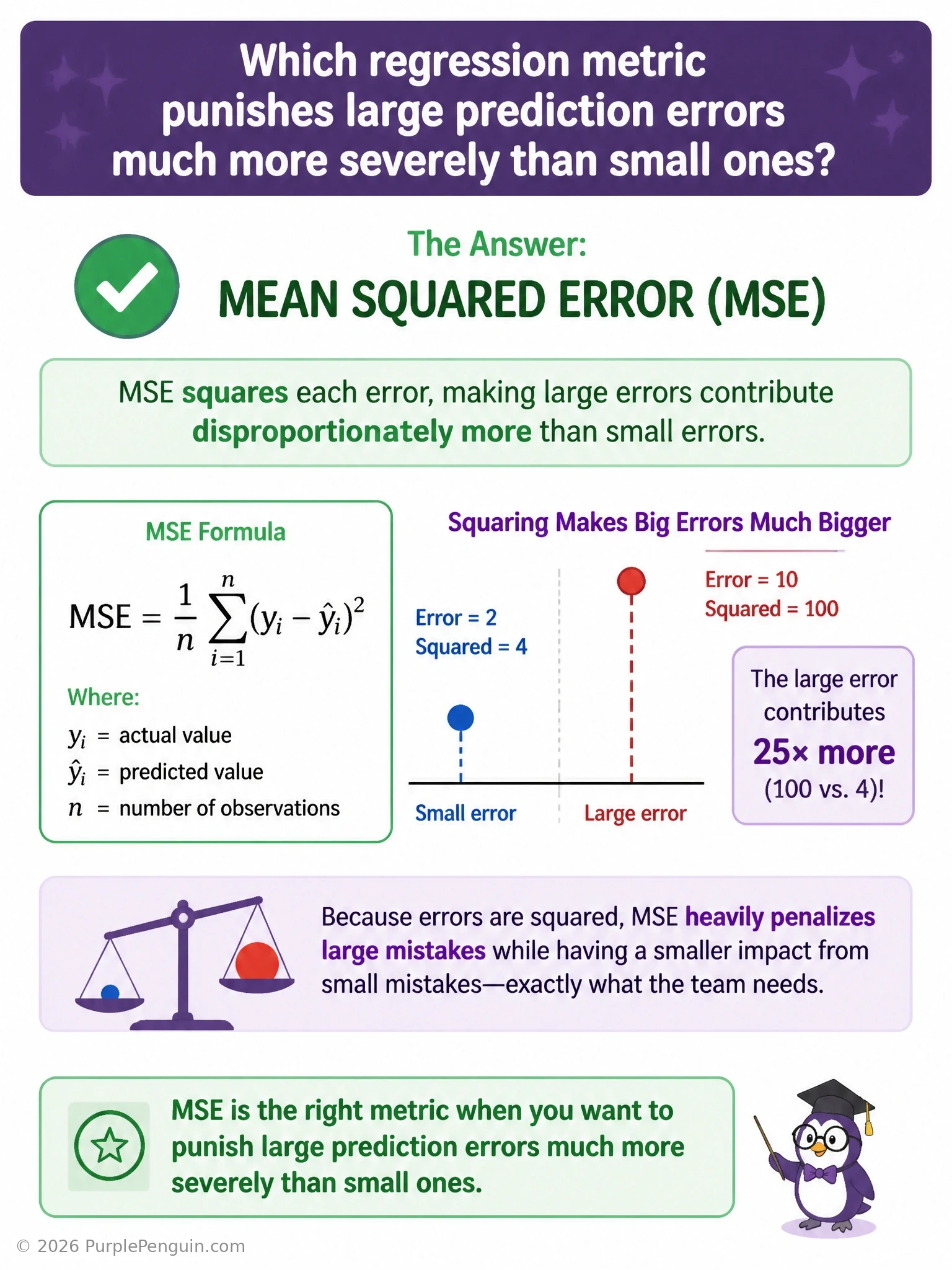
If you want a metric that comes down hard on big mistakes, mean squared error, or MSE, is your answer. Because it squares each error before averaging, a small error like 2 contributes just 4, but a large error like 20 contributes 400 — ten times the error but a hundred times the penalty. That squaring is exactly what makes MSE disproportionately sensitive to large errors. That's answer D. Mean absolute error is the fair, straightforward one — it weights every error proportional to its size, with no extra punishment for bigger mistakes, so it's the wrong choice here. R-squared isn't measuring error magnitude directly, it's about proportion of variance explained. And precision is a classification metric entirely, about correctness of positive predictions, unrelated to numeric distance in regression.
Full explanation below image
Full Explanation
Mean squared error (MSE) is calculated by taking the difference between each predicted value and its corresponding true value, squaring that difference, and then averaging the squared differences across all examples. The squaring operation is the key mechanism that makes MSE disproportionately punish large errors relative to small ones: because error magnitude is squared before averaging, an error twice as large contributes four times as much to the total, and an error ten times as large contributes one hundred times as much. This means a model with a few very large errors will receive a much higher (worse) MSE than a model whose errors are all small and evenly distributed, even if both models have the same average absolute error, making MSE especially sensitive to outliers.
The first distractor, mean absolute error (MAE), averages the absolute value of each error without squaring, so it scales linearly with error size: a 20-unit error contributes exactly twice as much as a 10-unit error, never disproportionately more. MAE is therefore considered more robust to outliers precisely because it does not amplify large errors the way MSE does, making it the wrong choice when the explicit goal is to penalize large errors more heavily. The second distractor, R-squared, measures the proportion of variance in the target variable explained by the model relative to simply predicting the mean; it is a normalized, unitless goodness-of-fit measure, not a direct measurement of individual error magnitudes, and it does not have any mechanism for weighting large versus small errors differently. The third distractor, precision, is a classification metric defined as true positives divided by (true positives plus false positives); it has no defined meaning in a regression context involving continuous numeric predictions and true values, and is unrelated to measuring the distance between a predicted number and an actual number.
A useful memory aid: 'squared' in mean squared error is the tell — squaring is what stretches the penalty for large deviations compared to small ones, which is why MSE (and its square-rooted cousin, RMSE, used to bring the units back to the original scale) is the standard choice whenever a task specifically needs to discourage large, potentially costly prediction errors, such as in applications where a single very wrong prediction is far more damaging than several mildly wrong ones.