A team is training a very deep neural network with dozens of layers and wants an optimizer that handles this scale well. Why is Adam typically recommended for this kind of architecture?
Select an answer to reveal the explanation.
Short Explanation and Infographic
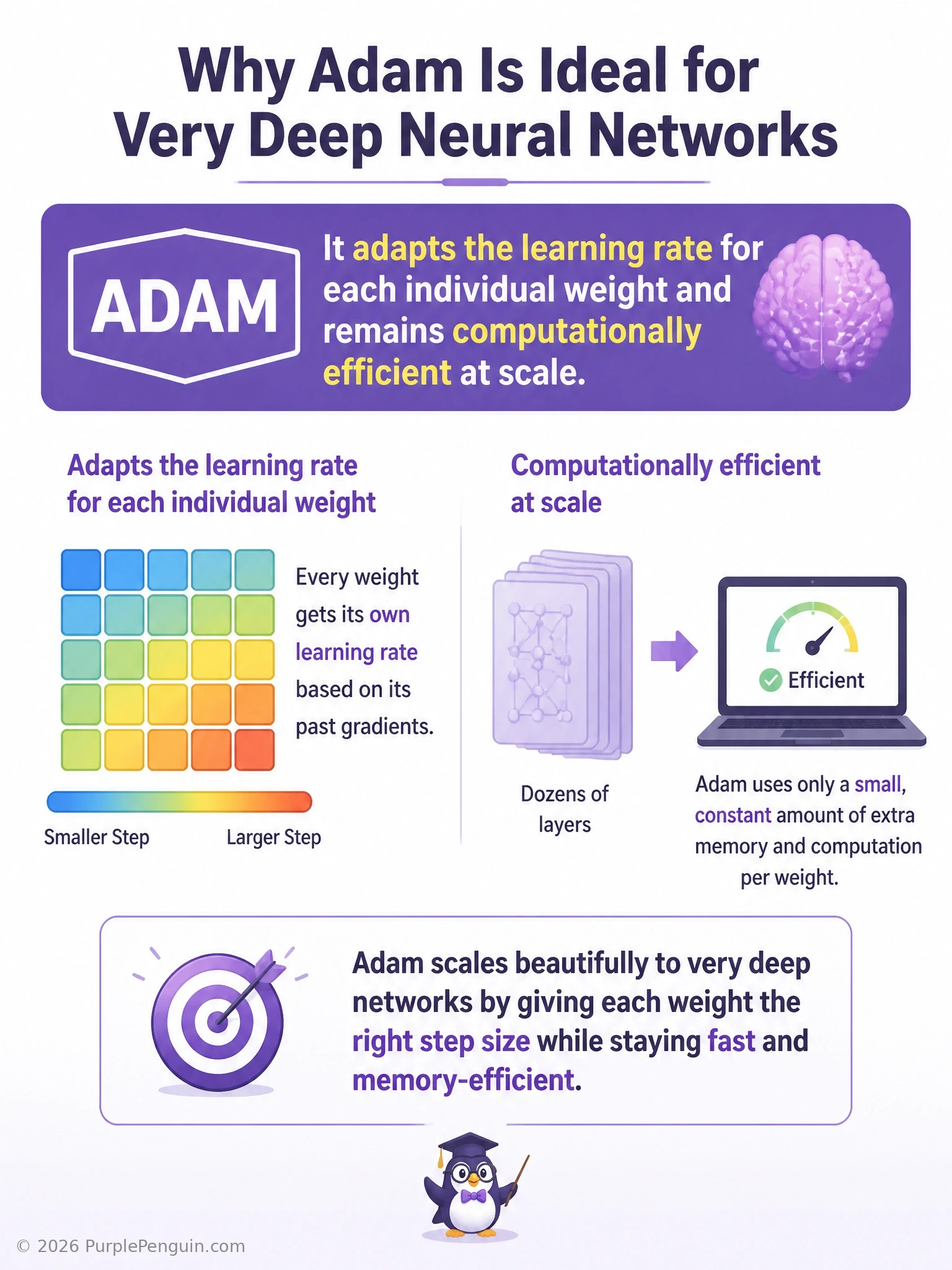
Very deep networks have a lot of weights spread across many layers, and different layers often need different step sizes to train well. Adam is well-suited here because it automatically adapts the learning rate for each individual parameter based on that parameter's own gradient history, so you're not stuck hand-tuning per-layer rates, and it stays computationally efficient even as parameter counts balloon into the millions. That's answer C. It doesn't magically eliminate vanishing gradients — that's a structural problem tackled with residual connections, better activations, or normalization, not just swapping optimizers. It doesn't require manual per-layer tuning either — that's the opposite of the point. And no optimizer, Adam included, guarantees a lower final loss than every alternative on every architecture — that depends on the problem, data, and tuning.
Full explanation below image
Full Explanation
Adam is frequently recommended as a strong default optimizer for very deep neural networks because it maintains an adaptive, per-parameter learning rate derived from decaying moving averages of both the raw gradients (first moment) and the squared gradients (second moment). In architectures with dozens or hundreds of layers and millions of parameters, different weights, especially those in different layers, can experience very different gradient magnitudes and scales during training; a single global learning rate applied uniformly, as in plain SGD, often struggles to serve all of these parameters well simultaneously. Adam's per-parameter adaptivity lets each weight effectively receive an appropriately scaled update based on its own recent gradient behavior, which tends to produce faster, more stable convergence across very deep networks without requiring exhaustive manual tuning of learning rates for different parts of the model. Adam is also computationally efficient, requiring only modest additional memory to store the two moving-average vectors per parameter, making it practical even as parameter counts scale into the millions or billions.
The first distractor is incorrect because Adam does not structurally eliminate the vanishing gradient problem; vanishing gradients arise primarily from how gradients are propagated backward through many layers, particularly with certain activation functions or without normalization/skip connections, and are typically addressed through architectural choices like ReLU-family activations, batch or layer normalization, and residual (skip) connections, not simply by choosing a particular optimizer. The second distractor is incorrect and inverts Adam's actual benefit: rather than requiring the practitioner to manually specify a distinct learning rate for every layer, Adam's core appeal is that it automatically adapts per-parameter rates from gradient statistics, substantially reducing the manual tuning burden compared to approaches that would otherwise require such fine-grained manual configuration. The fourth distractor is incorrect because no optimizer, including Adam, can be guaranteed to produce a lower final training loss than every other optimizer across all architectures and datasets; empirical performance depends on the specific problem, data characteristics, hyperparameter choices, and architecture, and other optimizers or well-tuned SGD variants sometimes outperform Adam in particular settings, especially on generalization to unseen data in certain tasks.
The underlying principle worth remembering is that Adam's popularity in large, deep architectures stems from a practical combination of adaptivity (per-parameter learning rates informed by gradient history) and efficiency (low memory and compute overhead relative to the benefit gained), not from any claim of solving all training pathologies or outperforming every alternative unconditionally.