A fraud-detection model shows high precision but low recall on the test set. What does this combination actually indicate about its behavior?
Select an answer to reveal the explanation.
Short Explanation and Infographic
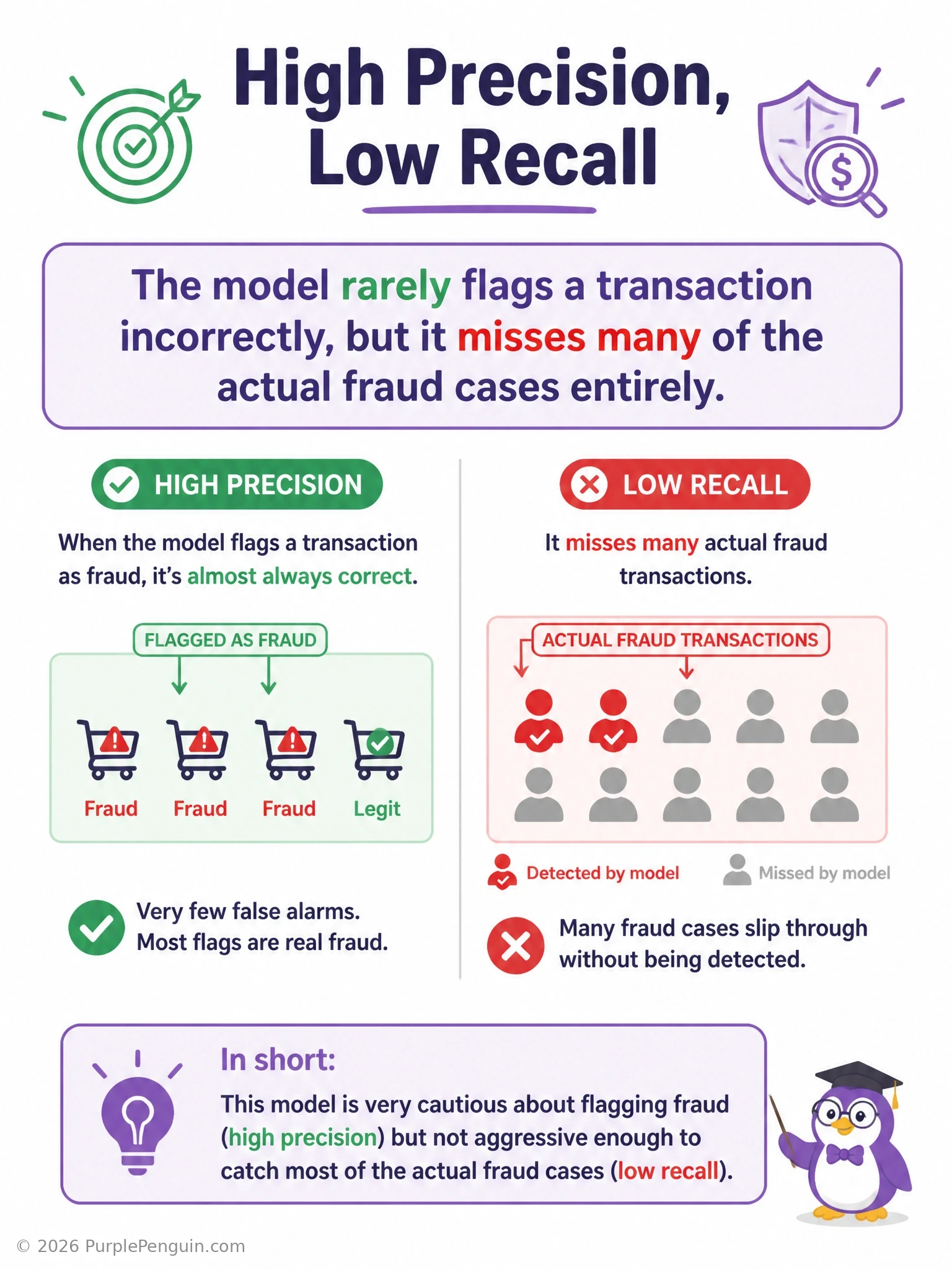
Here's the deal: precision asks 'when the model says fraud, how often is it right?' and recall asks 'of all the real fraud out there, how much did it actually catch?' High precision, low recall means the model is cautious — when it flags fraud it's usually correct, but it's also letting a lot of real fraud slip through undetected. That's answer A. Option two flips it — that's high recall, low precision, casting a wide net and crying wolf a lot. Option three is wrong because this is a lopsided error pattern, not a balanced one. And option four is wrong too — precision and recall don't dictate overall accuracy, especially on imbalanced data like fraud, where accuracy can look great even with terrible recall since most transactions are legitimate anyway.
Full explanation below image
Full Explanation
Precision is defined as true positives divided by (true positives plus false positives), measuring how trustworthy a positive prediction is: of everything the model labeled as fraud, what fraction was genuinely fraud. Recall (also called sensitivity or true positive rate) is defined as true positives divided by (true positives plus false negatives), measuring how completely the model finds the actual positive cases: of all the real fraud that exists, what fraction did the model successfully identify. A model with high precision but low recall is conservative in its positive predictions: it flags relatively few transactions as fraud, but the ones it does flag are almost always genuine fraud (few false positives), while simultaneously failing to flag a large share of the actual fraud cases, letting them pass through as false negatives.
The second answer choice describes the inverse situation, high recall combined with low precision, where the model aggressively flags many transactions as fraud, successfully catching most true fraud cases, but at the cost of also misclassifying many legitimate transactions as fraudulent, producing numerous false positives; this is the opposite tradeoff from what high-precision, low-recall describes. The third answer choice is incorrect because high precision paired with low recall is by definition an asymmetric error pattern, heavily skewed toward false negatives (missed fraud) rather than false positives (false alarms), not an unbiased 50/50 error distribution. The fourth answer choice is incorrect because precision and recall values do not mechanically determine overall accuracy; on a highly imbalanced dataset such as fraud detection, where legitimate transactions vastly outnumber fraudulent ones, a model could have low recall (missing most fraud) yet still post very high overall accuracy simply because it correctly labels the overwhelming majority of legitimate transactions as legitimate, illustrating exactly why accuracy alone is a poor metric for imbalanced classification problems.
The underlying principle is the precision-recall tradeoff: tightening a model's decision threshold to only flag cases it is highly confident about raises precision but tends to lower recall, since fewer borderline true positives get flagged, while loosening the threshold raises recall but tends to lower precision, since more false alarms get included. A helpful memory aid is that precision is about the purity of positive predictions, while recall is about the completeness of positive detection, and metrics like the F1 score exist specifically to balance both when neither alone tells the full story.