In a binary classification confusion matrix, what does a true negative represent?
Select an answer to reveal the explanation.
Short Explanation and Infographic
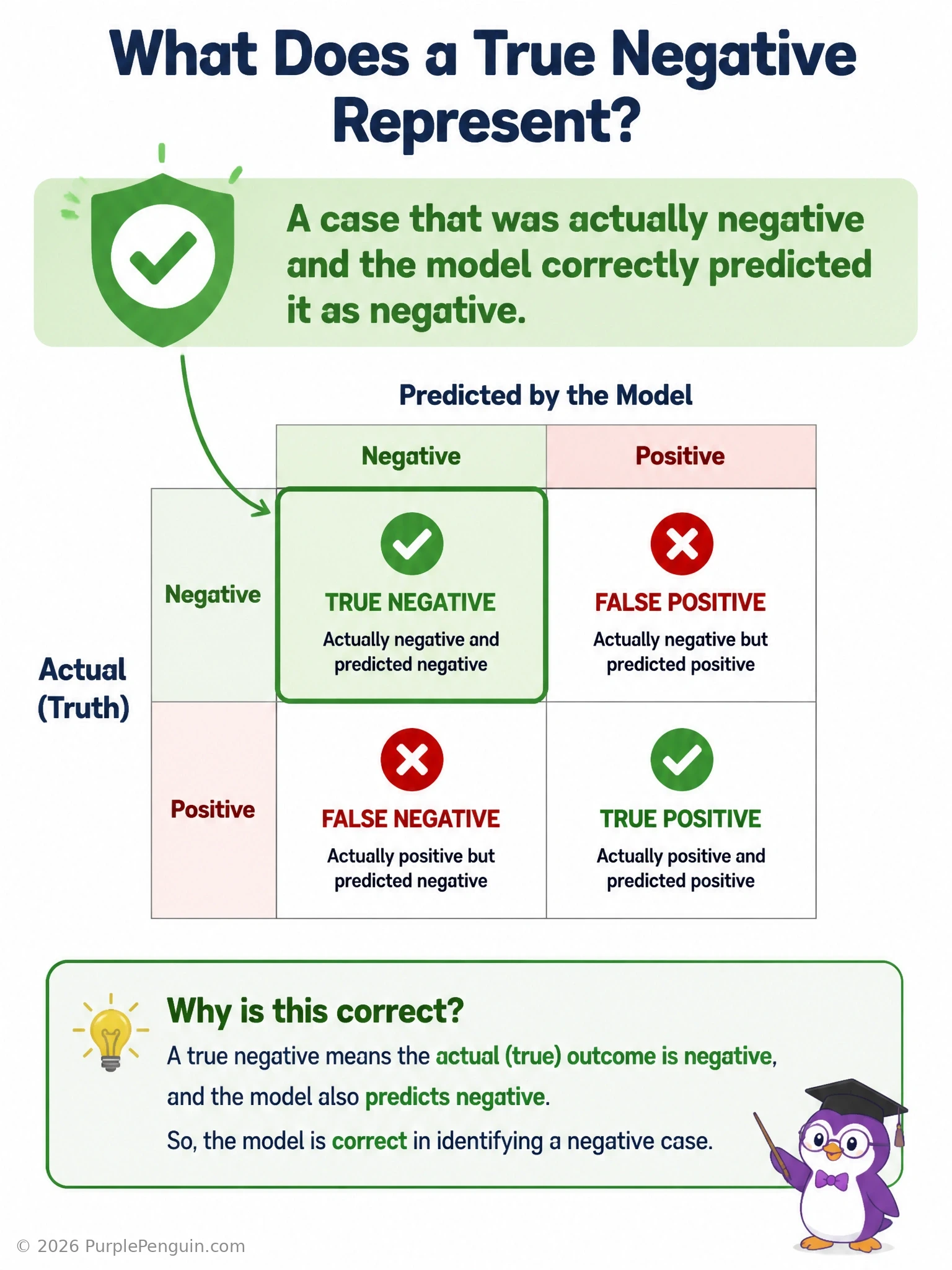
Let's untangle these four confusion-matrix terms, since people mix them up constantly. A true negative is the boring, correct case on the negative side: the actual label was negative, and the model said negative too. Nothing went wrong, just a correct call. That's answer A. A case that's actually positive but predicted negative is a false negative — a miss, a real positive slipped through undetected. A case that's actually negative but predicted positive is a false positive — a false alarm on something actually fine. And a case that's actually positive and correctly predicted positive is a true positive, the mirror image of true negative. Keep 'true' meaning the prediction was right and 'false' meaning it was wrong, and the rest follows.
Full explanation below image
Full Explanation
In binary classification, every prediction falls into exactly one of four categories based on two factors: whether the actual (ground truth) label was positive or negative, and whether the model's prediction was positive or negative. A true negative occurs when the actual label is negative and the model also predicts negative, meaning the model correctly identified an example that truly did not belong to the positive class. True negatives, along with true positives, make up the correct predictions counted in the numerator of the accuracy formula, and they appear on the main diagonal of a binary confusion matrix alongside true positives.
A case that was actually positive but predicted as negative is a false negative, not a true negative; this represents a missed detection, where the model failed to catch a genuinely positive case, which is the type of error that matters most in scenarios like missed disease diagnoses or missed fraud, and it directly reduces recall. A case that was actually negative but predicted as positive is a false positive, the opposite kind of error, representing a false alarm where the model incorrectly flagged something that was actually fine; this type of error directly reduces precision. A case that was actually positive and correctly predicted as positive is a true positive, the positive-class counterpart to a true negative — both are correct predictions, but they concern opposite classes, so confusing the two would misrepresent which class the model is correctly handling.
A simple way to keep all four terms straight is to read each name as two separate words: the second word (positive or negative) tells you what the model predicted, and the first word (true or false) tells you whether that prediction matched reality. True negative, then, decodes directly to 'the model predicted negative, and that prediction was true (correct).' This decomposition also underlies every derived metric — precision, recall, specificity, and F1 score are all just different ratios built from these four fundamental counts.