What is the main goal of hyperparameter tuning in a deep learning workflow?
Select an answer to reveal the explanation.
Short Explanation and Infographic
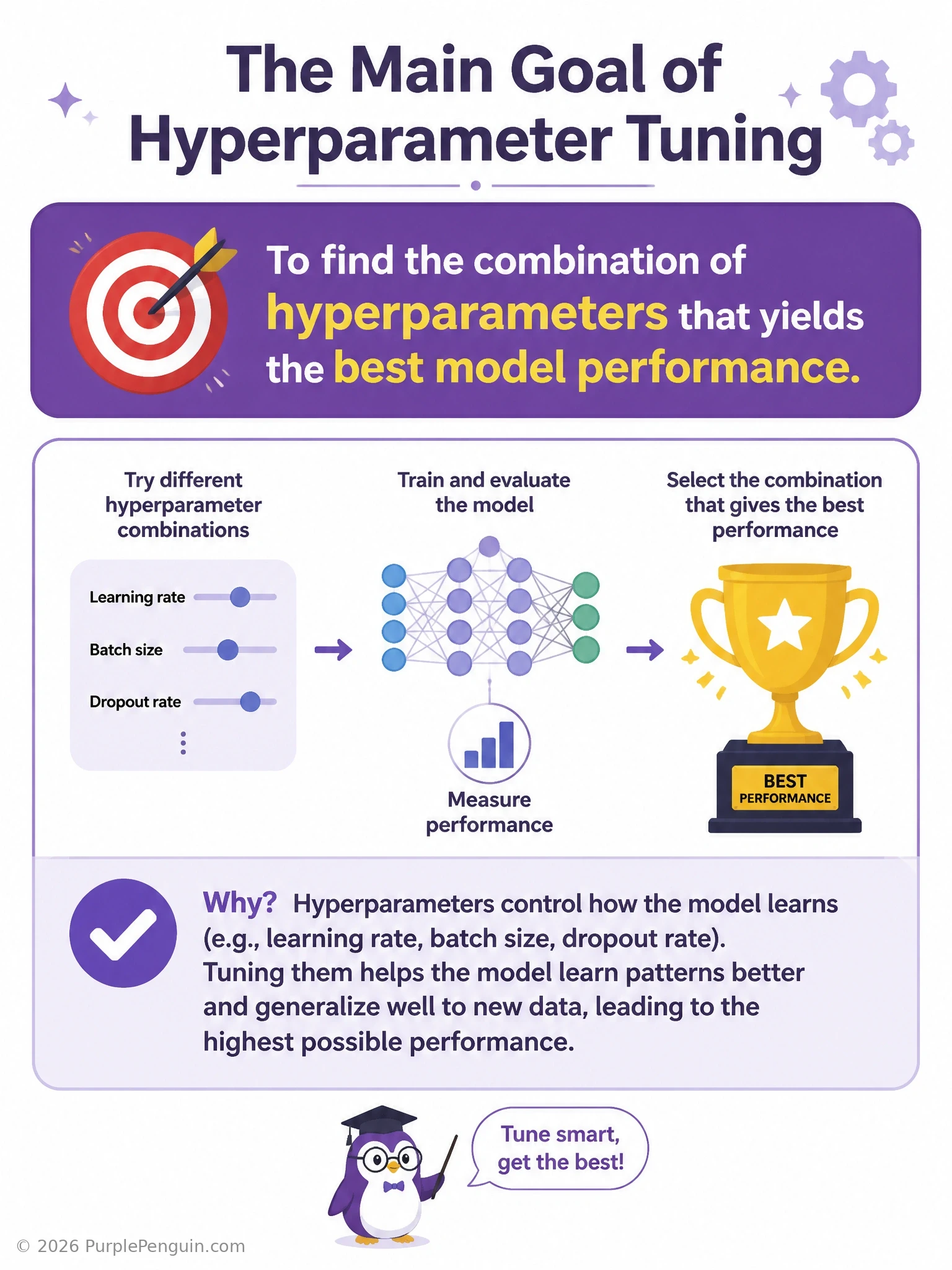
Hyperparameter tuning is the search for the sweet spot. You've got knobs like learning rate, batch size, number of layers, dropout rate, regularization strength — none of which the model learns on its own from data, you have to set them yourself before or during training. Tuning is the process of systematically trying different combinations of those knobs — via grid search, random search, or something smarter like Bayesian optimization — to find the combo that gives you the best performance, usually measured on a validation set. That's answer B. It's not about manually relabeling training data — that's a completely separate data-quality task. It's not about cramming in as many layers as possible — more layers isn't automatically better, and can easily lead to overfitting or vanishing gradients. And it doesn't eliminate the need for a validation set — quite the opposite, you NEED a validation set to actually judge which hyperparameter combination is winning.
Full explanation below image
Full Explanation
Hyperparameters are the configuration values set before training begins that are not learned directly from the data through gradient descent — examples include the learning rate, batch size, number of layers, number of units per layer, dropout probability, regularization strength (lambda), and choice of optimizer. Hyperparameter tuning is the systematic process of searching across combinations of these values to find the configuration that produces the best model performance, typically evaluated on a held-out validation set (or via cross-validation) rather than the training set itself, to ensure the chosen configuration generalizes well rather than merely fitting the training data.
The first distractor describes a data-cleaning or data-quality task — correcting mislabeled examples — which is a separate activity from hyperparameter tuning and happens (if needed) during data preparation, not during the search over training configuration choices. The second distractor is incorrect because simply maximizing the number of layers is not the goal of tuning; an excessively deep or wide network relative to the available data and task complexity can lead to overfitting, vanishing/exploding gradients, and unnecessary computational cost, so tuning aims to find an appropriately sized architecture, not the largest one possible. The third distractor is incorrect because a validation set (or cross-validation scheme) is actually essential to hyperparameter tuning — it provides the very performance signal used to compare different hyperparameter combinations and choose the best one; tuning without a validation set would leave no reliable way to know which configuration actually generalizes best.
Common hyperparameter tuning strategies include grid search (exhaustively trying every combination in a predefined grid), random search (sampling combinations randomly, often more efficient than grid search in high-dimensional spaces), and Bayesian optimization or other model-based search methods (which use the results of previous trials to intelligently choose the next combination to try). Because training deep learning models can be computationally expensive, techniques like early stopping within each trial, reduced-data proxies, and parallelized search across multiple machines are often used to make hyperparameter tuning tractable at scale.