What is the 'bottleneck layer' in an autoencoder?
Select an answer to reveal the explanation.
Short Explanation and Infographic
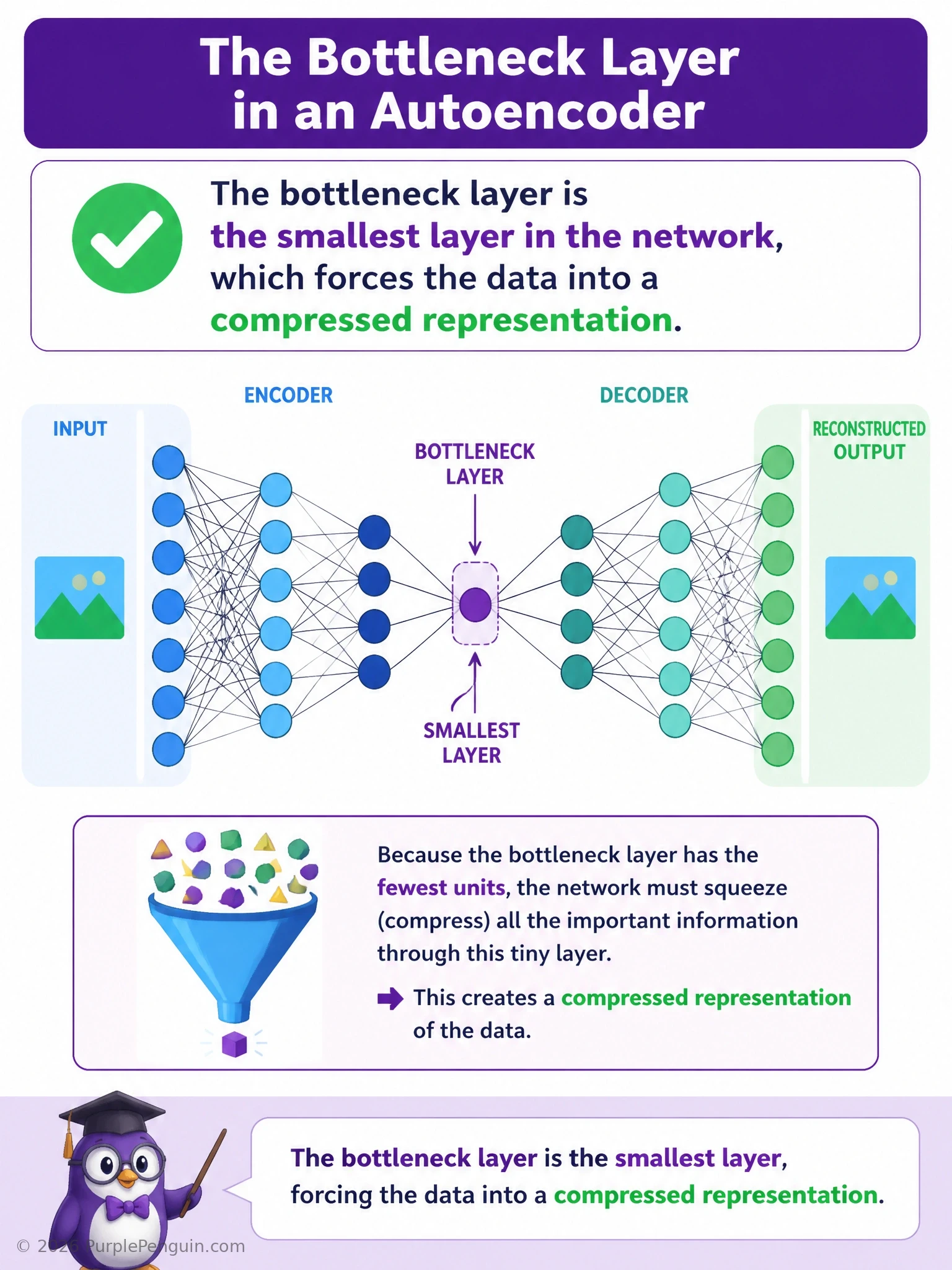
The bottleneck is exactly what it sounds like: the narrowest point in the network, sitting right between the encoder and decoder, where the number of units is much smaller than the input dimension. That narrowness is on purpose — it forces the network to squeeze all the important information about the input down into a compact, compressed code, since there just isn't room to pass everything through unchanged. That's why it's the correct answer here. The final output layer is the reconstruction, which comes after the bottleneck, not the bottleneck itself. It's not a dropout-style regularization layer either — the bottleneck is a fixed architectural choice about layer size, not a stochastic training trick. And the loss comparing input to output is computed outside the network entirely, after the full forward pass, not at any single internal layer.
Full explanation below image
Full Explanation
The bottleneck layer, also called the latent layer or code layer, is the smallest layer in an autoencoder's architecture, positioned between the encoder and the decoder. The encoder progressively reduces the dimensionality of the input as it passes through successive layers, culminating in the bottleneck, which has significantly fewer units than the original input dimension. Because the bottleneck is so much smaller than the input, it acts as an information constraint: the network cannot simply pass all the input information straight through unchanged, so it is forced to learn a compressed representation that captures only the most salient, informative features needed to reconstruct the input reasonably well. The decoder then takes this compressed representation and expands it back out, attempting to reconstruct the original input. This bottleneck-driven compression is what makes autoencoders useful for dimensionality reduction, feature learning, denoising, and anomaly detection, since the compressed code captures the essential structure of 'normal' data.
The first distractor, the final output layer that reconstructs the input, describes the last layer of the decoder, which comes after the bottleneck in the network's data flow; the reconstruction layer typically has the same dimensionality as the original input, the opposite of the bottleneck's small size.
The second distractor, a layer that randomly removes connections during training, describes dropout, an unrelated regularization technique. The bottleneck's small size is a fixed, deliberate architectural constraint present in every forward pass, not a stochastic mechanism applied only during training.
The third distractor, the location where the loss function is computed, is incorrect because the reconstruction loss (commonly mean squared error or binary cross-entropy) is computed by comparing the final reconstructed output to the original input after the full encoder-decoder pass, not at any specific internal layer such as the bottleneck.
Memory aid: think of the bottleneck as squeezing water through a narrow neck of a bottle, only the most essential 'droplets' of information about the input can make it through, which is exactly the compressed representation the encoder is forced to learn.