In a feedforward neuron, why is a bias term added alongside the weighted sum of inputs?
Select an answer to reveal the explanation.
Short Explanation and Infographic
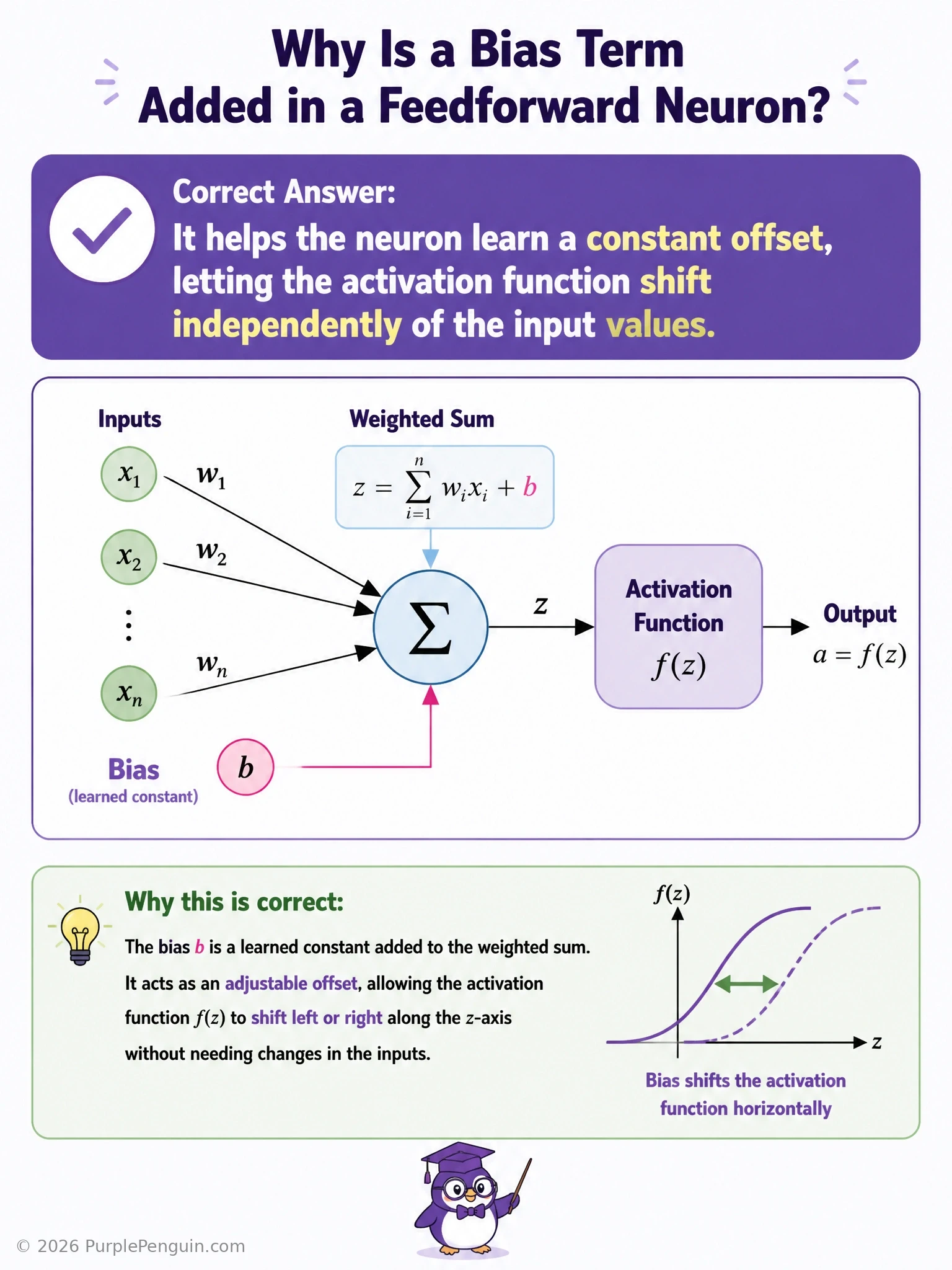
Picture a neuron as computing a straight line: weighted inputs give you the slope, but without a bias, that line is forced to pass through the origin every time, whatever the inputs are. The bias term is just an extra learnable number added in, and it lets the neuron shift its activation curve left or right, up or down, independent of what the inputs happen to be. That flexibility to learn a constant offset is exactly why bias exists, making that the right answer. It has nothing to do with scaling the learning rate — that's an optimizer-level setting, not a per-neuron parameter. It doesn't force outputs to be positive either — that depends entirely on the activation function you choose. And bias definitely doesn't switch off neurons; that's a totally different idea related to pruning or dropout, not what bias does at all.
Full explanation below image
Full Explanation
In a feedforward neuron, the pre-activation value is computed as the weighted sum of the inputs plus a bias term, before that sum is passed through an activation function. The bias is a learnable parameter, just like the weights, but unlike weights it is not multiplied by any input; it is simply added on. Its purpose is to give the neuron the flexibility to shift its activation function along the input axis, allowing it to represent functions that do not necessarily pass through the origin. Without a bias term, every neuron's weighted sum would be forced to equal zero whenever all inputs are zero, which severely limits the family of functions the network can represent. With a bias, the network can learn an appropriate offset for each neuron, much like the intercept term in a linear regression equation, making the model considerably more expressive and better able to fit real-world data patterns.
The first distractor, scaling the learning rate per layer, describes an entirely different concept related to optimization strategies (such as layer-wise learning rate scaling used in some advanced optimizers), not the role of the bias parameter within a neuron's computation.
The second distractor, guaranteeing a positive output, is incorrect because whether an output is constrained to be positive depends entirely on the choice of activation function (for example, ReLU produces non-negative outputs, while a linear activation can produce any real value); the bias term itself is just an additive constant and does not by itself constrain the sign of the output.
The third distractor, permanently disabling a neuron once accuracy plateaus, describes something closer to network pruning or a stopping criterion, not the function of a bias term. Bias values are continuously updated during training via backpropagation just like weights, and nothing about bias causes neurons to be shut off.
Memory aid: think of the bias as the 'y-intercept' of a neuron's linear equation, weights determine the slope/direction, and the bias lets the whole function slide up, down, left, or right so the network isn't stuck forcing every function through the origin.