In a convolutional neural network, what is the main purpose of adding padding around the input feature map before applying a convolution?
Select an answer to reveal the explanation.
Short Explanation and Infographic
Padding is just adding a frame of extra values, usually zeros, around the edges of your feature map before the filter slides over it. Why bother? Two reasons: it lets you control exactly how big the output feature map ends up, and it keeps the corner and edge pixels from getting shortchanged, since without padding they only get touched by the filter a handful of times compared to the center pixels. So the border-and-size-control answer is correct. Normalizing pixel values is a preprocessing step, not padding. Randomly dropping values is dropout, a totally different regularization trick. And padding doesn't touch the channel count at all — that's controlled by the number of filters you use, not the border you add.
Full explanation below image
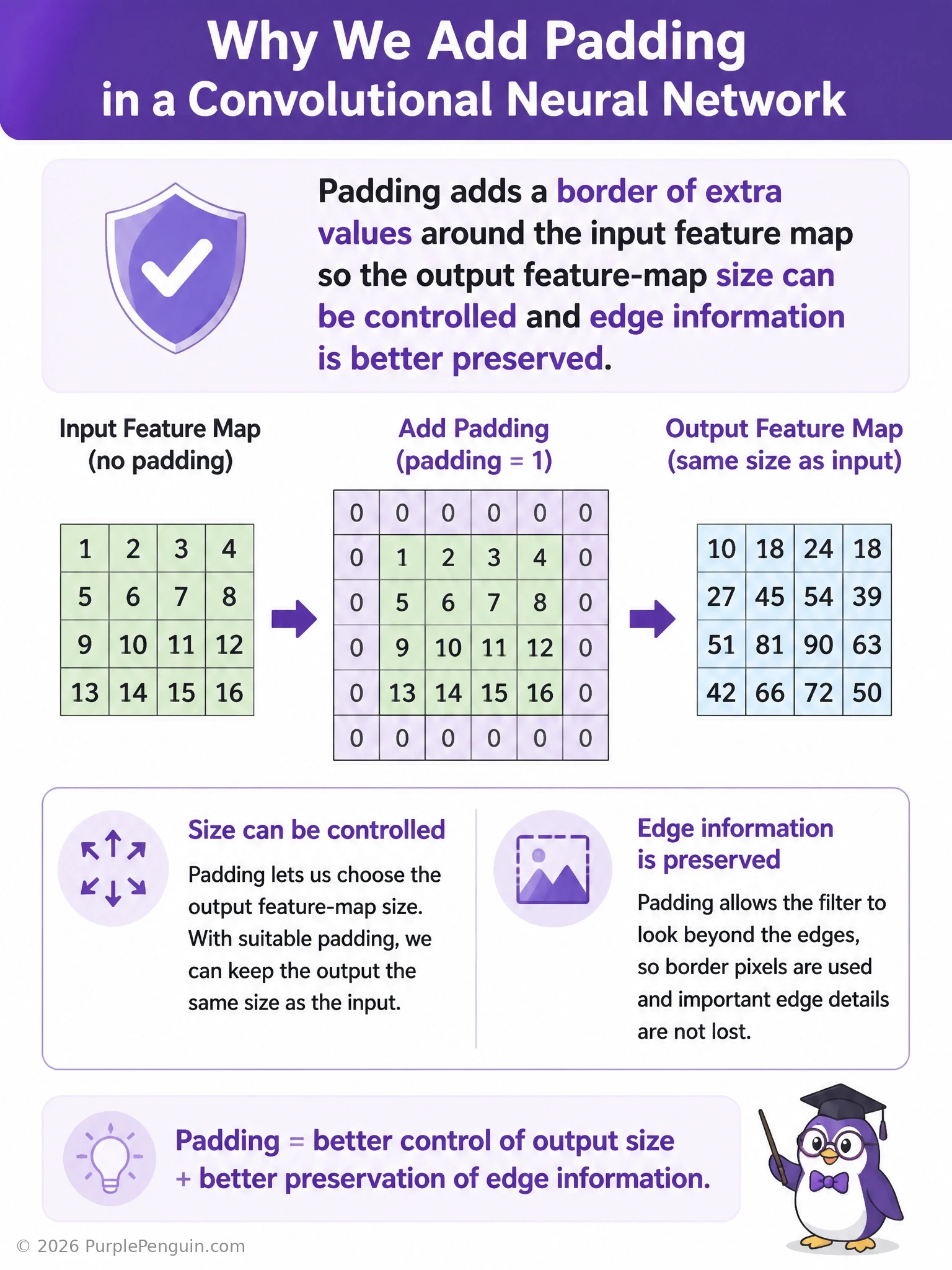
Full Explanation
Padding in a CNN refers to adding extra values, most commonly zeros, around the border of an input feature map before a convolution operation is applied. This serves two closely related purposes: first, it gives explicit control over the spatial dimensions of the output feature map. Without padding ('valid' convolution), the output shrinks with every convolutional layer, which can quickly reduce feature maps to unusably small sizes in deep networks. With 'same' padding, the output can be kept at the same spatial size as the input, which is especially important in architectures like U-Net that need to preserve resolution for pixel-wise tasks. Second, padding addresses the fact that, without it, pixels near the border of the input are used in far fewer convolution operations than pixels near the center, effectively under-representing edge information. Padding ensures the filter can be centered properly on border pixels too, giving more balanced treatment across the whole spatial extent of the input.
The first distractor, normalizing pixel values to a 0–1 range, describes a data preprocessing or scaling step (such as min-max normalization), which is unrelated to padding; padding does not rescale values, it adds new border values around the existing ones.
The second distractor, randomly dropping a portion of input values, describes dropout, a regularization technique applied during training to reduce overfitting by deactivating neurons or units. Padding is a structural, deterministic operation applied to every forward pass, not a stochastic regularizer.
The third distractor, reducing the number of channels, confuses padding with operations like 1x1 convolutions or channel-reduction techniques used in bottleneck layers; padding operates purely on the height and width (spatial) dimensions of a feature map and has no effect on channel depth.
Memory aid: think of padding as 'building a picture frame' around your feature map so the filter can properly sweep over every original pixel, including the edges, while also letting you dial in the exact output size you want.