A team is building a system that automatically transcribes customer support calls into written text. Which type of model architecture is best suited to this task?
Select an answer to reveal the explanation.
Short Explanation and Infographic
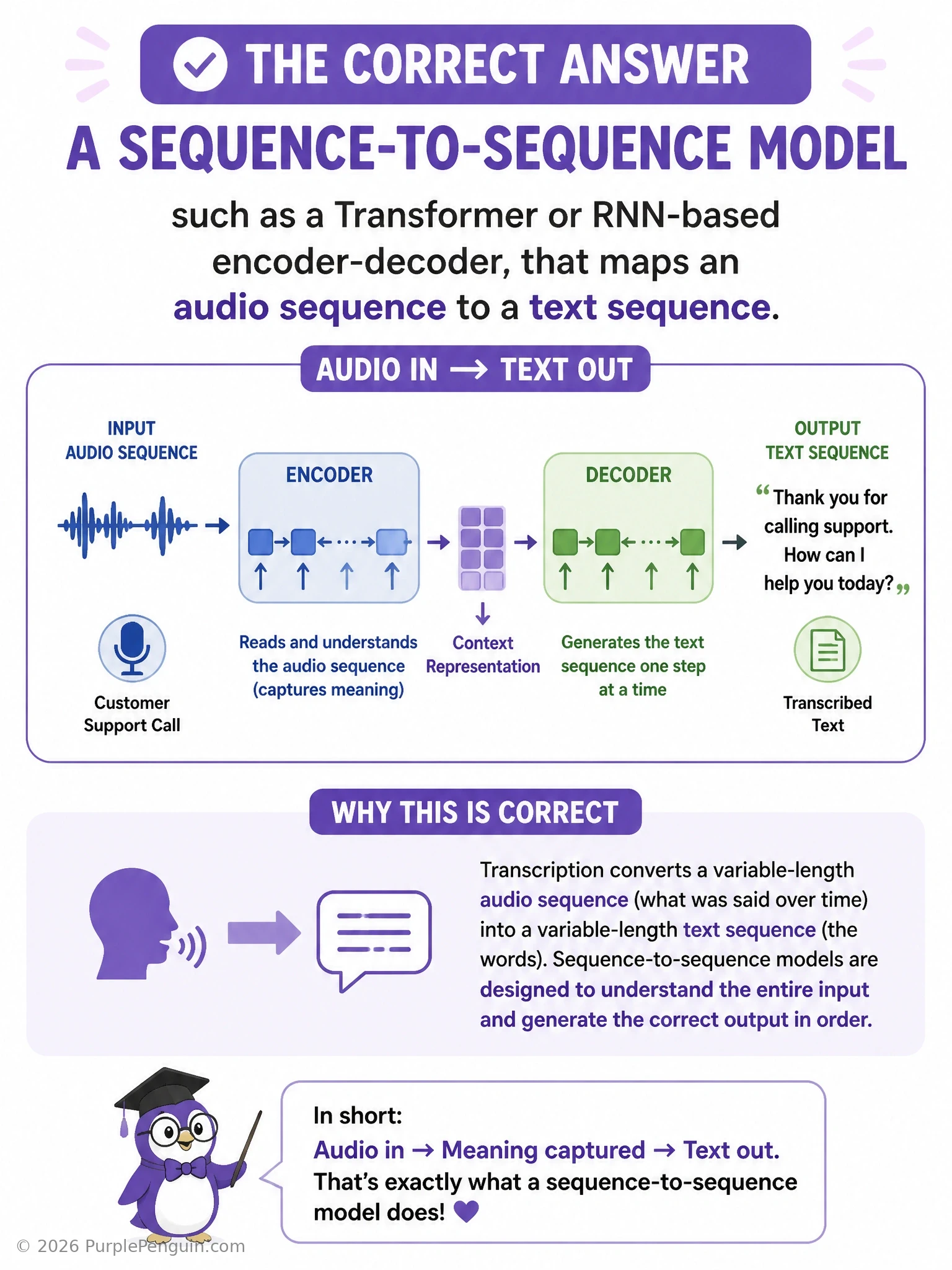
Here's the deal: transcription is a sequence-in, sequence-out problem. You're taking a variable-length stream of audio and turning it into a variable-length stream of words, and the lengths don't even line up one-to-one. That's exactly the job a sequence-to-sequence model was built for, whether it's a Transformer or an RNN-based encoder-decoder, so option A is your answer. A single conv layer plus softmax can't handle variable-length output at all — it's built for fixed classification, not generating a sentence. A GAN's discriminator is busy telling real from fake, which has nothing to do with producing a transcript. And a plain autoencoder just reconstructs its own input audio — it never produces text, so it's not even in the same ballpark as transcription.
Full explanation below image
Full Explanation
Automatic speech recognition (transcribing audio to text) is fundamentally a sequence-to-sequence problem: the input is a variable-length sequence of audio frames, and the output is a variable-length sequence of words or subword tokens, and the two sequences are not aligned one-to-one. This is precisely the class of problem that sequence-to-sequence architectures, whether built from Transformers with attention or from RNN/LSTM encoder-decoder pairs, are designed to solve. An encoder processes the audio sequence into a rich internal representation, and a decoder generates the output text sequence, often using an attention mechanism to focus on the most relevant parts of the audio at each step of generating a word.
The first distractor, a single convolutional layer followed by a softmax classifier, is incorrect because that setup only supports fixed-size, single-label classification (e.g., picking one class from a list). It cannot generate a variable-length sequence of words, and it has no mechanism for handling the temporal alignment between audio and text.
The second distractor, a GAN trained to discriminate real from fake audio, is incorrect because a discriminator's job is binary classification (real vs. generated), which is unrelated to producing a transcript; GANs are typically used for generation tasks like synthesizing new audio or images, not for converting one modality into a textual sequence.
The third distractor, a standalone autoencoder trained only to reconstruct its input, is incorrect because an autoencoder's output is a reconstruction of the same input in the same modality (audio in, audio out). It is not designed to produce a different modality of output, such as text, and provides no mechanism for generating linguistic tokens.
A useful memory aid: whenever you see 'convert one sequence into a different, variable-length sequence' — whether that's speech to text, text to another language, or text to a summary — think sequence-to-sequence encoder-decoder architectures, historically RNN/LSTM-based and now dominated by Transformers.