You inherit a trained model and notice its output layer uses a plain linear activation with no squashing at all. What kind of task was this model most likely built for?
Select an answer to reveal the explanation.
Short Explanation and Infographic
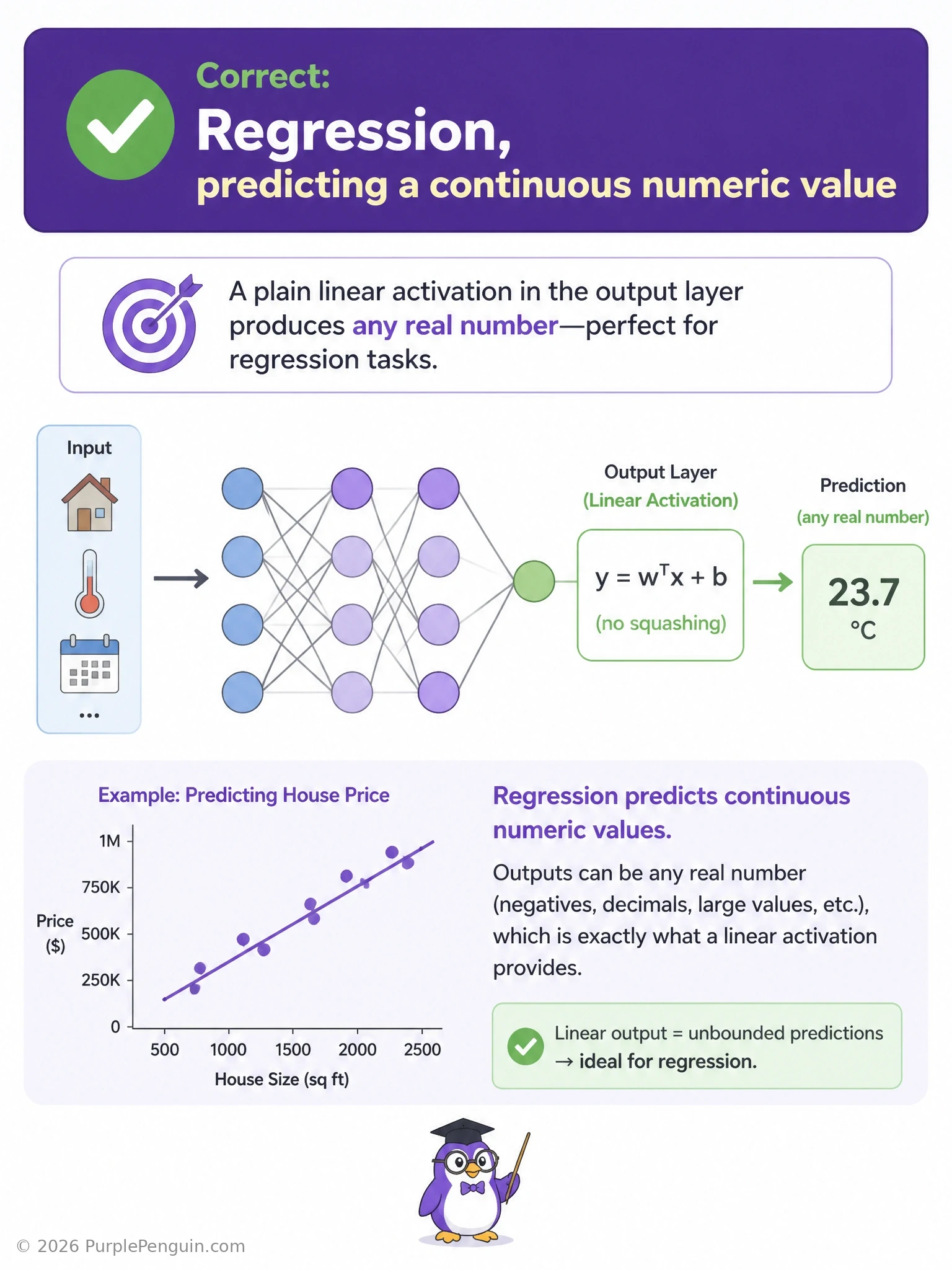
If you open up a model and see a bare linear output, no sigmoid, no softmax, that's your tell it's built for regression. Linear activation just lets the raw number through untouched, which is exactly what you want when predicting something continuous like a price, a temperature, or a sensor reading. Classification tasks, whether it's picking one class out of many, choosing between two options, or tagging multiple independent labels, all need some kind of squashing function to turn raw scores into probabilities between 0 and 1. A linear output can't do that job, so seeing it immediately rules out every classification variant on this list.
Full explanation below image
Full Explanation
A linear output activation, where the final layer's raw weighted sum passes through unmodified, is the standard signature of a regression task. Regression targets are continuous and can take any real value, so the network needs an output that is similarly unbounded; linear activation provides exactly that, with no artificial ceiling, floor, or normalization applied to the prediction.
Multi-class classification with mutually exclusive categories is wrong because that task requires a softmax output layer, which converts raw scores (logits) into a probability distribution across classes that sums to 1, allowing the model to express relative confidence among competing categories. A linear output would produce unbounded, non-probabilistic numbers that cannot be interpreted as class likelihoods. Binary classification is wrong because that task pairs with a sigmoid activation on a single output neuron, squashing the result into the (0, 1) range to represent the probability of the positive class; a linear activation offers no such bounded probability interpretation. Multi-label classification, where multiple independent binary tags can all be true simultaneously, is wrong because it also relies on sigmoid activations, just applied independently to each output neuron rather than a single one, again requiring bounded probability outputs rather than an unbounded linear value.
The underlying principle is that the output activation function should always match the statistical nature of the target variable: unbounded continuous values call for linear activation and are typically paired with a loss like mean squared error or mean absolute error; probabilities over mutually exclusive classes call for softmax paired with categorical cross-entropy; a single yes/no probability calls for sigmoid paired with binary cross-entropy; and independent multi-label probabilities call for per-neuron sigmoid paired with binary cross-entropy applied per label. A helpful diagnostic habit is to reverse-engineer a model's task from its output activation and loss function pairing, since architects rarely mismatch these on purpose, doing so would produce nonsensical training dynamics or an output that cannot be meaningfully interpreted for the intended task.