What is the core difference between max pooling and average pooling in a CNN's downsampling layer?
Select an answer to reveal the explanation.
Short Explanation and Infographic
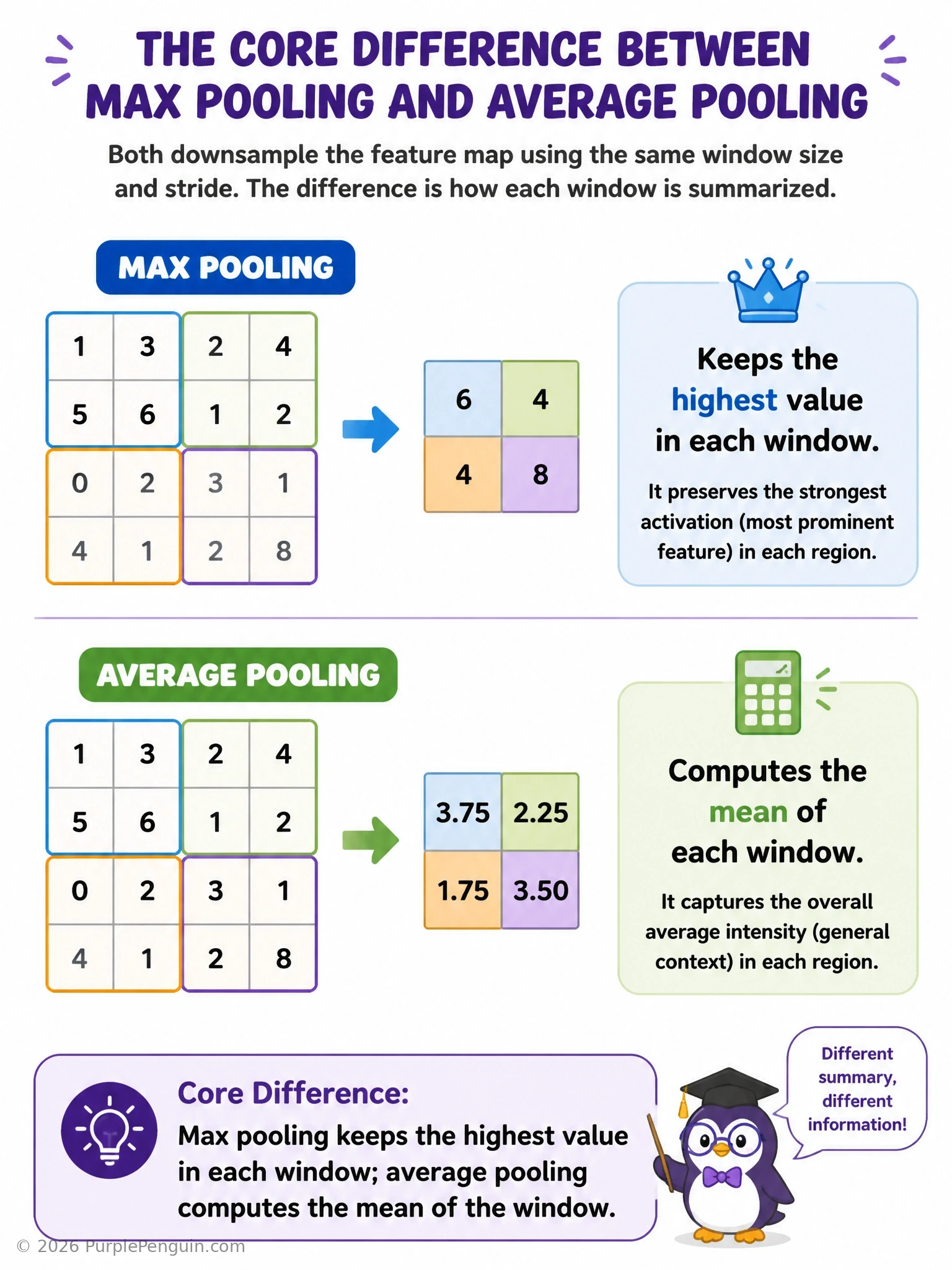
Picture sliding a little window over your feature map. Max pooling just grabs the single loudest signal in that window, the strongest activation, and passes it along. Average pooling instead blends everything in the window into one calm average value. Max tends to keep sharp, standout features like edges or textures, which is why it's the more common choice in classification networks. Average tends to smooth things out, which is handy later on when you want a gentler summary. The other options have it backwards or invent details, like learnable weights, that neither pooling method actually has, since both are parameter-free operations.
Full explanation below image
Full Explanation
Max pooling and average pooling are both parameter-free downsampling operations that slide a window (commonly 2x2) across a feature map and reduce each window to a single value, but they differ in how that value is computed. Max pooling outputs the maximum activation within each window, which preserves the strongest, most salient feature detected in that local region, such as a sharp edge or a distinctive texture response. Average pooling outputs the arithmetic mean of all activations within the window, producing a smoother, blended summary that dampens noise but can also dilute strong, localized signals.
The first distractor simply swaps the definitions, describing max pooling as averaging and average pooling as taking the maximum, which is the reverse of the actual behavior. The second distractor is wrong because pooling, regardless of type, reduces spatial dimensions (height and width); neither variant increases them, that would describe an upsampling or transposed-convolution operation instead. The third distractor is wrong because neither pooling method introduces learnable weights or biases; both are fixed, deterministic operations applied identically at every location, which is precisely why they are computationally cheap and do not add parameters to the model, unlike a strided convolution which can learn a similar downsampling effect with trainable weights.
In practice, max pooling has historically been more popular in classification CNNs (as in early architectures like LeNet and AlexNet) because it emphasizes the presence of a feature regardless of its exact location, contributing to translation invariance. Average pooling, particularly global average pooling at the very end of a network, is often used to collapse an entire feature map into a single value per channel before a final classification layer, since it produces a smoother, less spiky summary suited to that role. A simple memory aid: "max picks the peak; average finds the flat middle."