A fraud team has millions of unlabeled, high-dimensional transaction embeddings and wants to flag unusual records without any labeled examples of fraud. Which unsupervised architecture is the classic fit?
Select an answer to reveal the explanation.
Short Explanation and Infographic
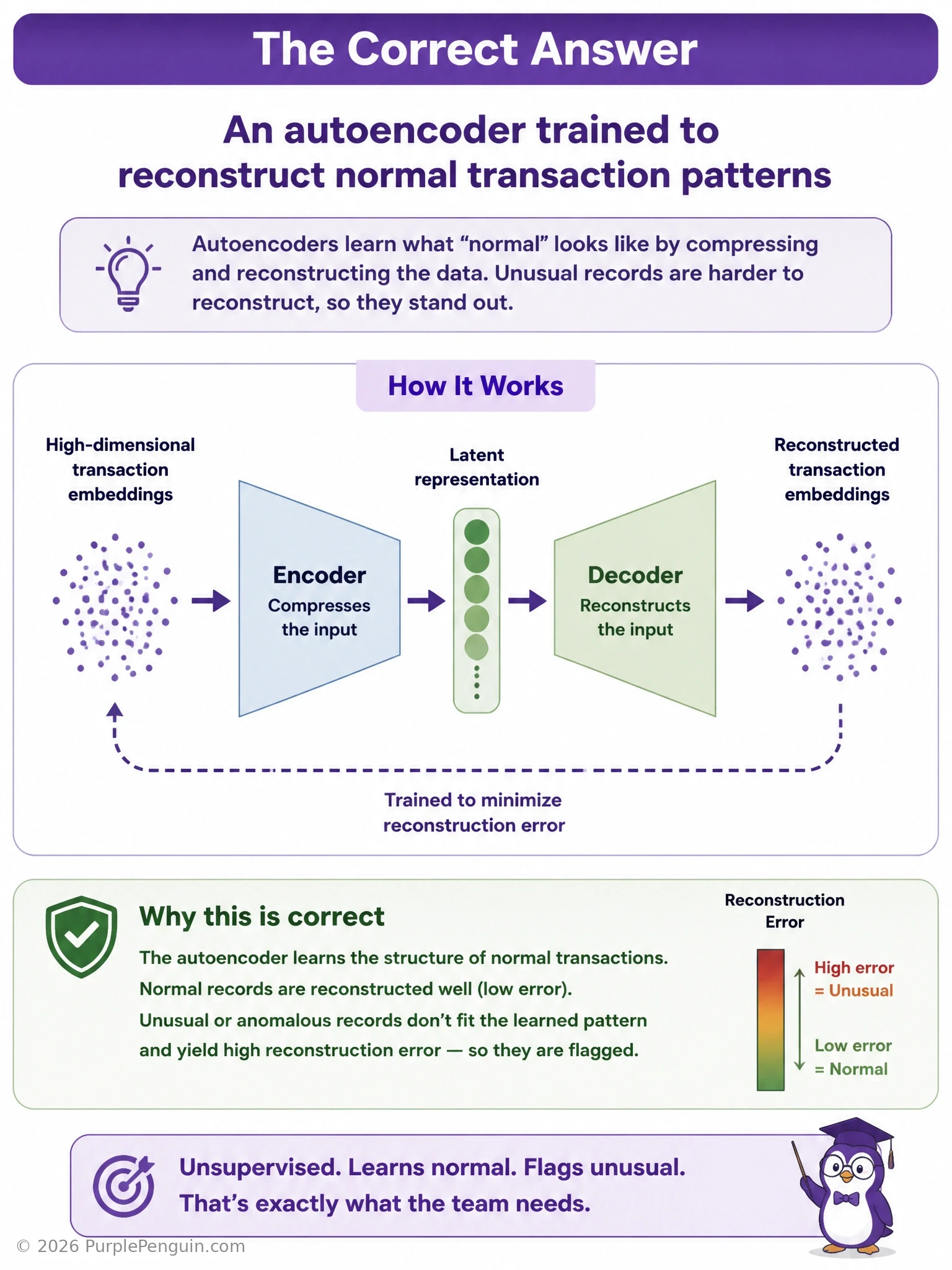
Here's the deal with anomaly detection when you've got no labels: you train an autoencoder on the normal, everyday data and let it learn to compress and rebuild it really well. Since it's only ever seen normal patterns, it gets great at reconstructing those, but when a weird, fraudulent transaction shows up, the reconstruction is noticeably worse. That reconstruction error becomes your anomaly score. CNNs and RNNs in this list both lean on labels, which you don't have, and a random forest with hand-built rules isn't really learning representations at all, it's just following what a human already wrote down.
Full explanation below image
Full Explanation
An autoencoder is the standard unsupervised architecture for anomaly detection on high-dimensional data. It consists of an encoder that compresses input into a lower-dimensional latent representation and a decoder that reconstructs the original input from that representation. The network is trained purely on normal (non-anomalous) data, so it becomes proficient at reconstructing typical patterns while treating them as high-priority signals to preserve during compression. When an anomalous transaction, one whose feature pattern the network never learned to compress efficiently, is passed through, the reconstruction error is disproportionately high, and that error magnitude serves directly as an anomaly score without needing any labeled fraud examples.
The CNN option is wrong because it is listed here as trained on labeled fraud images, which violates the unsupervised, unlabeled premise of the scenario; CNNs also expect a spatial grid structure like images, not arbitrary high-dimensional embeddings. The RNN option is wrong for the same reason: it specifies supervised sequence labels, which the fraud team explicitly does not have, and RNNs are built for sequential/temporal dependencies rather than being the default choice for flat high-dimensional vectors. The random forest option is wrong because it depends on hand-engineered rules rather than learned representations; it is not a deep learning architecture and does not scale to capturing complex nonlinear structure in high-dimensional embeddings the way a neural encoder-decoder can.
A useful mental model: autoencoders detect anomalies by asking "how well can I recreate this from a compressed summary of what normal looks like?" Large reconstruction error signals a poor fit to the learned normal distribution, which is precisely the anomaly signal fraud, defect, and intrusion detection systems rely on. This makes autoencoders attractive whenever labeled anomalies are scarce or nonexistent but plenty of normal-case data is available to train on.