When comparing the internal gating structures of a GRU and an LSTM cell, which statement correctly describes the difference?
Select an answer to reveal the explanation.
Short Explanation and Infographic
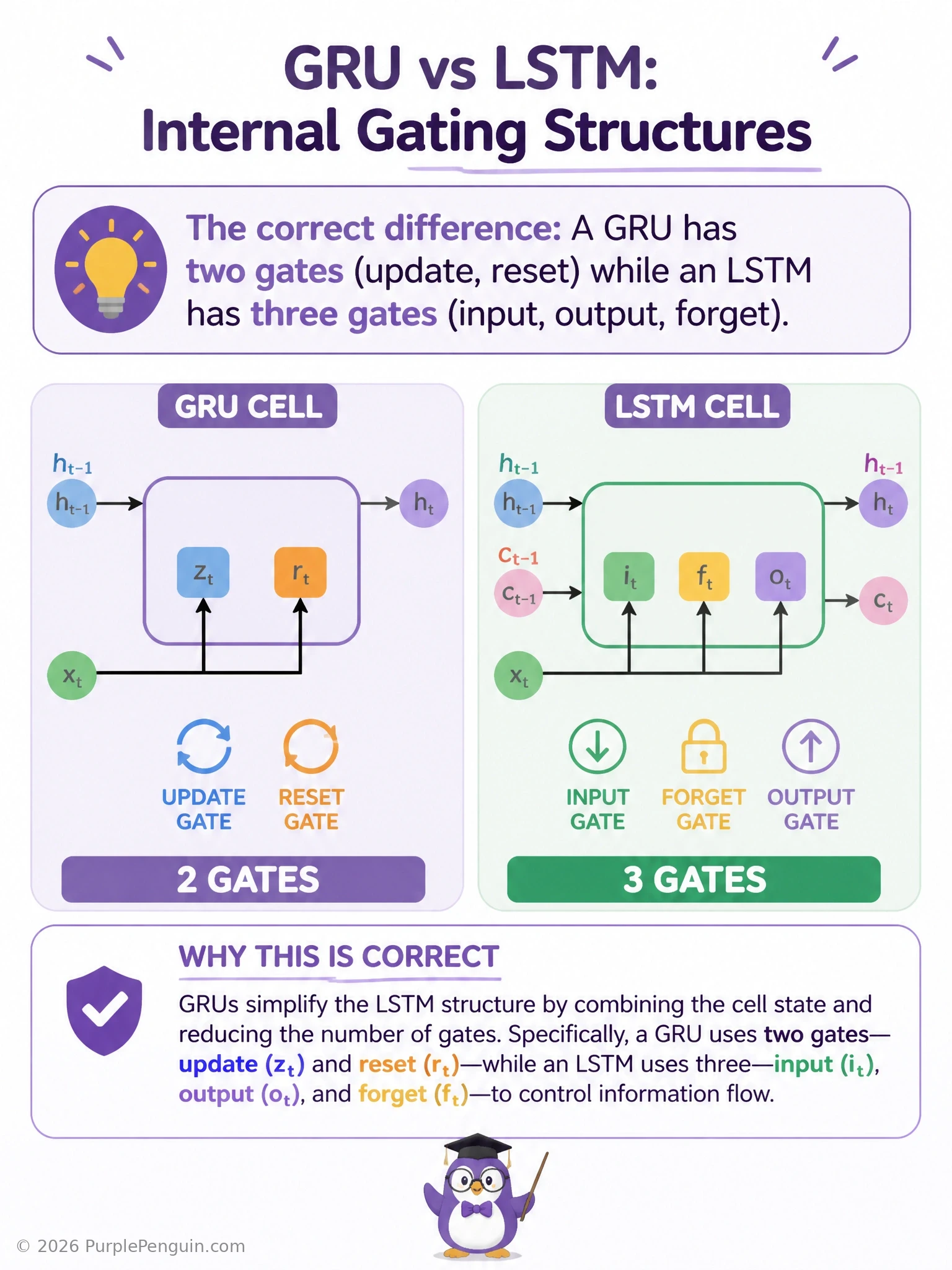
Easy way to remember this: LSTM is the more elaborate cousin. An LSTM cell has three gates — input, output, and forget — plus a separate cell state running alongside the hidden state, giving it fine-grained control over what gets written in, what gets read out, and what gets erased. A GRU simplifies that down to just two gates — update and reset — and merges the cell state and hidden state into one, which makes it lighter and often faster to train while still fighting off the vanishing-gradient problem nearly as well. So GRU = 2 gates (update, reset), LSTM = 3 gates (input, output, forget). Any answer that flips those numbers, claims they're identical, or says GRU has zero gates is just wrong on the mechanics.
Full explanation below image
Full Explanation
A standard LSTM (Long Short-Term Memory) cell contains three gates: the forget gate, which decides what information to discard from the cell state; the input gate, which decides what new information to write into the cell state; and the output gate, which decides what part of the (updated) cell state to expose as the hidden state output. These three gates work alongside a dedicated cell state that runs through the sequence largely unchanged except where the gates modify it, giving LSTMs precise control over long-term memory retention.
A GRU (Gated Recurrent Unit) simplifies this design down to two gates: the update gate, which controls how much of the previous hidden state to keep versus how much new candidate information to blend in (effectively combining the roles of the LSTM's forget and input gates), and the reset gate, which controls how much of the previous hidden state to ignore when computing the new candidate state. Critically, a GRU also merges the LSTM's separate cell state and hidden state into a single hidden state, which reduces the parameter count and often speeds up training and inference while still substantially mitigating the vanishing-gradient problem that plagues vanilla RNNs.
The first distractor simply swaps the gate counts and names between the two architectures, which is the exact inverted-fact trap this question is designed to catch. The second distractor is wrong because the two architectures are not equivalent — they have different numbers of gates and different internal state structures, even though both belong to the family of gated recurrent architectures designed to solve the same vanishing-gradient problem. The third distractor is wrong because a GRU is very much a gated architecture (it just has fewer gates than an LSTM); claiming it has no gates would make it indistinguishable from a vanilla RNN, which is not the case.
Memory aid: 'GRU is Grubby-simple — 2 gates, 1 state; LSTM is Lengthier — 3 gates, 2 states (cell + hidden).'