An artificial neuron computes a weighted sum of its inputs, adds a bias term, and passes the result through a nonlinear activation function. What is this process fundamentally intended to model?
Select an answer to reveal the explanation.
Short Explanation and Infographic
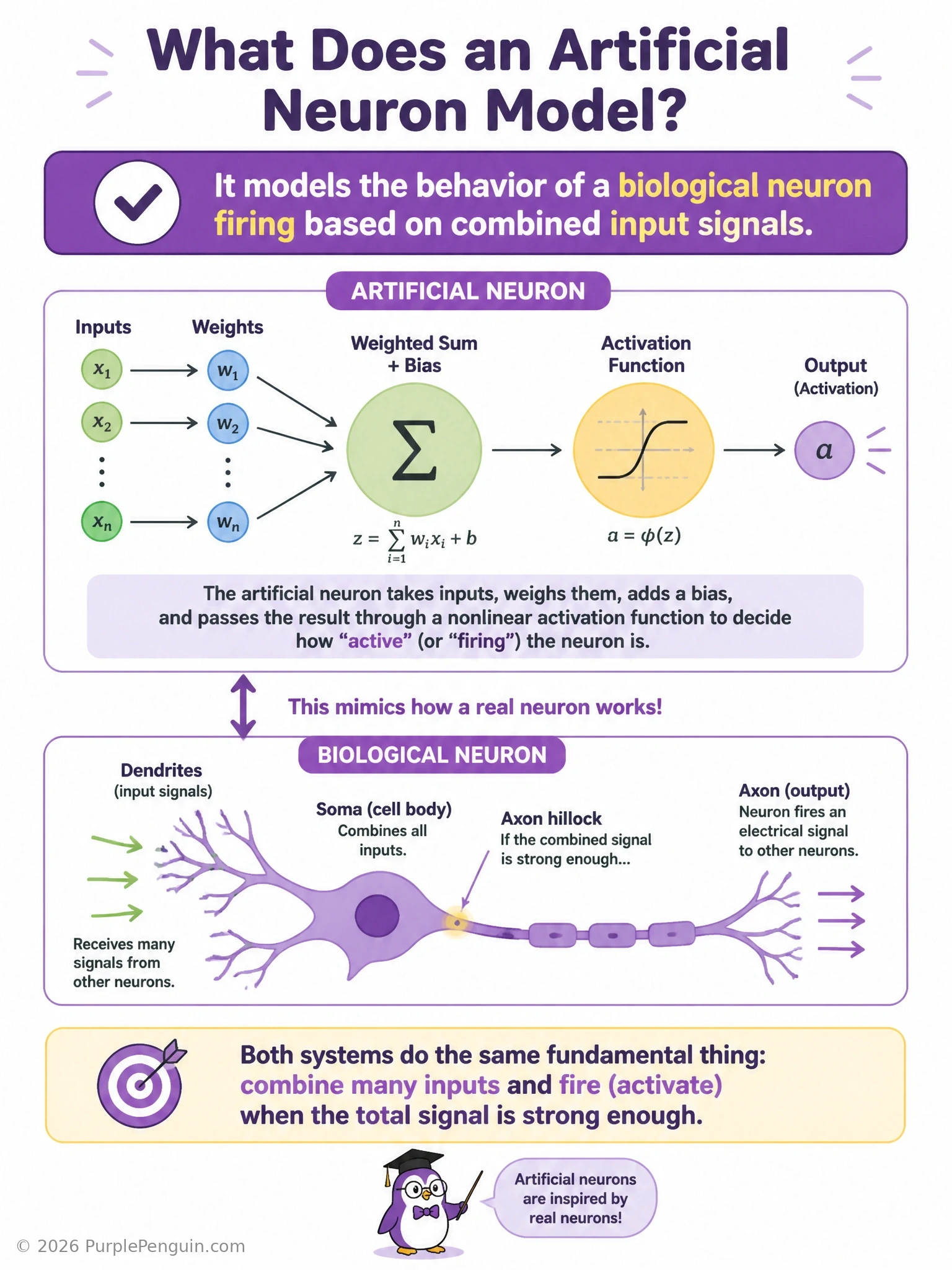
This one goes back to where the whole idea of a 'neural' network came from. A biological neuron receives signals from many other neurons through its dendrites, and depending on how strong and how many of those combined signals are, it either fires an output spike or it doesn't — that's a threshold-based decision. The artificial neuron's weighted sum plus bias plus activation function is a simplified mathematical stand-in for exactly that: the weights represent synapse strength, the bias represents the neuron's firing threshold, and the nonlinear activation represents whether and how strongly it 'fires.' It's not related to database indexing, program compilation, or hash-bucket distribution — those are just unrelated computer-science concepts that show up as tempting-sounding wrong answers.
Full explanation below image
Full Explanation
The artificial neuron model — computing z = (sum of weight_i * input_i) + bias, then applying an activation function f(z) — is a deliberate, simplified abstraction of biological neuron behavior. In biological neurons, dendrites receive electrochemical signals from many upstream neurons; these signals are effectively combined (summed) at the cell body, and if the combined signal exceeds a certain threshold, the neuron fires an action potential down its axon to downstream neurons. The artificial neuron mirrors this: the weights represent the strength (or influence) of each incoming connection, analogous to synaptic strength; the bias term shifts the threshold at which the neuron 'activates,' analogous to a firing threshold; and the nonlinear activation function determines the neuron's output response once the combined input crosses that threshold, echoing the all-or-nothing (or graded) firing behavior of real neurons. This biological analogy is the historical and conceptual foundation for the term 'neural network.'
The first distractor, database index retrieval, describes a data-structure lookup mechanism (e.g., B-trees or hash indexes) used to quickly find records matching a query — an entirely different domain with no weighted-sum-and-threshold analogy. The second distractor, program compilation, refers to translating human-readable source code into executable machine instructions, a static, rule-based transformation process unrelated to signal aggregation or thresholding. The fourth distractor, hash function bucket distribution, describes how a hash function maps keys to array indices to enable fast lookups; while it does involve a mathematical transformation of an input, it has no learned weights, no bias, and no biologically inspired firing concept.
Memory aid: weights = synapse strength, bias = firing threshold, activation function = the fire-or-don't-fire decision — the artificial neuron is a stylized, differentiable cartoon of a real one.