A retailer has purchase history for thousands of customers but no predefined labels for them, and wants to automatically group similar customers together to design targeted marketing campaigns. Which category of machine learning task is this?
Select an answer to reveal the explanation.
Short Explanation and Infographic
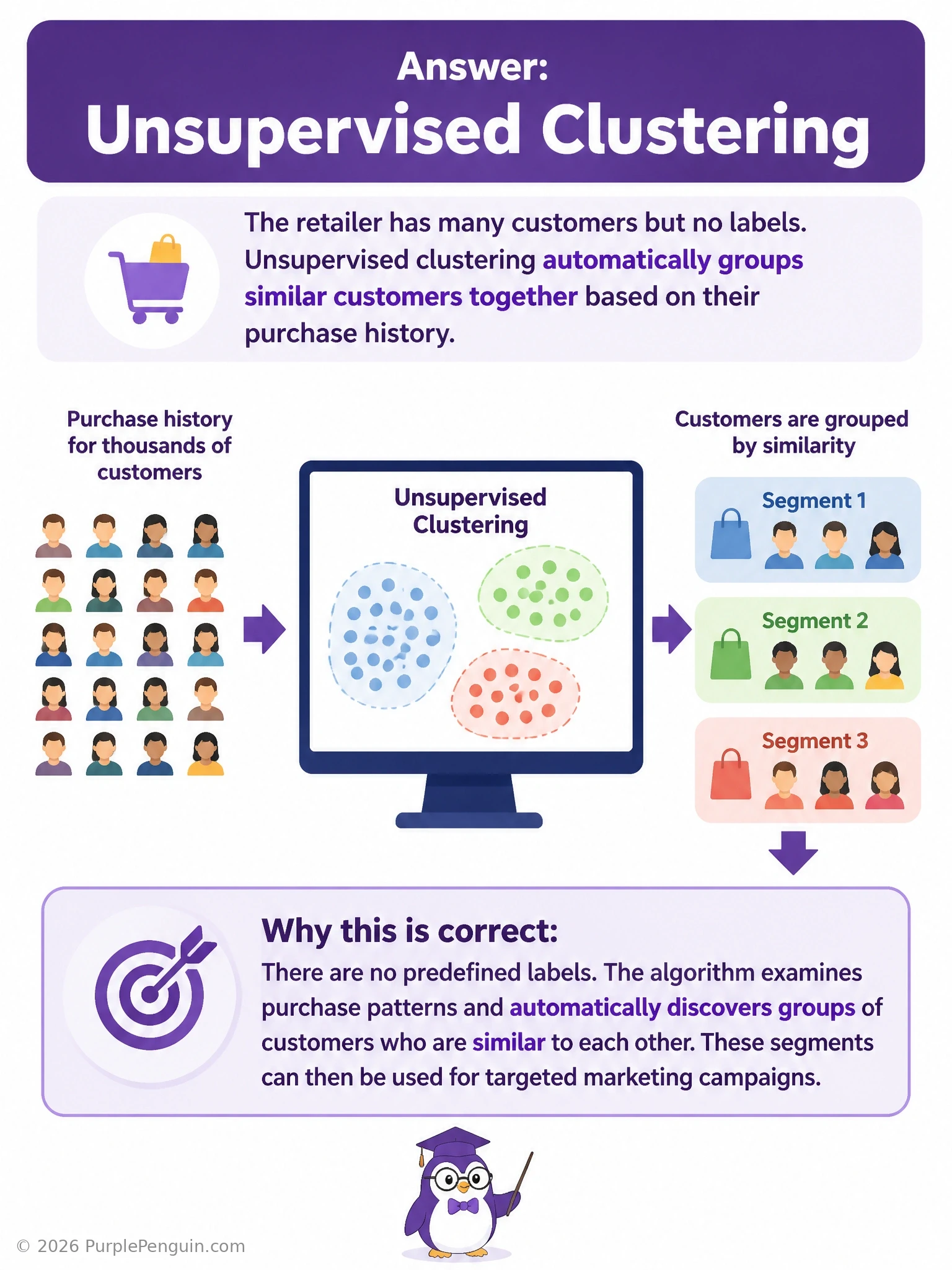
Notice the key phrase: no predefined labels. There's no "correct answer" column telling you which segment each customer belongs to — you're just handing the algorithm raw purchase data and asking it to find natural groupings on its own. That's the definition of unsupervised clustering, so that's the answer, with algorithms like K-Means being the classic tool for exactly this job. Supervised regression needs labeled numeric targets to predict, like sales revenue, which isn't what's described here. Reinforcement learning is about an agent learning through trial-and-error rewards in an environment, not about grouping static customer records. And supervised classification also requires labeled categories to learn from — if the retailer already knew which segment each customer belonged to, this wouldn't be a clustering problem at all.
Full explanation below image
Full Explanation
This scenario describes unsupervised clustering: the retailer has feature data (purchase history) but no ground-truth labels indicating which segment or group each customer belongs to. Clustering algorithms, such as K-Means, hierarchical clustering, or DBSCAN, work by measuring similarity or distance between data points and grouping similar points together without any supervision signal telling the algorithm what the "right" groups are. The output is a set of discovered clusters that the retailer can then interpret and act on, for example by tailoring marketing campaigns to each cluster's typical purchasing behavior. This is a textbook unsupervised learning use case because the defining characteristic of unsupervised learning is the absence of labeled outcomes; the algorithm must find structure in the data on its own.
Supervised regression is incorrect because regression requires a labeled, continuous target variable (such as predicted spend or lifetime value) that the model learns to predict from input features. There is no such labeled target described in this scenario; the goal is grouping, not predicting a continuous number.
Reinforcement learning is incorrect because it involves an agent that takes actions within an environment and learns a policy through trial and error, guided by reward signals accumulated over time. There is no environment, action, or reward structure here; this is a static, one-shot analysis of existing customer records, not a sequential decision-making problem.
Supervised classification is incorrect because classification, like regression, requires labeled categories in the training data (for example, "high-value customer" versus "low-value customer" already tagged) so the model can learn a mapping from features to those known labels. The scenario explicitly states there are no predefined labels, which rules out any supervised approach, classification included.
Memory aid: no labels plus "find natural groups" always points to unsupervised clustering — supervised methods need an answer key, and this problem doesn't have one.